
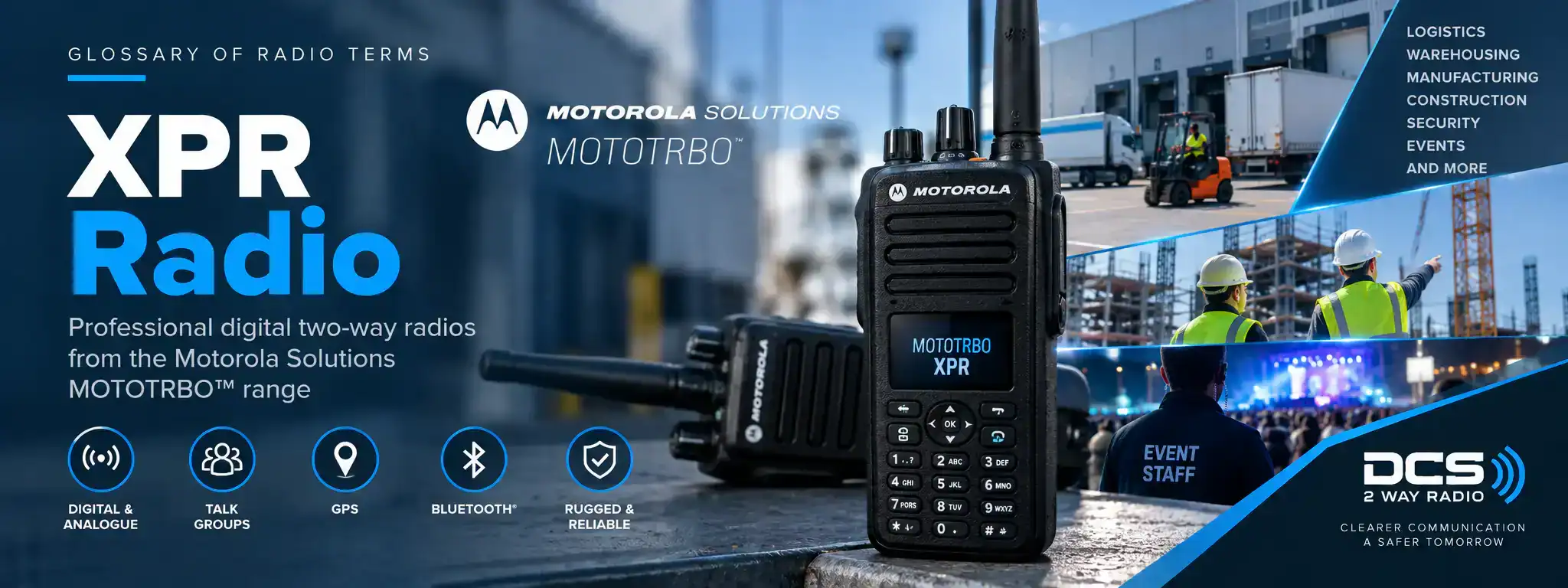
XPR Radio
An XPR radio is a professional two-way radio from the Motorola SolutionsMotorola Solutions is a global communications technology company that develops professional two-way radios, radio systems, dispatch platforms and other communication and safety technologies. MOTOTRBO™MOTOTRBO™ is Motorola Solutions' professional digital two-way radio platform, based on the DMR standard. It supports business communication ranging from simple radio systems to multi-site networks. XPR range. XPR radios are designed for business and operational communications, providing digital two-way radio capabilities for organisations that need dependable voice communication across workplaces, sites and larger operational environments.
The XPR range has included a number of portable radioA Portable Radio is a battery-powered two-way radio designed to be carried and operated by an individual, providing mobile communication for professional and operational users. series, with different models offering features such as digital and analogue operation, repeaterA Repeater receives a two-way radio transmission and retransmits it, usually from an elevated location, to extend the coverage and reliability of a radio communication system. support, Bluetooth®Bluetooth® is a short-range wireless technology used with compatible two-way radios to connect accessories such as headsets, earpieces and microphones without a physical cable., Wi-FiWi-Fi is a wireless networking technology that connects compatible devices to a local or wider network. In radio systems, it can support programming, updates, data services and IP-based communications., GPS, emergency functions and enhanced audio, depending on the model.
What is an XPR radio?
XPR is a product family name used by Motorola Solutions for professional MOTOTRBO two-way radios.
XPR radios are primarily associated with DMR (Digital Mobile RadioA Mobile Radio is a two-way radio designed to be installed in a vehicle. It normally uses the vehicle's power supply and an external antenna to provide reliable communication while travelling or working in the field.) technology and are designed for professional users rather than consumer walkie-talkie applications. Different XPR models have been developed for different working environments and requirements.
XPR radios and MOTOTRBO
XPR radios form part of the wider MOTOTRBO™ platform from Motorola Solutions.
MOTOTRBO is based on DMR technology and supports professional digital radio communications. Depending on the model and system configuration, MOTOTRBO radios can provide features beyond basic push-to-talk communication.
These can include group calling, private calling, scanning, messaging, GPS and other data capabilities.
XPR digital radios
XPR radios are designed primarily for digital communication, although some models also support analogue operation.
Digital radio can provide clear voice communications and additional functionality compared with a basic analogue radioAnalogue radio uses continuously varying radio signals to transmit voice communication. It remains widely used for reliable two-way communication across business, industry, events, security and other applications.radio systemA Radio System is a complete communication solution comprising two-way radios and, where required, equipment such as repeaters, antennas, base stations, mobile radios and network infrastructure.. It can also support features such as talk groups and individual calling, depending on how the radio is programmed.
This makes XPR radios suitable for a wide range of commercial and industrial applications.
XPR radios and DMR
DMR (Digital Mobile Radio) is an open digital radio standard used for professional two-way radio communications.
XPR radios are associated with the MOTOTRBO implementation of DMR technology. Some XPR models support two-slot TDMA operation, allowing efficient use of licensed radioA Licensed Radio is a two-way radio operated under an appropriate radio licence. Licensed systems can provide greater control over frequencies, coverage and infrastructure than licence-free radio services such as PMR446. spectrumSpectrum is the range of radio frequencies used for wireless communication. Two-way radios operate within specific parts of the radio spectrum, subject to frequency allocation and licensing requirements..
The exact capabilities depend on the particular XPR model and radio system.
XPR radios and repeater systems
Many XPR radios can be used with radio repeaters to extend communication coverageRadio Coverage is the geographical area in which a two-way radio system can provide reliable communication. Coverage depends on the radios, antennas, frequency, terrain, buildings and system infrastructure..
A repeater receives a transmissionTransmission is the process of sending voice, data or signalling from a radio using a radio-frequency signal to another radio, repeater or communication system. from a radio and retransmits it from a fixed location. This can significantly increase the usable coverage of a radio system compared with radios communicating directly with one another.
For larger sites or organisations operating across multiple locations, XPR radios can also form part of wider radio networkA Network is a connected system of radios, equipment and infrastructure that allows users to communicate across a defined area. Radio networks can range from simple radio-to-radio systems to large multi-site networks. designs.
XPR radios and talk groups
Digital XPR radio systems can be programmed with talk groups, allowing users to be organised according to departments, locations or operational functions.
For example, a business could have separate talk groups for:
- Security
- Warehouse operations
- Transport
- Maintenance
- Management
- Site operations
This allows communications to be organised without requiring every user to listen to every conversation.
XPR radios and radio features
Features vary between XPR models, but professional XPR radios can offer functionality such as:
- Digital and analogue operation
- Group calling
- Private calling
- ChannelA two-way radio channel is a programmed set of communication settings, typically including frequency and signalling, that allows compatible radios to communicate with one another. scanning
- Emergency alerts
- Bluetooth® connectivity
- GPS
- Text messaging
- Repeater operation
- Enhanced audio
- Wi-Fi on selected models
The exact specification should always be checked against the individual radio model.
XPR radios and workplace communications
XPR radios are designed for professional environments where reliable communication is important.
They can be used by teams working in warehouses, manufacturing facilities, construction sites, logistics operations, security, hospitality, events and other commercial environments.
The appropriate XPR model depends on the working environment, required coverage, number of users and features needed.
XPR radios and rugged environments
Some XPR models are designed for demanding working environments and offer protection against factors such as dust and water.
For example, Motorola’s XPR 3000e series includes models with an IP67 rating, while specialist XPR models are available for hazardous environments.
The level of protection varies between models, so the specific radio specification should be considered when selecting equipment for harsh or hazardous environments.
XPR radios and radio licensing
Professional XPR radios can operate on licensed business radioBusiness Radio refers to professional two-way radio systems used by businesses and organisations for instant communication, often using licensed frequencies and equipment designed for commercial use. frequencies, depending on the system and configuration.
In the UK, businesses using licensed two-way radio frequencies generally need the appropriate Ofcom Business Radio LicenceAn Ofcom Business Radio Licence authorises businesses and organisations in the UK to use specified radio frequencies for professional two-way radio communication, subject to the licence conditions..
The frequencyAn antenna transmits and receives radio-frequency signals, allowing a two-way radio to communicate. Antenna type, frequency, height and location can all affect radio performance and coverage., licence type and radio programming need to be matched correctly to the intended application.
XPR radios and radio programming
Professional XPR radios are programmed to match the requirements of the radio system.
Programming can determine settings such as channels, talk groups, frequencies, signalling and other operational features. More advanced systems may also use features such as over-the-air programming or management.
Correct programming is important to ensure that radios operate together as intended.
XPR radios for business
XPR radios can be used where a business requires a professional handheld communication system rather than a basic licence-free walkie-talkie.
They are particularly suited to organisations that need multiple users, structured communications, repeater coverage or additional digital radio functionality.
The most suitable model will depend on the operational requirements rather than simply choosing the highest specification radio.
XPR radios and radio hire
XPR radios can also be used for temporary communications where professional digital radios are required for a project, event or short-term operation.
Two-way radio hireRadio Hire is the temporary rental of two-way radios and related communication equipment for events, projects and operational requirements, providing professional communication without purchasing the equipment. allows organisations to use professional radio equipment for a defined period without purchasing a complete fleet.
The appropriate equipment can be selected according to the site, number of users, required coverage and duration of the project.
XPR radios and DCS 2 Way Radio
DCS 2 Way Radio supplies professional two-way radio equipment and communication solutions for businesses and organisations across a wide range of industries.
XPR radios can form part of a professional digital radio solution where their features and capabilities match the customer’s requirements. Depending on the application, a system may also include repeaters, antennas, accessories, programming and other radio infrastructureRadio infrastructure is the equipment and supporting systems behind a professional two-way radio network, including repeaters, antennas, base stations, network connections, power systems and dispatch equipment..
For temporary requirements, professional radio hire can provide access to suitable equipment without the need for a permanent radio fleet.
Related radio terms
- Digital Mobile Radio (DMR)Digital Mobile Radio (DMR) is an ETSI digital radio standard for professional two-way communications, supporting voice, group calling, data and other features on compatible radio systems.
- MOTOTRBO™
- Motorola Solutions
- Digital Radio
- Professional Mobile Radio (PMR)Professional Mobile Radio (PMR) describes private two-way radio systems designed for business and professional users, ranging from simple radio networks to advanced digital and multi-site systems.
- Repeater
- Talk GroupA Talk Group is a predefined group of users or radios within a two-way radio system that share a common communication group, allowing teams to communicate without involving other users.
- Channel
- Radio Programming
- Over-the-Air Programming (OTAP)Over-the-Air Programming (OTAP) allows compatible two-way radios to be configured or updated remotely through a radio network, reducing the need to physically connect each radio to a programming computer.
- Emergency CallAn Emergency Call is a priority two-way radio function that allows a user to quickly request assistance and, on supported systems, establish an urgent voice communication with a dispatcher or control room.
- GPS (Global Positioning System)GPS is a satellite-based positioning system that allows compatible two-way radios to determine their location. GPS data can support tracking, dispatch, fleet management and Geo-Fencing.
- Bluetooth®
- Licensed Radio
- OfcomOfcom (Office of Communications) is the UK's communications regulator. For two-way radio users, Ofcom manages and regulates access to radio spectrum and the use of radio frequencies in the UK. Business Radio LicenceA Business Radio Licence is an Ofcom authorisation allowing professional two-way radios to use specified frequencies and operating conditions for business communications in the UK.
- Radio Hire