
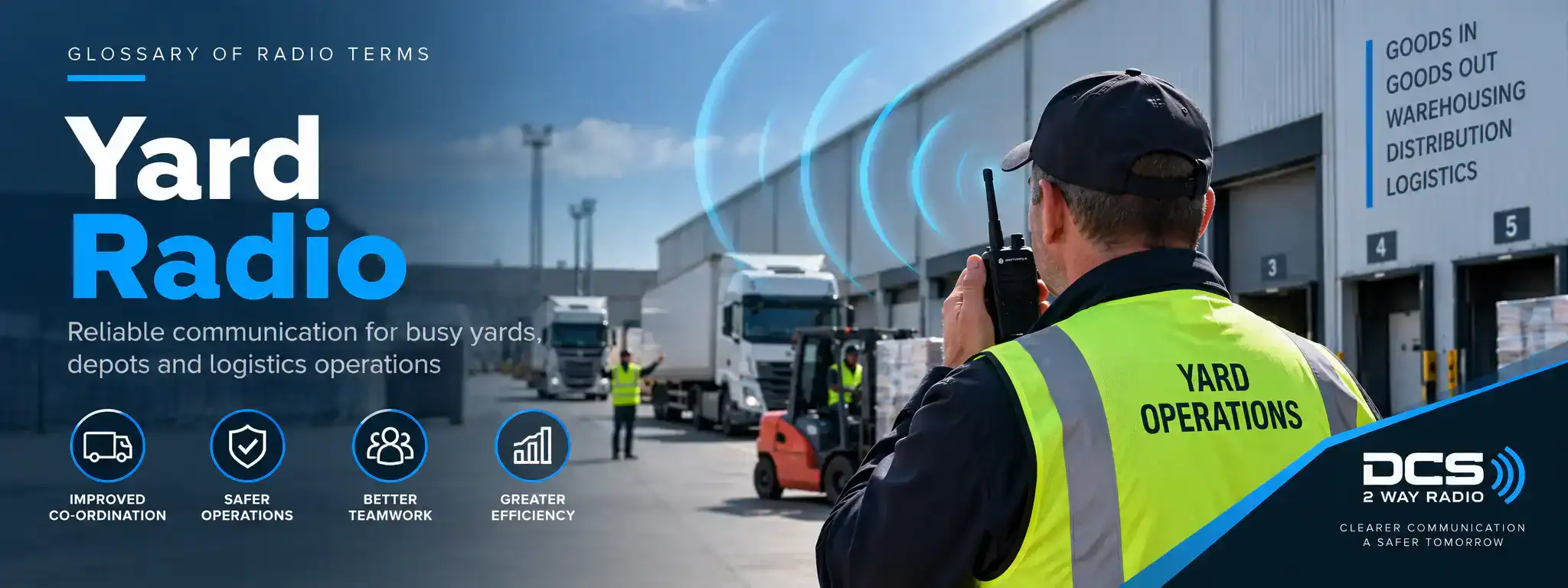
Yard Radio
A Yard Radio is a two-way radio used to support communication between teams working in yards, depots, distribution centres, warehouses, ports and other outdoor operational areas. Yard radios allow staff to communicate quickly while moving around large or busy sites, helping coordinate vehicles, loading and unloading, deliveries, security and day-to-day operations.
Yard radio systems can use analogue or digital two-way radios, with the most suitable solution depending on the size of the site, required coverageRadio Coverage is the geographical area in which a two-way radio system can provide reliable communication. Coverage depends on the radios, antennas, frequency, terrain, buildings and system infrastructure., working environment and number of users.
What is a yard radio?
A yard radio is not a specific type or standard of two-way radio. The term generally describes a radio used for communications within an operational yard or similar working environment.
Handheld radios are commonly used because employees can carry them while moving between vehicles, buildingsAn antenna transmits and receives radio-frequency signals, allowing a two-way radio to communicate. Antenna type, frequency, height and location can all affect radio performance and coverage., loading areas and storage locations. Mobile radios can also be installed in vehicles operating around the site.
Why are yard radios used?
Yards can be busy environments where staff, vehicles and equipment are constantly moving. Radio communication provides a fast way for employees to communicate without relying on mobile phones or having to return to a fixed location.
Yard radios can be used to coordinate vehicle movements, communicate loading instructions, report problems and keep different teams in contact throughout the working day.
Yard radios and logistics
Yard radios are particularly useful in logistics and transport operations.
Drivers, yard operatives, warehouse teams, supervisors and transport coordinators may all need to communicate with one another. Two-way radios allow these teams to share information quickly, particularly when vehicles are arriving, departing, loading or being positioned within a busy yard.
Yard radios and warehouses
Many warehouses have external yards connecting loading bays, storage areas and vehicle access points.
A radio systemA Radio System is a complete communication solution comprising two-way radios and, where required, equipment such as repeaters, antennas, base stations, mobile radios and network infrastructure. can allow warehouse and yard teams to communicate without the limitations that can occur when staff move between indoor and outdoor areas.
Where the radio system needs to cover both the warehouse and the external yard, factors such as building construction, site size and radio frequencyAn antenna transmits and receives radio-frequency signals, allowing a two-way radio to communicate. Antenna type, frequency, height and location can all affect radio performance and coverage. should be considered when designing the system.
Yard radios and haulage
Haulage yards can involve multiple vehicles arriving and departing throughout the day. Communication between drivers and yard staff can help coordinate vehicle movements and loading activities.
Handheld radios can be used by yard operatives, while vehicle-mounted radios can provide communications for drivers operating within the site.
For larger haulage operations, a structured radio system can provide separate channels or talk groups for different teams or functions.
Yard radios and ports
Yard radio communication is also relevant to ports and maritime operations, where large outdoor areas may include warehouses, vehicle yards, loading zones, docks and storage areas.
Radio systems can help different operational teams communicate across these environments, particularly where reliable site-wide communication is important.
The radio equipment and system design may need to take account of the challenging conditions found in port environments, including large structures, machinery, vehicles and extensive outdoor areas.
Yard radios and construction
Construction sites can have significant vehicle movements, material storage areas and temporary yards.
Two-way radios can allow site teams to communicate with plant operators, delivery drivers, banksmen, security personnel and other workers.
For temporary construction projects, radio hireRadio Hire is the temporary rental of two-way radios and related communication equipment for events, projects and operational requirements, providing professional communication without purchasing the equipment. can provide a practical way of equipping a site with communications without requiring the purchase of a permanent fleet.
Yard radios and security
Security teams operating across industrial sites, logistics yards and distribution centres can use two-way radios to maintain contact while patrolling or responding to incidents.
Radios can provide instant communication between security personnel and other operational teams. Depending on the radio system, features such as emergency alerts, lone workerA Lone Worker is someone who works without direct supervision or immediate assistance nearby. Compatible two-way radios can provide safety features such as timed check-ins, emergency alerts and GPS location. functions and GPS may also be available.
Yard radio coverage
The coverage required by a yard radio system depends on the size and layout of the site.
Buildings, warehouses, metal structures, vehicles, terrain and other obstructions can affect radio signals. A small yard may only require handheld radios communicating directly with one another, while a larger site may require additional infrastructureRadio infrastructure is the equipment and supporting systems behind a professional two-way radio network, including repeaters, antennas, base stations, network connections, power systems and dispatch equipment..
A radio repeaterA Repeater receives a two-way radio transmission and retransmits it, usually from an elevated location, to extend the coverage and reliability of a radio communication system. can be used where additional coverage is required. Repeaters receive and retransmit radio signals, potentially extending the usable range of a radio system.
Yard radios and digital radio
Digital two-way radios can provide additional features compared with basic analogue systems.
Depending on the equipment and system configuration, digital radios may support features such as talk groups, private calling, GPS, emergency alarms, call alerts and digital voice recordingDigital Voice Recording records two-way radio communications as digital audio, allowing authorised users to replay and review conversations for monitoring, training, incident investigation or record keeping..
Digital radio can also make more efficient use of available radio spectrumSpectrum is the range of radio frequencies used for wireless communication. Two-way radios operate within specific parts of the radio spectrum, subject to frequency allocation and licensing requirements. through technologies such as DMR (Digital Mobile RadioA Mobile Radio is a two-way radio designed to be installed in a vehicle. It normally uses the vehicle's power supply and an external antenna to provide reliable communication while travelling or working in the field.).
Yard radios and talk groups
Larger yard operations may use talk groups to organise communications between different teams.
For example, a logistics operation could have separate talk groups for:
- Yard operations
- Warehouse staff
- Transport
- Security
- Management
- Maintenance
This allows teams to communicate with the people who need to hear the information without unnecessarily occupying every radio user’s channelA two-way radio channel is a programmed set of communication settings, typically including frequency and signalling, that allows compatible radios to communicate with one another..
Yard radios and vehicle communication
Vehicle-mounted radios can complement handheld yard radios.
Drivers operating forklifts, trucks, HGVs or other vehicles can communicate with colleagues while remaining inside their vehicles. Depending on the application, a vehicle radio can be connected to an external antennaAn antenna transmits and receives radio-frequency signals, allowing a two-way radio to communicate. Antenna type, frequency, height and location can all affect radio performance and coverage. to improve radio performance.
The combination of handheld and mobile radios can provide a flexible communication system across larger operational sites.
Yard radios and worker safety
Reliable communication can be particularly important where employees are working around moving vehicles, heavy machinery and other operational hazards.
Two-way radios allow workers to communicate quickly when situations change or assistance is required. Radios with emergency buttons or other safety features may provide additional functionality where the equipment supports them.
Radio communication should form part of a wider site safety system rather than being relied upon as the sole safety measure.
Yard radios and radio hire
Yard radio requirements can change depending on the operation.
Temporary logistics projects, construction work, seasonal operations, events and short-term storage facilities may only require radios for a limited period. Two-way radio hire can provide a temporary communication solution without the need to purchase a complete radio fleet.
Longer-term operations may benefit from purchasing and deploying a permanent radio system.
Licence-free and licensed yard radios
Some smaller yard operations may be able to use licence-free radios, depending on the application and required performance.
For larger or more demanding operations, licensed radios can provide access to specific frequencies and may offer greater flexibility when designing a professional radio system.
The appropriate option depends on the site, number of users, required coverage and operational requirements.
Yard radios and radio system design
A yard radio system should be designed around the way the site actually operates.
Factors that may need to be considered include:
- Site size and layout
- Indoor and outdoor coverage
- Number of radio users
- Vehicle movements
- Buildings and physical obstructions
- Required channels or talk groups
- Radio frequencyFrequency is the number of cycles a radio wave completes each second, measured in Hertz. In two-way radio, frequency determines where a transmission operates within the radio spectrum.
- Analogue or digital technology
- Repeater requirements
- Licensing
- Emergency and safety features
- Battery requirements
- Accessories and charging facilities
A site surveyA Site Survey is an assessment of a location to determine whether a two-way radio system will provide the required coverage, reliability and performance. can help identify potential coverage problems before equipment is deployed.
Yard radios and DCS 2 Way Radio
DCS 2 Way Radio provides two-way radio solutions for logistics, warehousing, haulage, ports, construction and other industrial operations where reliable communication is important.
Depending on the requirements, a yard radio solution can include handheld radios, vehicle radios, repeaters, accessories and other radio infrastructure. Radio hire is also available for organisations requiring communications for temporary projects or short-term operations.
The appropriate system depends on the size and layout of the site, the working environment and how teams need to communicate.
Related radio terms
- Two Way Radio
- Warehouse RadioA Warehouse Radio is a professional two-way radio used by warehouse, distribution and logistics teams for instant communication across storage areas, loading bays, yards and operational facilities.
- Radio Hire
- Radio System
- Repeater
- Coverage
- Channel
- Talk GroupA Talk Group is a predefined group of users or radios within a two-way radio system that share a common communication group, allowing teams to communicate without involving other users.
- DMR (Digital Mobile Radio)
- Mobile Radio
- Site Survey
- Worker SafetyWorker Safety refers to measures used to protect employees from workplace risks. Two-way radios can support worker safety through instant communication, emergency alerts, Lone Worker and Man Down functions.
- Licensed RadioA Licensed Radio is a two-way radio operated under an appropriate radio licence. Licensed systems can provide greater control over frequencies, coverage and infrastructure than licence-free radio services such as PMR446.
- Licence-Free RadioA Licence-Free Radio is a two-way radio that can be used without an individual radio licence when it complies with the applicable licence-exempt rules. In the UK, PMR446 is the main licence-free radio service.
- VHF (Very High Frequency)VHF (Very High Frequency) is the 30 MHz to 300 MHz radio-frequency range. VHF two-way radios are widely used for professional communications across outdoor, rural and open areas.
- UHF (Ultra High Frequency)UHF (Ultra High Frequency) is the 300 MHz to 3 GHz radio-frequency range. UHF two-way radios are widely used for professional communications, particularly in buildings and urban environments.