Bit Rate
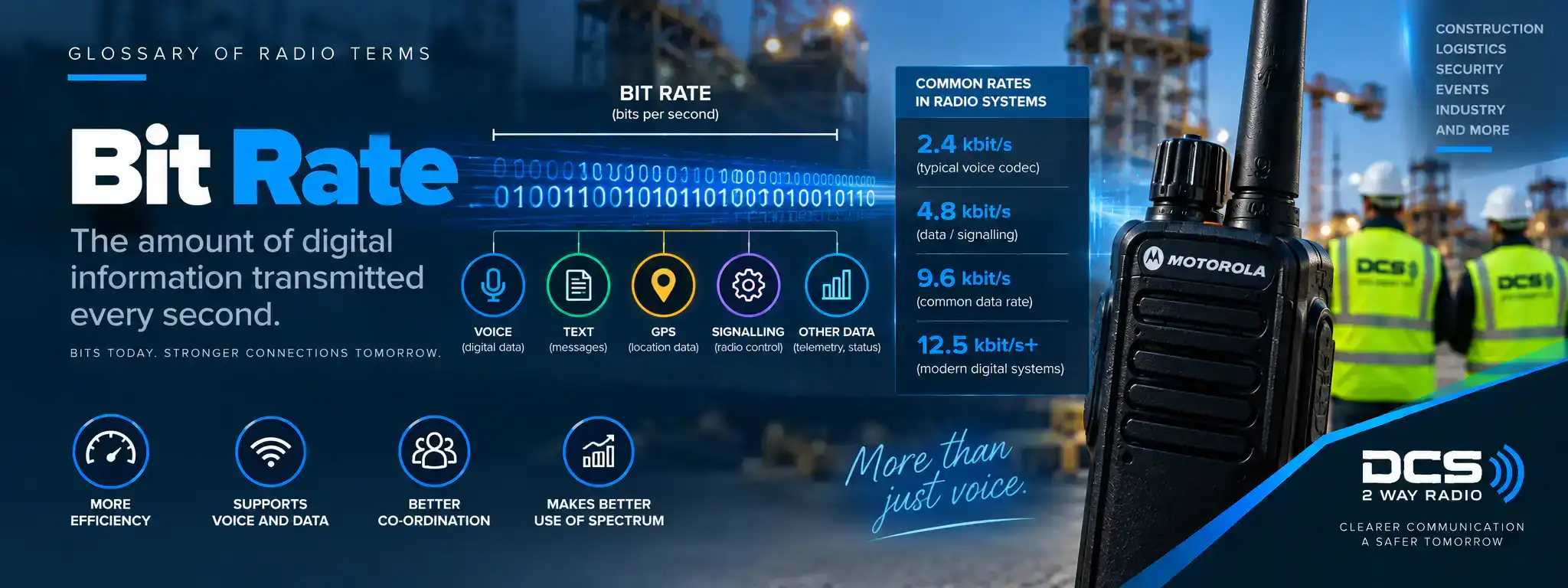
Bit rate is the amount of digital information transmitted or processed over a period of time. It is normally measured in
bits per second (bit/s), with higher values expressed as kilobits per second (kbit/s) or megabits per second (Mbit/s).
In digital two-way radio, bit rate is relevant to the amount of digital information being transmitted, including encoded voice, signalling and data. It is one of several technical factors that influence how a digital
radio systemA Radio System is a complete communication solution comprising two-way radios and, where required, equipment such as repeaters, antennas, base stations, mobile radios and network infrastructure. communicates information efficiently.
What is bit rate?
Bit rate describes how many individual bits of digital information are transmitted each second.
A bit is the smallest unit of digital information and can have a value of either 0 or 1.
For example, a bit rate of 9,600 bit/s means that 9,600 bits of digital information are transmitted each second.
Bit rate is different from the amount of information being transmitted. A higher bit rate means more bits can be transmitted per second, but it does not automatically mean that a radio system will have greater range or better voice quality.
Bit rate and two-way radio
In a digital two-way radio, voice is converted into digital information before it is transmitted.
The radio uses a
vocoder to analyse and encode speech into a digital representation. Additional information, such as signalling and error-protection data, can also be included in the transmitted digital signal.
The resulting information has to be transmitted within the available radio
channelA two-way radio channel is a programmed set of communication settings, typically including frequency and signalling, that allows compatible radios to communicate with one another. and according to the requirements of the digital radio technology being used.
Bit rate and digital radio
Digital radio differs from
analogue radioAnalogue radio uses continuously varying radio signals to transmit voice communication. It remains widely used for reliable two-way communication across business, industry, events, security and other applications. because information is represented as digital data rather than directly as an analogue audio waveform.
The bit rate is therefore an important characteristic of digital communication systems.
However, the relationship between bit rate and radio performance is not straightforward. A digital radio system is designed around a combination of
modulationAnalogue radio uses continuously varying radio signals to transmit voice communication. It remains widely used for reliable two-way communication across business, industry, events, security and other applications., channel bandwidth, coding, error correction and other techniques.
This means that simply increasing the bit rate is not necessarily an improvement.
Bit rate and DMR
DMR (Digital Mobile RadioA Mobile Radio is a two-way radio designed to be installed in a vehicle. It normally uses the vehicle's power supply and an external antenna to provide reliable communication while travelling or working in the field.) is a digital radio standard used for professional two-way radio communications.
DMR uses
4FSK (Four-Level FrequencyAn antenna transmits and receives radio-frequency signals, allowing a two-way radio to communicate. Antenna type, frequency, height and location can all affect radio performance and coverage. Shift Keying) modulation and
TDMA (Time Division Multiple Access).
A DMR radio channel has a 12.5 kHz physical channel bandwidth and is divided into two time slots using TDMA. This allows two logical communication paths to share the same physical radio channel.
The bit rate of a DMR system therefore needs to be considered alongside its modulation and TDMA structure rather than viewed in isolation.
Bit rate vs baud rate
Bit rate and
baud rate are related but they are not necessarily the same thing.
Bit rate describes the number of bits transmitted per second, whereas baud rate describes the number of symbols transmitted per second.
A single symbol can represent more than one bit when a modulation system uses multiple possible symbol states.
For example, 4FSK uses four different
frequencyFrequency is the number of cycles a radio wave completes each second, measured in Hertz. In two-way radio, frequency determines where a transmission operates within the radio spectrum. states. Each symbol can represent two bits of information.
This distinction becomes important when discussing the technical performance of digital radio systems.
Bit rate and bandwidth
Bit rate is closely related to
bandwidth, but the two terms describe different things.
Bandwidth refers to the amount of radio-frequency
spectrumSpectrum is the range of radio frequencies used for wireless communication. Two-way radios operate within specific parts of the radio spectrum, subject to frequency allocation and licensing requirements. occupied by a signal, while bit rate refers to the amount of digital information being transmitted.
A well-designed digital communication system aims to transmit the required information efficiently within the available bandwidth.
This is particularly important for professional radio because radio spectrum is limited and must be shared between different users and services.
Bit rate and voice quality
A higher bit rate does not automatically produce better voice quality in a two-way radio.
Digital voice systems use specialised voice coding techniques designed to represent speech efficiently. The amount of data required depends on the vocoder and the way the digital radio system has been designed.
Other factors, including the radio's audio processing, microphone, speaker, signal quality and error correction, also influence the resulting voice quality.
Bit rate and vocoders
A
vocoder converts speech into a compact digital representation that can be transmitted over a communications system.
Professional digital radio technologies use vocoders to reduce the amount of information required to represent speech while maintaining intelligibility.
The vocoder therefore plays an important role in determining how voice information fits within the available digital
transmissionTransmission is the process of sending voice, data or signalling from a radio using a radio-frequency signal to another radio, repeater or communication system. capacity.
Bit rate should consequently be considered together with voice coding rather than as a standalone measure of audio quality.
Bit rate and error correction
Digital radio systems may use error-detection and error-correction techniques to improve the reliability of received information.
Some of the transmitted data may therefore be used for purposes other than carrying the user's voice.
This additional information can help the receiving radio detect or correct certain errors caused by noise or
interferenceRadio interference occurs when unwanted radio-frequency signals or electrical noise disrupt two-way radio communications, causing distorted audio, broken transmissions, reduced coverage or loss of communication..
The balance between useful information, signalling and error protection is part of the design of a digital radio system.
Bit rate and radio interference
Radio interference can cause errors in the digital information being received.
As the quality of the radio signal decreases, the
receiverA Receiver is the part of a two-way radio that detects and processes incoming radio signals, converting them into audible voice or usable data for the user. may have increasing difficulty correctly decoding the transmitted information.
Digital systems can use error correction and other techniques to maintain usable communication under less-than-perfect conditions.
However, digital radio is not immune to interference. If the received signal becomes too poor for reliable decoding, communication can eventually be lost.
Bit rate and radio coverage
Bit rate does not determine the range of a two-way radio.
Radio
coverageRadio Coverage is the geographical area in which a two-way radio system can provide reliable communication. Coverage depends on the radios, antennas, frequency, terrain, buildings and system infrastructure. is influenced by factors such as:
- Transmitter powerAn antenna transmits and receives radio-frequency signals, allowing a two-way radio to communicate. Antenna type, frequency, height and location can all affect radio performance and coverage.
- Frequency
- AntennaAn antenna transmits and receives radio-frequency signals, allowing a two-way radio to communicate. Antenna type, frequency, height and location can all affect radio performance and coverage. type and position
- Terrain
- BuildingsAn antenna transmits and receives radio-frequency signals, allowing a two-way radio to communicate. Antenna type, frequency, height and location can all affect radio performance and coverage. and other obstructions
- Receiver sensitivity
- Interference
- RepeaterA Repeater receives a two-way radio transmission and retransmits it, usually from an elevated location, to extend the coverage and reliability of a radio communication system. locations
- Radio system design
A digital radio operating at a particular bit rate can therefore have very different coverage depending on how the complete system has been designed.
Bit rate and data services
Digital two-way radios can transmit more than voice.
Depending on the radio technology and equipment, digital systems can support information such as:
- GPS data
- Text messages
- TelemetryTelemetry is the automatic collection and transmission of information from a remote device, vehicle, machine or radio to another location for monitoring, analysis or control.
- Radio status information
- Emergency signalling
- Location information
- System management data
These services consume part of the available digital communication capacity.
The way data and voice share the available capacity depends on the radio technology and system configuration.
Bit rate and professional radio systems
Professional radio systems are designed to balance communication requirements with the available radio spectrum.
The system designer needs to consider the required voice services, data services, number of users, coverage area and radio technology.
Bit rate is one technical parameter within this wider design process.
For most radio users, the important consideration is not choosing a radio with the highest bit rate, but selecting a system that provides the required communication performance for the application.
Bit rate and radio programming
Radio programming determines many of the operational characteristics of a professional two-way radio system.
Digital radio settings need to be compatible across the radios and
infrastructureRadio infrastructure is the equipment and supporting systems behind a professional two-way radio network, including repeaters, antennas, base stations, network connections, power systems and dispatch equipment. forming part of the system.
Incorrect configuration can result in radios being unable to communicate correctly, even where they operate within the same general frequency range.
Professional radio programming therefore needs to take account of the digital technology and system configuration being used.
Bit rate and radio hire
For organisations using
two-way radio hireRadio Hire is the temporary rental of two-way radios and related communication equipment for events, projects and operational requirements, providing professional communication without purchasing the equipment., the technical configuration of the equipment is normally selected according to the requirements of the project.
Users generally do not need to manage bit-rate settings themselves. The hired radios and associated infrastructure are configured to operate as a compatible system.
This can be particularly useful for temporary events, construction projects, logistics operations and other environments where professional digital communications are required for a limited period.
Bit rate and DCS 2 Way Radio
At DCS 2 Way Radio, digital radio systems can be designed around the communication requirements of the organisation and its working environment.
Bit rate is one of the technical characteristics involved in digital communications, alongside modulation, bandwidth, coding, error correction, frequency and radio system design.
For businesses requiring reliable communications, the overall performance of the radio system is more important than any single technical specification. The right combination of radios, repeaters, antennas, programming and infrastructure can provide the communication capability required for the site.
Related radio terms
- Digital Mobile Radio (DMR)Digital Mobile Radio (DMR) is an ETSI digital radio standard for professional two-way communications, supporting voice, group calling, data and other features on compatible radio systems.
- Digital Radio
- Vocoder
- 4FSK (Four-Level Frequency Shift Keying)
- TDMA (Time Division Multiple Access)
- Bandwidth
- Modulation
- Radio Frequency (RF)Radio Frequency (RF) refers to electromagnetic waves used to transmit voice and data wirelessly. Two-way radios use RF signals to communicate between radios, repeaters and other system infrastructure.
- Frequency
- Receiver
- Interference
- Error Correction
- Telemetry
- GPS (Global Positioning System)GPS is a satellite-based positioning system that allows compatible two-way radios to determine their location. GPS data can support tracking, dispatch, fleet management and Geo-Fencing.
- Radio Programming
- Radio System
- Repeater
- Coverage
- Radio Hire
For demanding environments where reliable communications are essential, professional
two way radio hire gives your team the equipment they need.