
The Complete Guide to Two-Way Radios & Professional Mobile Radio (PMR)
Part 2 - Chapter 9
Hybrid Communication Systems
Hybrid Communication Systems
Combining the Best of Professional Mobile Radio and Broadband Communications
Modern organisations rarely operate from a single location or rely on a single type of workforce. A logistics company may have warehouse staff working on-site, drivers travelling nationwide and managers working remotely. A construction business might have multiple projects running simultaneously across different regions. A facilities management company may support hundreds of client sites, each with different communication requirements.
In these environments, relying on a single communication technology is not always the most effective solution.
Hybrid communicationHybrid Communication combines two or more communication technologies, such as two-way radio, DMR, cellular, Wi-Fi or IP networks, allowing different systems or users to communicate through a common platform. systems bring together multiple technologies, such as Professional Mobile Radio (PMR)Professional Mobile Radio (PMR) describes private two-way radio systems designed for business and professional users, ranging from simple radio networks to advanced digital and multi-site systems., Digital Mobile Radio (DMR)Digital Mobile Radio (DMR) is an ETSI digital radio standard for professional two-way communications, supporting voice, group calling, data and other features on compatible radio systems., Push-to-Talk over Cellular (PoC)Push-to-Talk over Cellular (PoC) provides radio-style push-to-talk communication over cellular or IP networks, allowing users to communicate across wide areas where suitable network connectivity is available., vehicle radios and cloud-based dispatch platforms into one integrated communication networkA Network is a connected system of radios, equipment and infrastructure that allows users to communicate across a defined area. Radio networks can range from simple radio-to-radio systems to large multi-site networks..
Rather than replacing existing investments, hybrid systems enable organisations to build on their existing infrastructureRadio infrastructure is the equipment and supporting systems behind a professional two-way radio network, including repeaters, antennas, base stations, network connections, power systems and dispatch equipment. while extending communication capabilities to meet changing operational demands.
This chapter examines what hybrid communication systems are, how they work and why they are becoming an increasingly popular choice for businesses across the UK.
What Is a Hybrid Communication System?
A hybrid communication system combines two or more communication technologies into a single operational platform.
Instead of asking staff to use separate systems depending on where they are working, hybrid solutions allow users on different technologies to communicate seamlessly.
For example:
- A warehouse operative uses a DMR handheld radio.
- A delivery driver uses a PoC mobile radioA Mobile Radio is a two-way radio designed to be installed in a vehicle. It normally uses the vehicle's power supply and an external antenna to provide reliable communication while travelling or working in the field..
- A regional manager uses a smartphone application.
- A control room operator communicates through a desktop dispatch console.
Although each user is connected differently, they can all communicate as though they were using the same radio network.
Why Hybrid Systems Are Growing
Businesses have changed significantly over the past decade.
Many organisations now operate:
- Multiple depots
- Regional offices
- Remote workers
- Mobile engineering teams
- National delivery fleets
- Temporary project sites
Traditional PMR systems provide outstanding communication within a defined coverageRadio Coverage is the geographical area in which a two-way radio system can provide reliable communication. Coverage depends on the radios, antennas, frequency, terrain, buildings and system infrastructure. area.
PoC extends communication wherever mobile broadbandBroadband is a high-speed data connection used by systems such as PoC radio to carry voice, video and other communications over mobile networks, Wi-Fi or IP networks. is available.
Combining the two enables organisations to benefit from both technologies without compromising on operational flexibility.
The Building Blocks of a Hybrid System
A hybrid communication platform can incorporate a variety of technologies.
## Professional Mobile Radio (PMR)
PMR provides:
* Reliable on-site communication
* Instant Push-to-Talk operation
* Dedicated infrastructure
* Local resilience
It remains the preferred choice for many industrial and high-density operational environments.
Digital Mobile Radio (DMR)
DMR contributes:
- Clear digital voice
- GPS services
- Text messaging
- Emergency alerts
- Talk groups
- Efficient spectrumSpectrum is the range of radio frequencies used for wireless communication. Two-way radios operate within specific parts of the radio spectrum, subject to frequency allocation and licensing requirements. usage
It often forms the core of the on-site communication network.
Push-to-Talk over Cellular (PoC)
PoC extends communication beyond the physical boundaries of the PMR network.
It enables communication with:
- Remote employees
- Mobile workers
- Nationwide operations
- International teams (where supported)
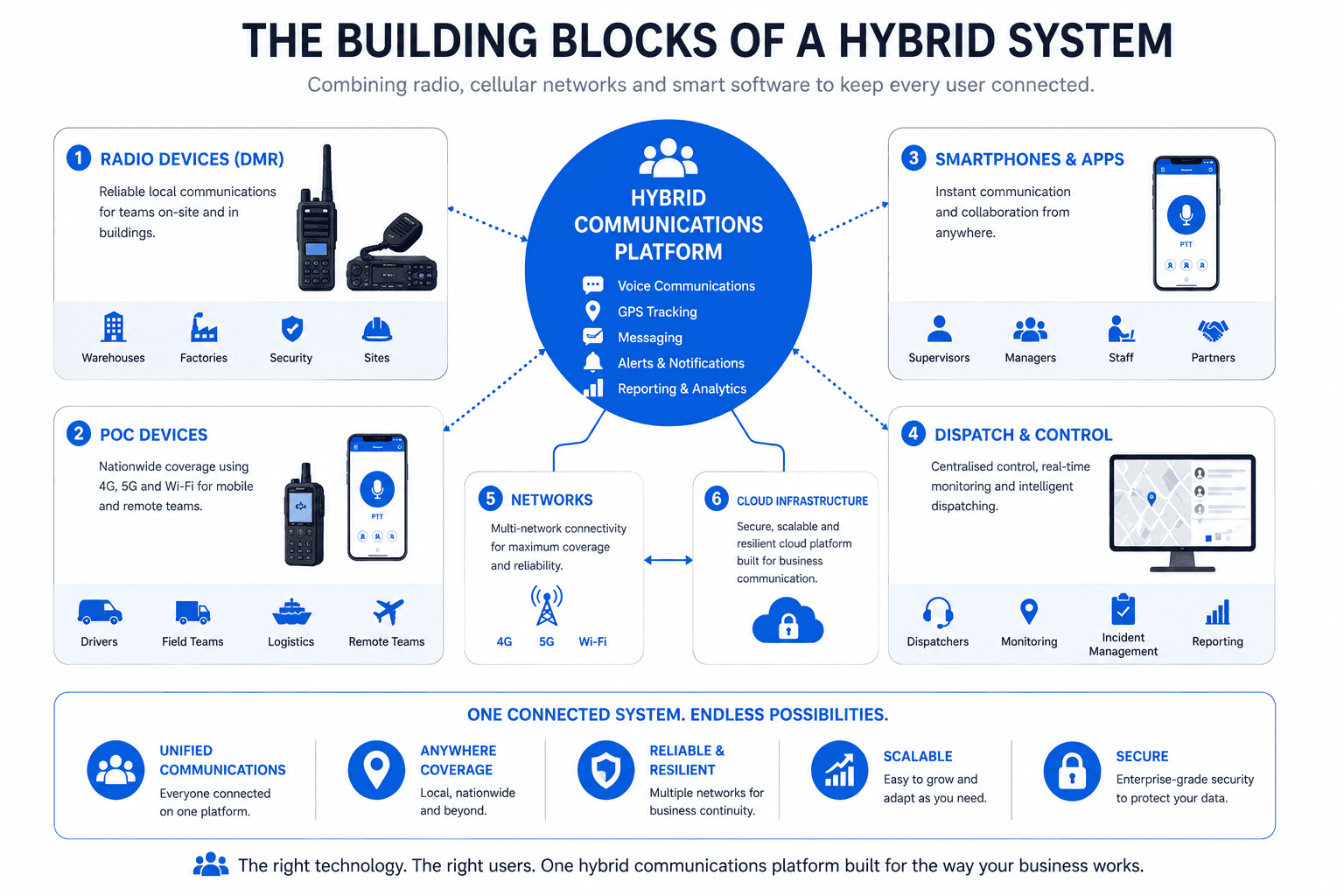
Smartphone Applications
Managers, supervisors and occasional users may participate using secure smartphone applications rather than carrying dedicated radio equipment.
This provides greater flexibility while reducing equipment requirements for some staff.
Dispatch Software
Modern control rooms often use dispatch software that integrates:
- Voice communication
- GPS tracking
- Call recordingCall Recording is a two-way radio feature or system function that captures and stores radio communications for later playback, review, incident investigation or record keeping.
- Mapping
- Incident managementIncident Management is the process of coordinating people, communications and resources during an incident. Two-way radios can provide rapid communication between teams, control rooms and responders.
- User status monitoring
Dispatch operators can communicate with all connected users regardless of device type.
How Hybrid Communication Works
At the centre of a hybrid communication system is a software platform that links multiple communication technologies together.
When a user transmits:
- The message enters the communication platform.
- The platform determines the destination users.
- The message is converted if necessary.
- The transmissionTransmission is the process of sending voice, data or signalling from a radio using a radio-frequency signal to another radio, repeater or communication system. is delivered across the appropriate network.
For example:
A DMR handheld radio can communicate with:
- Another DMR radio.
- A PoC handheld.
- A vehicle-mounted PoC unit.
- A smartphone application.
- A dispatch console.
The user simply presses the Push-to-Talk button as normal.
The complexity is handled behind the scenes.
Did You Know?
Before any radio leaves our workshop, it is programmed, configured and tested by our engineers. This ensures every device is ready to use straight out of the box and performs exactly as required.
Traditional PMR vs Hybrid Communication
Traditional Professional Mobile Radio (PMR) systems provide reliable on-site voice communications, while hybrid communication platforms combine PMR with Push-to-Talk over Cellular (PoC), smartphones and dispatch software. The comparison below highlights how hybrid systems extend communication beyond the limitations of a standalone radio network.
| Feature | Traditional PMR | Hybrid Communication |
|---|---|---|
| Coverage | Local or regional | Local, nationwide and international |
| Devices Supported | PMR radios only | DMR radios, PoC radios, smartphones and dispatch consoles |
| Network Type | Dedicated radio infrastructure | Radio network combined with 4G, 5G and Wi-FiWi-Fi is a wireless networking technology that connects compatible devices to a local or wider network. In radio systems, it can support programming, updates, data services and IP-based communications. |
| Remote Workers | Limited | Fully supported |
| Multi-Site Communications | Requires linked radio infrastructure | Seamless across multiple locations |
| Dispatch Integration | Basic or optional | Integrated voice, GPS and messaging |
| GPS Tracking | Available on compatible radios | Real-time tracking across all connected devices |
| Messaging | Limited | Voice, text, status and multimedia messaging |
| Scalability | Expansion may require additional infrastructure | Easily expanded by adding new users and devices |
| Business Continuity | Dependent on radio coverage | Multiple communication paths improve resilience |
| Best Suited For | Single-site or local operations | Organisations with multiple sites, mobile teams or nationwide operations |
Many organisations are now adopting hybrid communication platforms to combine the reliability of Professional Mobile Radio with the flexibility and nationwide reach of Push-to-Talk over Cellular. This approach allows employees to communicate seamlessly using the device and network best suited to their role, while maintaining a single, unified communications system.
A Practical Example
Consider a national facilities management company.
Head Office
Operations managers monitor work through a cloud dispatchCloud Dispatch is a cloud-based radio management and communication system that allows authorised dispatchers to communicate with, monitor and manage two-way radio users through an internet-connected platform. platform.
Regional Engineers
Engineers travel between customer sites using PoC vehicle radios.
Client Sites
Maintenance teams use DMR radios inside large buildingsAn antenna transmits and receives radio-frequency signals, allowing a two-way radio to communicate. Antenna type, frequency, height and location can all affect radio performance and coverage..
Supervisors
Regional supervisors communicate using smartphone applications.
When an urgent maintenance issue arises:
- The control room alerts all relevant personnel.
- Site engineers receive the message via DMR.
- Mobile engineers receive it through PoC.
- Supervisors respond via smartphone.
Everyone remains connected through a single communication environment.
Expert Insight
Successful communication systems start with people, not products. Matching technology to user requirements delivers better performance and greater flexibility.
How Hybrid Communications Connect Modern Businesses
The previous example demonstrates how a hybrid communications platform enables different users and technologies to work together as a single network. Rather than relying on one communication method, organisations can combine Digital Mobile Radio (DMR), Push-to-Talk over Cellular (PoC), smartphones and cloud-based dispatch software to create a flexible communications ecosystem. The diagram below illustrates how information flows between offices, field teams and customer sites, ensuring every employee stays connected regardless of their location or device.
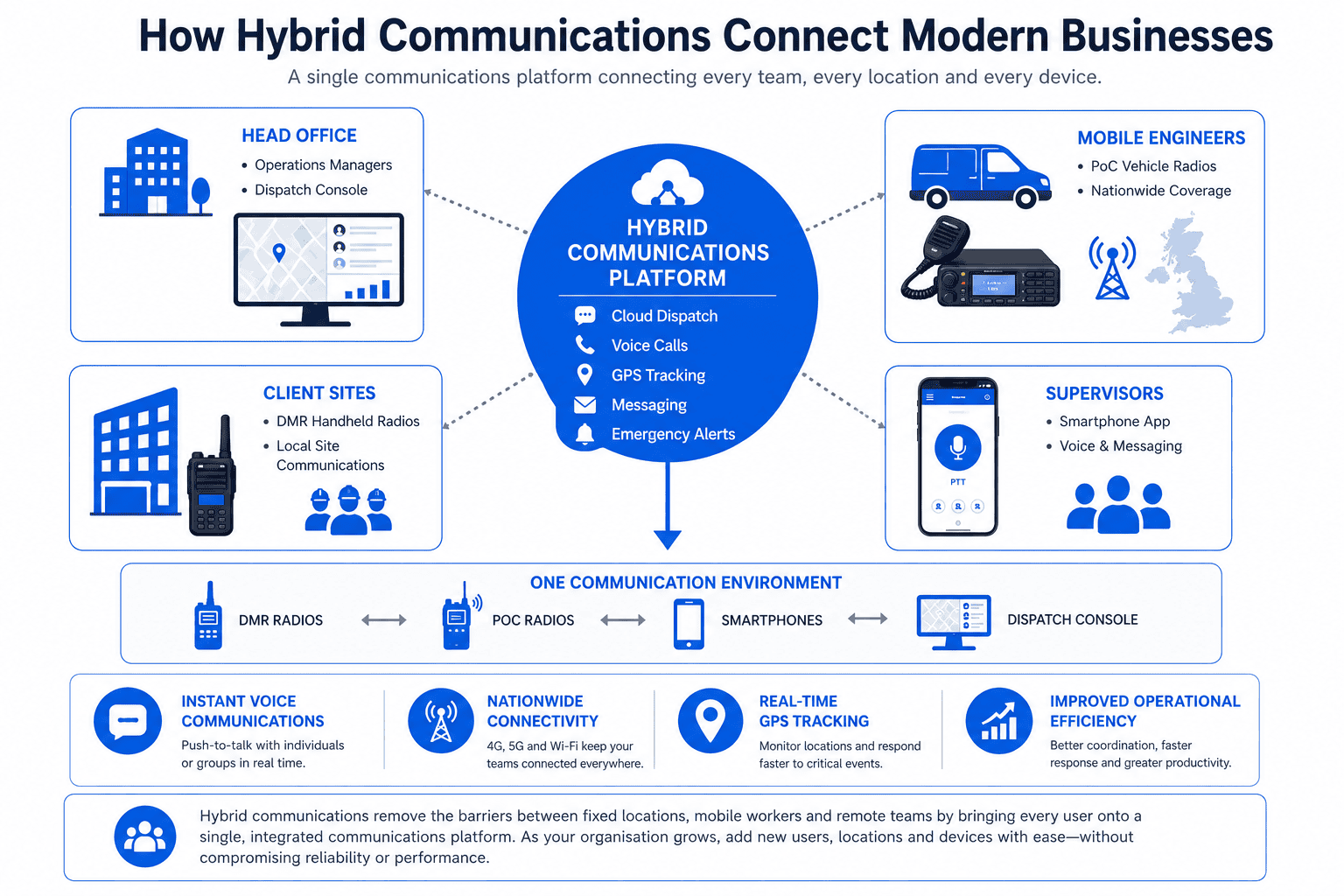
Hybrid communications remove the barriers between fixed locations, mobile workers and remote teams by bringing every user onto a single, integrated communications platform. Whether staff are using DMR radios on-site, PoC devices in the field, smartphones on the move or a dispatch console in the control room, everyone can communicate instantly and efficiently. As organisations grow, hybrid systems provide the flexibility to add new users, locations and devices without compromising reliability or operational performance.
Benefits of Hybrid Communication
Seamless Communication
Different technologies work together without users needing to think about the underlying network.
Greater Coverage
PMR provides dependable local communication.
PoC extends communication nationally.
Together they create a highly flexible communication platform.
Better Use of Existing Investment
Organisations can often retain existing PMR infrastructure while gradually introducing PoC capabilities.
This reduces disruption and protects previous investments.
Improved Business Continuity
If one communication method becomes unavailable, alternative technologies may continue operating.
This resilience supports operational continuity.
Did You Know?
Did you know? DCS 2 Way Radio's Connect Plus LTE/PoC platform delivers secure nationwide Push-to-Talk communications, allowing radios, smartphones and dispatch operators to communicate seamlessly across the UK using 4G, 5G and Wi-Fi networks.
Flexible User Options
Modern communication systems allow organisations to equip employees with the device that best suits their role. Rather than issuing the same equipment to every user, hybrid communication platforms enable DMR radios, PoC devices, smartphones and dispatch consoles to work together seamlessly.
This flexibility helps improve productivity, user adoption and operational efficiency by ensuring each employee has access to the most appropriate communication tool for their working environment.
| User | Preferred Device |
|---|---|
| Warehouse Operative | DMR Handheld Radio |
| Driver | PoC Mobile Radio |
| Supervisor | Smartphone with PoC App |
| Security Officer | Rugged PoC or DMR Handheld |
| Control Room Operator | Dispatch Console |
By matching the communication device to each user's role, organisations can improve collaboration, simplify workflows and ensure staff have the right tools to communicate effectively wherever they are working.
Integration with Business Systems
Hybrid communication platforms increasingly integrate with wider business applications.
Examples include:
- Fleet managementFleet Management is the process of managing a two-way radio fleet, including equipment, users, programming, maintenance, firmware, security and radio system configuration.
- Job dispatch software
- Building management systems
- Fire alarm monitoring
- CCTV platforms
- Access control systems
- Lone workerA Lone Worker is someone who works without direct supervision or immediate assistance nearby. Compatible two-way radios can provide safety features such as timed check-ins, emergency alerts and GPS location. platforms
- Incident reporting systems
This allows communication to become part of broader operational workflows rather than functioning as a standalone system.
Supporting Business Growth
One of the strongest advantages of hybrid systems is scalability.
As organisations expand, they can:
- Add new users.
- Introduce additional sites.
- Deploy new technologies.
- Connect remote workers.
- Expand geographically.
without completely replacing their communication infrastructure.
This supports long-term business growth.
Industry Applications
Hybrid communication systems are now common across many sectors.
Logistics
Warehouse staff communicate via DMR while drivers use PoC across the UK.
Construction
Site teams use PMR locally while project managers coordinate multiple sites through broadband communication.
Healthcare
Hospitals use PMR internally while community teams communicate using PoC.
Utilities
Field engineers remain connected to regional operations centres regardless of location.
Security
Static guards use PMR while mobile patrols communicate over PoC.
Events
Temporary PMR systems coordinate on-site operations while organisers travelling between venues remain connected via broadband.
Considerations Before Deployment
Although hybrid systems offer significant benefits, careful planning remains essential.
Organisations should consider:
Existing Infrastructure
Can current PMR equipment be integrated?
Network Coverage
Is mobile broadband available where remote users operate?
User Roles
Different employees may require different communication devices.
Security
How will communication be protected across different technologies?
Future Expansion
Will the platform support additional users and locations?
Training
Staff should understand how to use the system effectively, even if the underlying technology differs.
Common Misconceptions
"Hybrid systems are too complicated."
Modern platforms are designed to hide technical complexity from users.
Most employees simply press the Push-to-Talk button exactly as they always have.
"We need to replace all our radios."
In many cases, existing infrastructure can continue operating alongside newer technologies.
Migration can often take place gradually.
"Hybrid systems are only for large organisations."
Although particularly valuable for larger businesses, hybrid communication can also benefit smaller organisations with multiple sites or mobile workers.
The Future of Hybrid Communications
As communication technologies continue to evolve, hybrid platforms are expected to become increasingly common.
Emerging developments include:
- Artificial intelligence-assisted dispatch
- Automated language translation
- Video communication integration
- Wearable communication devices
- IoT sensor integration
- Satellite connectivity
- Enhanced cloud services
The distinction between traditional radio systems and broadband communication is likely to become less pronounced as technologies continue to converge.
Key Takeaways
- Hybrid communication systems combine multiple technologies into one integrated platform.
- PMR, DMR, PoC, smartphone applications and dispatch software can all work together.
- Organisations benefit from greater flexibility, wider coverage and improved scalability.
- Hybrid systems help protect existing infrastructure investments while supporting future growth.
- Integration with wider business systems enhances operational efficiency.
- Successful deployments begin with understanding operational requirements rather than selecting technology first.
Expert Insight
- Hybrid communication is about matching technology to people not forcing people to adapt to technology.
- Different employees have different communication needs. Warehouse operatives, drivers, engineers and managers all work differently. A well-designed hybrid communication system allows each group to use the most appropriate device while ensuring everyone remains connected through a unified communication platform.
Business Perspective
Hybrid communication systems reflect the way modern organisations operate. Few businesses today are confined to a single building or a single method of working.
By integrating traditional radio infrastructure with broadband technologies and cloud services, organisations can create flexible communication environments that improve collaboration, support business continuity and adapt as operational requirements evolve.
For many businesses, hybrid communication represents the natural progression from standalone radio systems to fully connected enterprise communications.
Frequently Asked Questions
What is a hybrid communication system?
A hybrid communication system combines multiple communication technologies—such as DMR, PMR, PoC and smartphone applications—into a single integrated platform.
Do hybrid systems replace existing radio networks?
Not necessarily. Many organisations retain their existing PMR infrastructure while adding PoC and cloud-based services to extend communication capabilities.
Can DMR and PoC users communicate with each other?
Yes. Many hybrid platforms allow users on different technologies to communicate seamlessly through integrated communication gateways.
Are hybrid systems suitable for small businesses?
They can be. Businesses with multiple sites, mobile teams or future expansion plans may benefit from a hybrid approach, even if they have relatively few users.
What are the biggest advantages of hybrid communication?
Greater flexibility, wider geographic coverage, protection of existing investments, improved scalability and the ability to connect different types of users through one communication platform.
What People Say About DCS 2 Way Radio
Contact the UK's Premier Two Way Radio Experts Today