
The Complete Guide to Two-Way Radios & Professional Mobile Radio (PMR)
Part 4 - Chapter 15
Choosing the Right Radio Communication System
Choosing the Right Radio Communication System
Selecting the Best Solution for Your Organisation
Choosing a professional radio communication system is about much more than selecting a particular brand or model of handheld radio. The most successful deployments begin with a clear understanding of how an organisation operates, where its teams work and what it needs to achieve.
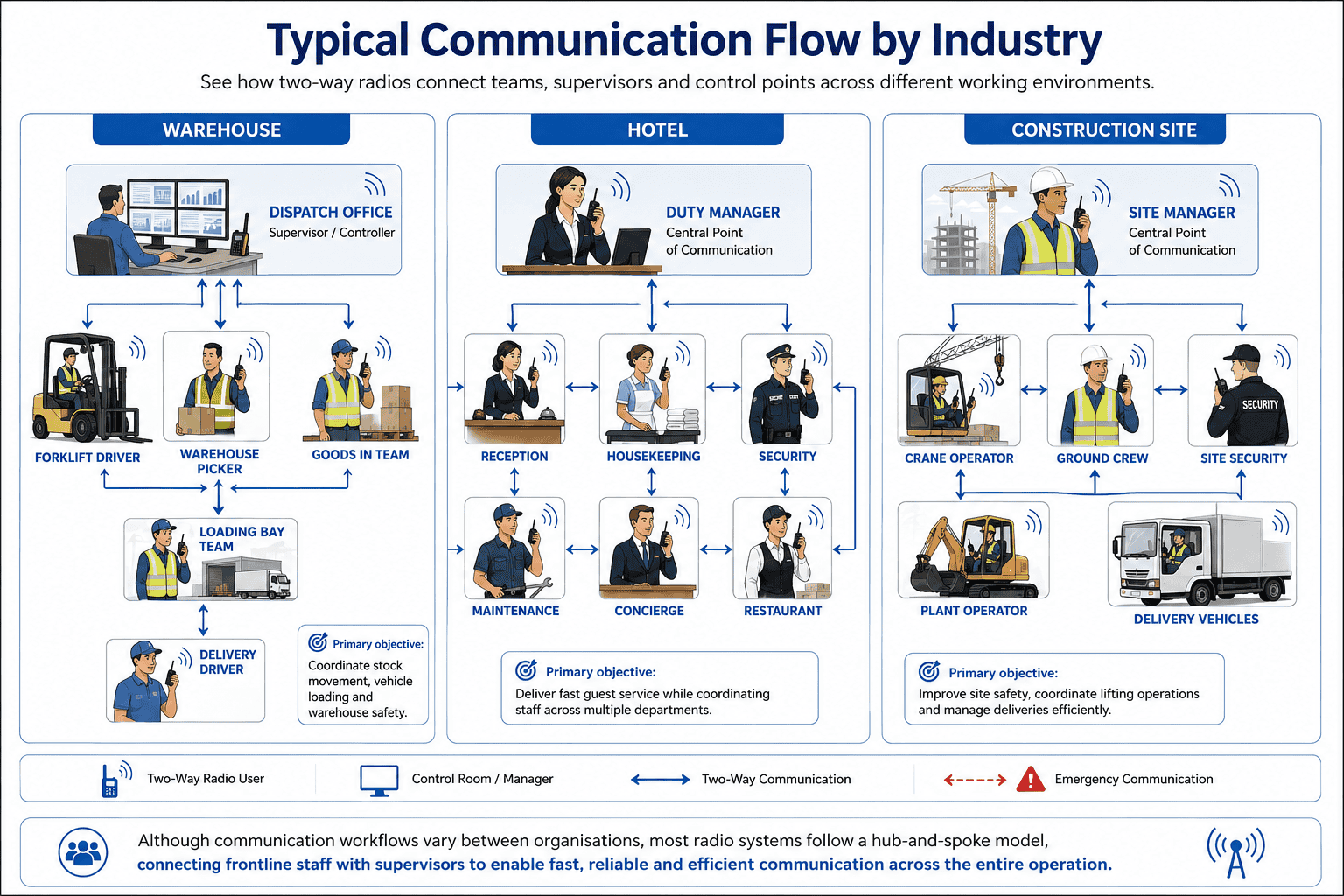
A communication system that performs exceptionally well in a hotel may be entirely unsuitable for a construction site. Likewise, a nationwide logistics company has very different requirements from a manufacturing facility operating from a single location.
Rather than asking "Which is the best radio?", organisations should ask "Which communication solution best supports our operational requirements?"
This chapter brings together the concepts explored throughout this guide and provides a practical framework for selecting the most appropriate communication system for your business.
Start with Your Operational Requirements
Before considering products or technologies, organisations should define how communication will be used.
Key questions include:
- Where will staff be working?
- How many users require communication?
- Will users remain on one site or travel?
- How critical is communication to daily operations?
- Are communications safety-critical?
- Will the system need to expand?
- Are there existing communication systems that should be integrated?
The answers to these questions form the foundation of every successful radio deployment.
Step 1 – Understand Your Environment
The physical environment has a major influence on system design.
Indoor Environments
Examples include:
- Hospitals
- Hotels
- Warehouses
- Shopping centres
- Manufacturing plants
Important considerations include:
- Building construction
- Floor layout
- Lift shafts
- Steel structures
- Basement areas
- Internal coverageRadio Coverage is the geographical area in which a two-way radio system can provide reliable communication. Coverage depends on the radios, antennas, frequency, terrain, buildings and system infrastructure.
Outdoor Environments
Examples include:
- Construction sites
- Farms
- Utilities
- Parks
- Festivals
- Transport infrastructureRadio infrastructure is the equipment and supporting systems behind a professional two-way radio network, including repeaters, antennas, base stations, network connections, power systems and dispatch equipment.
Consider:
- Terrain
- Vegetation
- Distance
- Weather
- Temporary structures
Mixed Environments
Many organisations operate across both indoor and outdoor areas.
These environments often benefit from carefully planned repeaterA Repeater receives a two-way radio transmission and retransmits it, usually from an elevated location, to extend the coverage and reliability of a radio communication system. systems or hybrid communicationHybrid Communication combines two or more communication technologies, such as two-way radio, DMR, cellular, Wi-Fi or IP networks, allowing different systems or users to communicate through a common platform. solutions.
Recommended Communication Technologies by Industry
Choosing the right communication technology depends on the environment in which it will be used. Different industries have unique operational challenges, coverage requirements and safety considerations. The table below provides a general overview of the communication technologies most commonly recommended for a range of business sectors.
| Industry | Recommended Technology | Typical Benefits |
|---|---|---|
| Retail | Licence-free or Digital Handheld Radios | Simple staff communication and customer service |
| Hospitality | Digital Handheld Radios | Discreet communications across departments |
| Warehousing & Logistics | DMR with Repeaters | Wide-area coverage and improved productivity |
| Manufacturing | DMR Infrastructure with Dispatch | Reliable communications and enhanced worker safetyWorker Safety refers to measures used to protect employees from workplace risks. Two-way radios can support worker safety through instant communication, emergency alerts, Lone Worker and Man Down functions. |
| Construction | Rugged DMR Radios | Durable equipment with emergency features |
| Security | DMR with GPS and Emergency Functions | Rapid incident response and personnel safety |
| Healthcare | DMR with Dispatch & GPS | Fast communication and improved patient response |
| Transport & Fleet | PoC Radios with Vehicle Terminals | Nationwide communications and live vehicle tracking |
| Utilities | Hybrid DMR & PoC Solution | Reliable local coverage with nationwide connectivity |
| Events | Hire Fleet with Portable Infrastructure | Scalable communications for temporary operations |
These recommendations provide general guidance only. Every organisation has unique operational requirements, and the most appropriate solution will depend on factors such as site size, coverage requirements, workforce mobility, safety considerations and future scalability. A professional site surveyA Site Survey is an assessment of a location to determine whether a two-way radio system will provide the required coverage, reliability and performance. can help determine the best communication system for your organisation.
Step 2 – Consider Coverage Requirements
Coverage is often the most important design consideration.
Questions include:
- Does communication only need to cover one building?
- Will users move between multiple sites?
- Is nationwide communication required?
- Are underground areas involved?
- Are remote rural locations included?
Different coverage requirements may suggest:
| Coverage Requirement | Suitable Solution |
|---|---|
| Small building | SimplexSimplex is a method of two-way radio communication where radios transmit and receive on the same frequency, communicating directly without a repeater. radios |
| Large warehouse | DMR with repeater |
| Multiple sites | Linked DMR networkA Network is a connected system of radios, equipment and infrastructure that allows users to communicate across a defined area. Radio networks can range from simple radio-to-radio systems to large multi-site networks. |
| Nationwide workforce | PoC or hybrid solution |
| Temporary event | Portable repeater or hire fleet |
Step 3 – Identify User Roles
Not every employee requires the same communication equipment.
Selecting the right equipment for each user role helps maximise productivity, improve user experience and ensure your organisation invests in the most appropriate communication devices. The table below outlines typical equipment choices for common operational roles.
| Role | Typical Device |
|---|---|
| Warehouse Operative | DMR handheld radio |
| Security Officer | Rugged handheld radio with emergency features |
| Driver | Vehicle-mounted radio or PoC mobile device |
| Supervisor | Handheld radio or smartphone Push-to-Talk application |
| Reception | Desktop base stationA base station is a fixed two-way radio installed at a permanent location, allowing an operator to communicate with handheld or mobile radios across a site or operating area. |
| Control Room | Dispatch console |
Selecting equipment based on individual user roles improves usability, enhances operational efficiency and helps ensure communication systems remain both cost-effective and fit for purpose.
Step 4 – Evaluate Safety Requirements
For many organisations, radio systems support more than operational efficiency they contribute directly to employee safety.
Consider whether users require:
- Emergency buttons
- Lone WorkerA Lone Worker is someone who works without direct supervision or immediate assistance nearby. Compatible two-way radios can provide safety features such as timed check-ins, emergency alerts and GPS location. monitoring
- Man DownMan Down is a safety feature on some professional two-way radios that can detect a possible fall or unusual radio position and automatically raise an alert if the user does not respond. detection
- GPS tracking
- Priority calling
- Call recordingCall Recording is a two-way radio feature or system function that captures and stores radio communications for later playback, review, incident investigation or record keeping.
Industries such as utilities, construction, security and healthcare often place particular emphasis on these capabilities.
Step 5 – Assess Infrastructure Needs
Some organisations require little or no infrastructure.
Others may need:
- Repeaters
- Base stations
- Antennas
- Control rooms
- IP networking
- Linked sites
The appropriate infrastructure depends on:
- Site size
- User numbers
- Building layout
- Geographic coverage
- Future growth
Professional site surveys can help determine these requirements.
Step 6 – Consider Licensing
Businesses should determine whether:
- Licence-free radios meet their needs, or
- Licensed frequencies provide greater reliability.
Factors influencing this decision include:
- Operational importance
- User numbers
- Coverage requirements
- InterferenceRadio interference occurs when unwanted radio-frequency signals or electrical noise disrupt two-way radio communications, causing distorted audio, broken transmissions, reduced coverage or loss of communication. risks
- Future expansion
Licensed systems often provide greater flexibility for larger or business-critical deployments.
Step 7 – Think About Future Growth
A communication system should support tomorrow's business not just today's.
Questions to consider include:
- Will additional staff be recruited?
- Could new sites be opened?
- Might departments expand?
- Will vehicle fleets increase?
- Could hybrid communication become beneficial?
Designing for future growth can reduce upgrade costs and operational disruption.
Step 8 – Integration Requirements
Many organisations now expect communication systems to integrate with other business technologies.
Potential integrations include:
- CCTV
- Access control
- Building management systems
- Fleet managementFleet Management is the process of managing a two-way radio fleet, including equipment, users, programming, maintenance, firmware, security and radio system configuration.
- Job management software
- Incident reporting platforms
- Dispatch software
- PoC services
Integration can significantly improve operational efficiency.
Step 9 – Maintenance and Support
Professional communication systems require ongoing support.
Organisations should consider:
- Equipment servicing
- Battery replacement
- Software updates
- Repairs
- Spare equipment
- User training
Reliable maintenance helps maximise system lifespan and minimise downtime.
Step 10 – Budget
Budget remains an important consideration.
However, organisations should evaluate:
- Total cost of ownership
- Operational benefits
- Equipment lifespan
- Productivity improvements
- Safety enhancements
- Scalability
The lowest purchase price does not always represent the best long-term value.
Comparing Common Communication Solutions
Different operational environments require different communication solutions. The table below provides general recommendations based on common industry requirements and typical deployment scenarios.
| Requirement | Recommended Solution |
|---|---|
| Small retail premises | Licence-free handheld radios |
| Hotel | Digital handheld radios |
| Warehouse | DMR system with repeater |
| Manufacturing plant | DMR infrastructure with dispatch console |
| Construction site | Rugged handheld radios |
| Security company | DMR radios with emergency features |
| Utilities | Hybrid PMR and PoC solution |
| Nationwide logistics | PoC radios with dispatch integration |
| Healthcare | DMR radios with GPS tracking and dispatch |
| Events | Hire fleet with portable repeater infrastructure |
These recommendations provide general guidance only. Every organisation has unique operational requirements, and the most appropriate solution will depend on factors such as site layout, coverage requirements, user numbers, safety considerations and future scalability.
Questions to Ask a Communication Provider
Before investing in a radio systemA Radio System is a complete communication solution comprising two-way radios and, where required, equipment such as repeaters, antennas, base stations, mobile radios and network infrastructure., businesses should ask:
- Has a site survey been completed?
- How will coverage be verified?
- Can the system expand?
- What maintenance is included?
- How quickly can faults be resolved?
- Is user training available?
- What warranty is provided?
- Can existing equipment be integrated?
- What future upgrade options exist?
These questions help ensure the chosen solution remains suitable over the long term.
Common Mistakes When Choosing a Radio System
Choosing Based Only on Price
The cheapest equipment may not provide the required performance or longevity.
Ignoring Coverage
Even excellent radios cannot overcome poor system design.
Buying for Today's Needs Only
Businesses often outgrow communication systems that lack scalability.
Overlooking User Training
Well-designed systems are only effective if users understand how to operate them correctly.
Underestimating Maintenance
Routine servicing and battery management are essential for long-term reliability.
Decision Framework
A practical decision-making process may look like this:
- Understand operational requirements.
- Assess the working environment.
- Define coverage needs.
- Evaluate safety requirements.
- Select the appropriate communication technology.
- Design supporting infrastructure.
- Consider future expansion.
- Compare ownership and hire options.
- Implement training and maintenance.
- Review system performance regularly.
Following this structured approach helps organisations make informed, evidence-based decisions.
Looking Beyond Technology
The most successful communication systems are not defined by their specifications.
They are judged by outcomes.
Effective communication should help organisations:
- Improve productivity.
- Increase employee safety.
- Reduce delays.
- Coordinate teams more effectively.
- Respond faster to incidents.
- Support business growth.
Technology is simply the tool that enables these objectives.
Key Takeaways
- Every organisation has unique communication requirements.
- The working environment significantly influences system design.
- Coverage, user roles and safety should be considered before selecting equipment.
- Future scalability is an important design consideration.
- Integration with wider business systems can enhance operational efficiency.
- Professional planning often delivers greater value than selecting equipment based solely on specifications.
- Successful communication systems support business objectives rather than simply providing voice communication.
Expert Insight
- There is rarely a single 'best' radio system only the best solution for a particular organisation.
- Businesses that begin by understanding their operational requirements almost always achieve better long-term outcomes than those that focus solely on equipment specifications. A carefully planned communication strategy delivers value long after the initial purchase has been forgotten.
Business Example
A growing distribution company initially operates from one warehouse using licence-free radios. As order volumes increase, it opens a second distribution centre and introduces a fleet of delivery vehicles.
Rather than continuing to rely on the original system, the company conducts a communication review. It upgrades to a digital DMR network with a repeater for each warehouse, integrates a dispatch platform for operational oversight and equips drivers with PoC devices to maintain nationwide communication.
Because the new system was selected based on operational requirements and future growth, the company improves coordination between sites, reduces delivery delays and creates a communication platform capable of supporting continued expansion.
Business Perspective
Selecting a professional communication system should be viewed as a strategic business decision rather than a simple equipment purchase. By carefully assessing operational needs, planning for future growth and considering how communication integrates with wider business processes, organisations can implement solutions that improve productivity, strengthen employee safety and provide lasting value. The right communication system is the one that enables people to work together more effectively today and as the organisation evolves.
Frequently Asked Questions
Which industries use professional two-way radios?
Professional radios are widely used in logistics, warehousing, manufacturing, construction, healthcare, hospitality, retail, security, education, transport, utilities, agriculture, events and many other sectors.
Are radios still used in the age of smartphones?
Yes. Professional radios provide instant group communication, excellent reliability, long battery life and operational features that smartphones alone often cannot replicate. Many organisations now use hybrid systems that combine both technologies.
What type of radio is best for warehouses?
Many warehouses benefit from digital UHF radios with repeater infrastructure to provide reliable coverage throughout buildingsAn antenna transmits and receives radio-frequency signals, allowing a two-way radio to communicate. Antenna type, frequency, height and location can all affect radio performance and coverage. containing steel racking and machinery.
Why are PoC radios popular in logistics?
PoC devices provide nationwide communication over mobile broadbandBroadband is a high-speed data connection used by systems such as PoC radio to carry voice, video and other communications over mobile networks, Wi-Fi or IP networks. networks, making them well suited to organisations with drivers and geographically dispersed teams.
Can communication systems be customised for different departments?
Yes. Modern radio systems allow organisations to create separate talk groups, user permissions and operational features tailored to the needs of individual teams.