
The Complete Guide to Two-Way Radios & Professional Mobile Radio (PMR)
Part 5 - Chapter 17
How Communication Technology Is Evolving
The Future of Professional Radio Communications
How Communication Technology Is Evolving
Professional radio communication has undergone remarkable transformation since the first mobile radioA Mobile Radio is a two-way radio designed to be installed in a vehicle. It normally uses the vehicle's power supply and an external antenna to provide reliable communication while travelling or working in the field. systems appeared in the early twentieth century. From bulky analogue equipment with limited coverageRadio Coverage is the geographical area in which a two-way radio system can provide reliable communication. Coverage depends on the radios, antennas, frequency, terrain, buildings and system infrastructure. to today's intelligent digital platforms integrating cloud services, GPS, broadbandBroadband is a high-speed data connection used by systems such as PoC radio to carry voice, video and other communications over mobile networks, Wi-Fi or IP networks. networks and business applications, the pace of innovation has accelerated dramatically.
Despite these advances, the core purpose of professional radio has remained unchanged: enabling people to communicate quickly, clearly and reliably when their work depends on it.
Looking ahead, that purpose is unlikely to change. What will evolve is the way communication systems are connected, managed and integrated into wider business operations.
The future of professional radio is not about replacing traditional technologies. Instead, it is about combining the proven reliability of Professional Mobile Radio (PMR)Professional Mobile Radio (PMR) describes private two-way radio systems designed for business and professional users, ranging from simple radio networks to advanced digital and multi-site systems. with emerging digital capabilities to create smarter, more resilient communication ecosystems.
This chapter explores the trends shaping the future of professional communication and what organisations should consider when planning for the years ahead.
The Continuing Importance of Instant Communication
Despite rapid advances in mobile technology, one characteristic continues to distinguish professional radio systems from many other communication methods:
Instantaneous group communication.
Pressing a single button to communicate immediately with an individual or an entire team remains faster and more efficient than:
- Making a telephone call
- Sending a text message
- Using email
- Joining a video meeting
For industries where seconds matter, Push-to-Talk communication is expected to remain fundamental for the foreseeable future.
The Growth of Digital Communications
Digital technologies have already transformed professional radio systems.
Over the coming years, organisations can expect further developments in:
- Audio quality
- SpectrumSpectrum is the range of radio frequencies used for wireless communication. Two-way radios operate within specific parts of the radio spectrum, subject to frequency allocation and licensing requirements. efficiency
- Device management
- Security
- Software integration
- Remote administration
Rather than changing how users operate radios, these improvements will continue enhancing reliability and operational efficiency behind the scenes.
Did You Know?
DCS 2 Way Radio supplies the latest professional two-way radio technology as soon as it's available in the UK, helping businesses benefit from the newest innovations in digital radio, PoC communications and cloud-connected solutions.
Hybrid Communication Will Become the Norm
One of the most significant trends is the increasing adoption of hybrid communicationHybrid Communication combines two or more communication technologies, such as two-way radio, DMR, cellular, Wi-Fi or IP networks, allowing different systems or users to communicate through a common platform. systems.
Future communication environments are likely to combine:
- DMR
- PoC
- Smartphone applications
- Vehicle radios
- Desktop dispatch
- Cloud services
Users may not even be aware of which technology is carrying their communication.
Instead, they will simply press the Push-to-Talk button while the platform intelligently routes messages through the most appropriate networkA Network is a connected system of radios, equipment and infrastructure that allows users to communicate across a defined area. Radio networks can range from simple radio-to-radio systems to large multi-site networks..
How Modern Communication Technologies Work Together
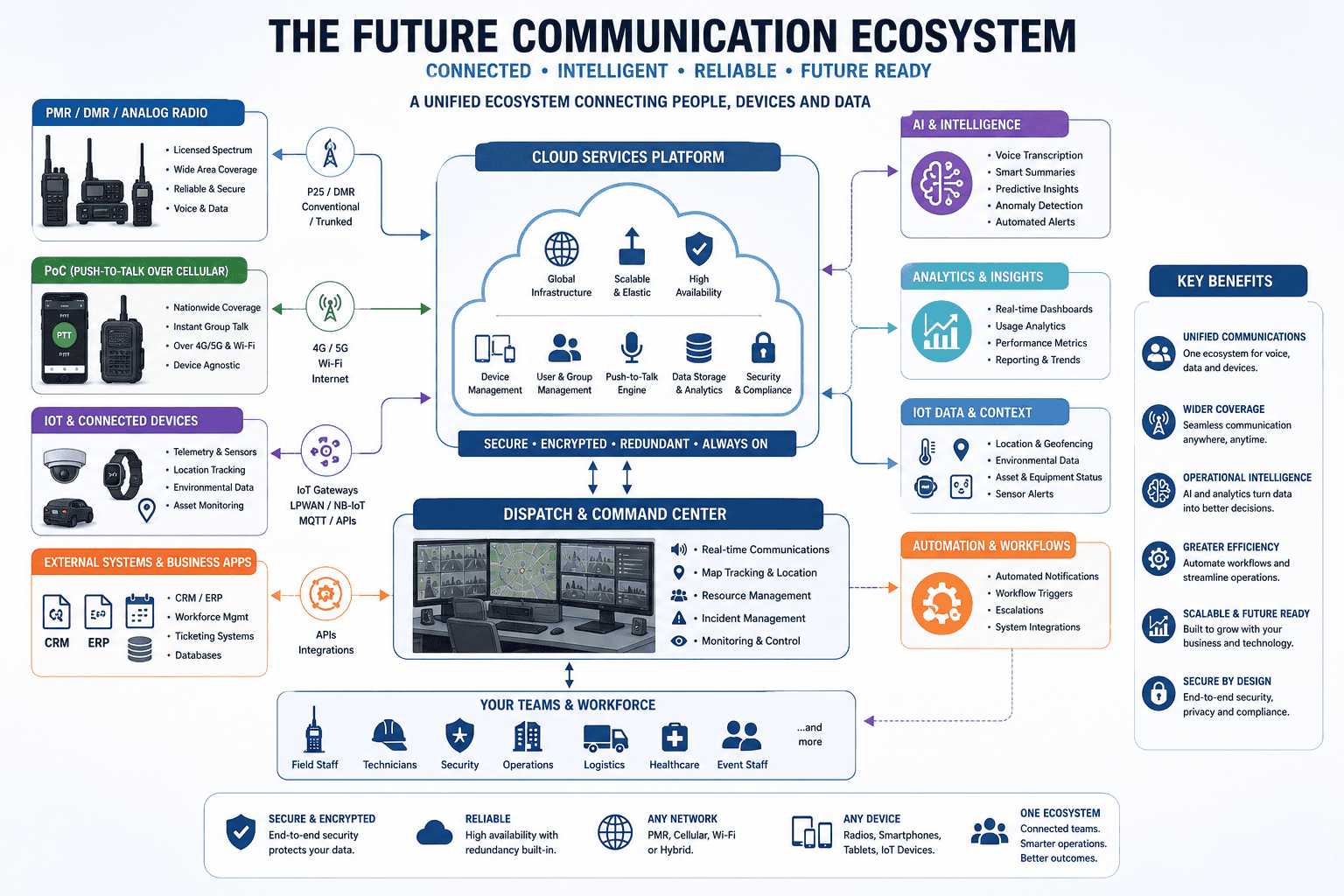
The future of professional communications is no longer built around a single device or network. Modern organisations are increasingly combining traditional two-way radio systems with cloud services, Push-to-Talk over Cellular (PoC)Push-to-Talk over Cellular (PoC) provides radio-style push-to-talk communication over cellular or IP networks, allowing users to communicate across wide areas where suitable network connectivity is available., artificial intelligence (AI), Internet of Things (IoT) devices and advanced dispatch software to create a single, connected communications ecosystem.
Rather than operating as separate technologies, these systems work together to provide secure voice communications, real-time location tracking, automated workflows, intelligent analytics and seamless collaboration between field workers, control rooms and business applications. This integrated approach enables organisations to respond faster, improve operational efficiency and make better-informed decisions across every aspect of their operation.
The diagram below illustrates how these technologies interact to create a future-ready communications platform, showing how data, voice, devices and people are connected through a central cloud infrastructureRadio infrastructure is the equipment and supporting systems behind a professional two-way radio network, including repeaters, antennas, base stations, network connections, power systems and dispatch equipment. to deliver smarter, more reliable business communications.
Cloud-Based Management
Cloud technologies are becoming increasingly important.
Future communication platforms are expected to provide:
- Centralised administration
- Remote programming
- Fleet managementFleet Management is the process of managing a two-way radio fleet, including equipment, users, programming, maintenance, firmware, security and radio system configuration.
- Automatic software updates
- Usage reporting
- Device diagnostics
Cloud managementCloud Management uses an online platform to remotely manage and monitor compatible two-way radios, users, devices and communication settings from a central location. reduces administrative overhead while making communication systems easier to maintain across multiple sites.
Artificial Intelligence
Artificial intelligence (AI) is beginning to influence professional communication in practical ways.
Potential future applications include:
Voice Transcription
Converting spoken communication into searchable text.
Intelligent Search
Finding historical conversations using keywords.
Incident Summaries
Automatically generating summaries of operational events.
Predictive Maintenance
Analysing equipment performance to identify potential faults before failures occur.
Decision Support
Helping dispatch operators prioritise incidents and allocate resources more effectively.
Importantly, AI is expected to support human decision-making rather than replace experienced operators.
Automation
Communication platforms are increasingly capable of automating routine processes.
Examples include:
- Automatic emergency alerts
- Device health monitoring
- Scheduled welfare checks
- Automated reporting
- Workflow integration
Automation reduces manual administration and allows teams to focus on higher-value activities.
Greater Integration
Professional radio systems are becoming part of broader operational ecosystems.
Future integrations are likely to include:
- CCTV
- Access control
- Building management systems
- IoT sensors
- Fleet management
- Workforce scheduling
- Incident managementIncident Management is the process of coordinating people, communications and resources during an incident. Two-way radios can provide rapid communication between teams, control rooms and responders. platforms
- Enterprise software
Rather than operating independently, communication systems will increasingly exchange information with other technologies.
Internet of Things (IoT)
The Internet of Things refers to connected devices that collect and exchange information.
Examples relevant to professional radio include:
- Environmental sensors
- Lone WorkerA Lone Worker is someone who works without direct supervision or immediate assistance nearby. Compatible two-way radios can provide safety features such as timed check-ins, emergency alerts and GPS location. devices
- Smart building systems
- Vehicle telematics
- Machinery monitoring
Radio systems may increasingly receive alerts generated automatically by these connected devices.
For example:
- Temperature alarms
- Equipment failures
- Security breaches
- Gas detection
- Flood monitoring
This enables organisations to respond more quickly to operational issues.
Private LTE and 5G Networks
Some larger organisations are exploring private broadband networks.
These technologies may offer:
- Dedicated wireless connectivity
- Improved capacity
- Enhanced security
- Greater operational control
Rather than replacing PMR, private LTE and 5G are expected to complement existing communication systems, particularly in large industrial environments.
Satellite Connectivity
Satellite communication is becoming more accessible.
Future developments may improve communication in:
- Remote construction projects
- Mining operations
- Offshore facilities
- Rural infrastructure
- Disaster response
As satellite technology evolves, organisations operating in isolated locations may benefit from greater communication resilience.
Wearable Technology
Communication devices continue to become smaller and more integrated.
Future developments may include:
- Smart helmets
- Body-worn communication devices
- Smartwatches
- Voice-controlled equipment
- Integrated safety sensors
These technologies may improve convenience while reducing the need to carry separate devices.
Video Communication
Although voice communication remains the priority for many operational environments, some situations may benefit from integrated video.
Potential applications include:
- Remote technical support
- Equipment inspections
- Incident assessment
- Infrastructure maintenance
Video is unlikely to replace Push-to-Talk voice but may become a valuable supplementary tool.
Did You Know?
The future of two-way radio is expected to combine digital PMR, Push-to-Talk over Cellular (PoC), AI, cloud technology and IoT into one intelligent communication platform, delivering smarter, faster and more connected operations for businesses.
Cybersecurity
As communication systems become increasingly connected, cybersecurity will remain an important priority.
Future systems are expected to place greater emphasis on:
- EncryptionEncryption protects two-way radio communications by converting voice or data into a secure form that can only be understood by authorised radios with the correct encryption capability and keys.
- Secure authentication
- Software updates
- Network monitoring
- Device management
Protecting communication infrastructure will become increasingly important as systems integrate with wider business networks.
Sustainability
Environmental considerations are influencing technology across every industry.
Future communication systems are likely to focus on:
- Longer battery life
- Lower powerAn antenna transmits and receives radio-frequency signals, allowing a two-way radio to communicate. Antenna type, frequency, height and location can all affect radio performance and coverage. consumption
- Repairability
- Recyclable materials
- Extended product lifecycles
These developments help organisations meet both operational and environmental objectives.
What Won't Change
While technology continues to evolve, several principles are likely to remain constant.
Organisations will always value communication systems that are:
- Reliable
- Simple to operate
- Robust
- Secure
- Fast
- Scalable
No matter how advanced communication technology becomes, operational simplicity will remain one of its greatest strengths.
Planning for the Future
When investing in communication systems today, organisations should consider:
- Future expansion
- Software compatibility
- Integration capability
- Upgrade pathways
- Vendor support
- Open standards
Choosing scalable platforms helps protect investment as technology continues to develop.
Looking Ahead
The future of professional communication is likely to be characterised by greater integration rather than wholesale replacement.
PMR, PoC, broadband networks, cloud platforms and artificial intelligence are expected to work together to create communication environments that are:
- More intelligent
- More connected
- More resilient
- Easier to manage
- Better integrated with business operations
The organisations that benefit most will be those that adopt new technologies thoughtfully while continuing to prioritise operational reliability.
Expert Insight
The dispatch operators of the future are expected to do much more than coordinate voice calls. By combining two-way radios with AI, cloud platforms, GPS tracking and live data, dispatchers will have greater situational awareness, enabling faster decisions, smarter resource allocation and improved incident response.
Key Takeaways
- Instant Push-to-Talk communication will remain central to professional operations.
- Hybrid communication systems are expected to become increasingly common.
- Artificial intelligence will enhance dispatch, reporting and system management.
- Cloud-based administration will simplify fleet management and maintenance.
- Greater integration with business systems will improve operational efficiency.
- Cybersecurity and sustainability will become increasingly important considerations.
- Organisations should prioritise scalable communication platforms that can adapt to future technological developments.
Expert Insight
- The future of professional radio is evolutionary rather than revolutionary.
- Organisations are unlikely to abandon proven communication technologies overnight. Instead, they will gradually combine traditional radio systems with broadband services, cloud platforms, automation and artificial intelligence. The most successful communication strategies will continue to focus on operational reliability while embracing innovations that genuinely improve efficiency and safety.
Business Example
A nationwide utility provider initially operates a traditional DMR radio network for field engineers. As its workforce expands, it introduces PoC devices for regional managers, cloud-based dispatch software for its operations centre and remote programming to simplify fleet management.
Later, GPS tracking is integrated with workforce scheduling software, allowing engineers to be dispatched automatically to the nearest available job. Environmental sensors at remote substations generate automatic alerts that appear directly within the dispatch platform.
Rather than replacing its existing radio network, the organisation enhances it incrementally. Each technological improvement builds upon the previous investment, creating a communication ecosystem that is more connected, efficient and resilient without disrupting day-to-day operations.
Business Perspective
The future of professional radio communication lies in intelligent integration rather than technological replacement. Businesses that invest in scalable platforms, open standards and flexible communication strategies will be well positioned to benefit from emerging innovations while preserving the reliability that professional radio systems have delivered for decades. As organisations become increasingly connected, communication will continue to serve as the foundation that links people, technology and operational processes together.
Frequently Asked Questions
Will smartphones replace professional two-way radios?
For many operational environments, no. Smartphones and PoC applications complement professional radios but do not replace the instant group communication, ruggedness and operational simplicity that dedicated radio systems provide.
Will artificial intelligence replace dispatch operators?
AI is expected to assist operators by automating routine tasks, summarising incidents and improving decision support. Human judgement will remain essential for managing complex operational situations.
What is the biggest trend in professional radio communications?
One of the most significant trends is the growth of hybrid communication systems that integrate PMR, PoC, cloud services and business applications into a single communication environment.
Should organisations invest in future-ready communication systems?
Yes. Choosing scalable platforms that support software updates, integration and future expansion helps protect long-term investment and reduces the need for major infrastructure replacement.
Will traditional radio infrastructure still be important?
Yes. Dedicated radio infrastructure is expected to remain a key component of many business-critical communication systems, particularly where resilience, coverage and operational independence are priorities.