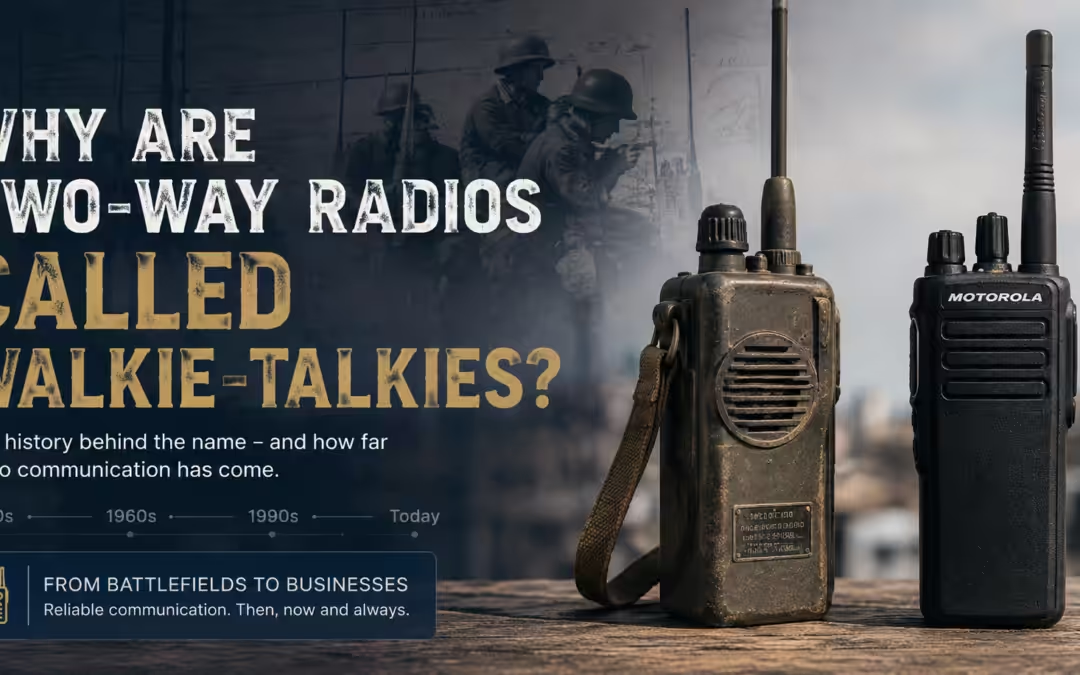
Why Are Two-Way Radios Called Walkie-Talkies?
If you have ever searched for walkie talkieA walkie talkie is a handheld two-way radio that allows users to communicate using radio signals. Professional walkie talkies can provide multiple channels, digital communication, emergency features and repeater-based coverage. hire, chances are you have also wondered where the rather unusual name came from.
Today, walkie-talkie is the term most people use for a handheld two-way radio. Businesses, event organisers, security teams and construction companies, however, will generally refer to them as two-way radios or professional radio systems.
But why do we call them walkie-talkies in the first place?
The answer goes back to the development of portable radioA Portable Radio is a battery-powered two-way radio designed to be carried and operated by an individual, providing mobile communication for professional and operational users. communications during the Second World War – and the name has survived even as the technology has changed almost beyond recognition.
What Does “Walkie-Talkie” Actually Mean?
The name is surprisingly straightforward.
A walkie-talkie is essentially a radio that allows someone to walk around while talking to another person using a compatible radio.
Unlike a conventional radio receiverA Receiver is the part of a two-way radio that detects and processes incoming radio signals, converting them into audible voice or usable data for the user., which only allows you to listen, a two-way radio allows communication in both directions. Press the push-to-talk button and you can speak to another radio or a group of radios operating on the same system.
The “walkie” part refers to portability, while “talkie” refers to the ability to communicate.
The terminology was informal rather than a precise technical description, but it proved memorable – and it stuck.
The Wartime Origins of the Walkie-Talkie
Portable two-way radio technology became particularly important during the Second World War.
Military forces needed a way for soldiers to communicate while moving around the battlefield. Conventional radio equipment could be large, heavy and dependent on vehicles or fixed positions, making genuinely portable communications difficult.
Early equipment included backpack-mounted radio sets that could be carried by soldiers. The technology subsequently developed into smaller handheld units that could be operated while moving.
The handheld SCR-536, introduced for the US military during the Second World War, is one of the radios most closely associated with the early development of what we now recognise as the walkie-talkie.
These early radios were a long way from the compact digital radios used by businesses today. They were relatively basic, had limited range and were designed primarily around military requirements.
Nevertheless, the fundamental idea was already there:
Pick up the radio, press the button and talk.
From Military Equipment to Business Communications
After the war, two-way radio technology continued to develop and became increasingly useful outside the military.
Portable radios found their way into industries where teams needed to communicate quickly without relying on telephone calls.
Construction sites were an obvious application. So were:
- Factories
- Warehouses
- Transport operations
- Hotels
- Security teams
- Major events
The basic principle remained remarkably simple.
Instead of stopping work to make a telephone call, someone could simply press a button and speak to colleagues immediately.
That simplicity is one of the reasons professional two-way radios remain so widely used today.
Are Walkie-Talkies and Two-Way Radios the Same Thing?
In everyday conversation, yes.
Technically, however, “two-way radio” is the broader and more accurate term.
A walkie-talkie normally refers to a handheld portable radio. A professional two-way radio systemA Radio System is a complete communication solution comprising two-way radios and, where required, equipment such as repeaters, antennas, base stations, mobile radios and network infrastructure. can include:
- Handheld radios
- Vehicle-mounted mobile radios
- Base stations
- Repeaters
- AntennaAn antenna transmits and receives radio-frequency signals, allowing a two-way radio to communicate. Antenna type, frequency, height and location can all affect radio performance and coverage. systems
- Other communications infrastructureRadio infrastructure is the equipment and supporting systems behind a professional two-way radio network, including repeaters, antennas, base stations, network connections, power systems and dispatch equipment.
For example, a large organisation might use handheld radios for employees working on site, mobile radios in vehicles and a repeaterA Repeater receives a two-way radio transmission and retransmits it, usually from an elevated location, to extend the coverage and reliability of a radio communication system. to extend coverageRadio Coverage is the geographical area in which a two-way radio system can provide reliable communication. Coverage depends on the radios, antennas, frequency, terrain, buildings and system infrastructure. across a large area.
So while someone might ask for a “walkie-talkie”, a radio communications specialist is more likely to talk about designing or supplying a two-way radio system.
How Have Walkie-Talkies Changed?
Quite dramatically.
The earliest portable radios were relatively large, had limited functionality and were generally based around analogue radioAnalogue radio uses continuously varying radio signals to transmit voice communication. It remains widely used for reliable two-way communication across business, industry, events, security and other applications. technology.
Modern professional radios can offer features such as:
- Digital communications
- Improved audio quality
- Group calling
- Individual calling
- GPS location
- Emergency buttons
- Lone-worker functions
- Text messaging
- EncryptionEncryption protects two-way radio communications by converting voice or data into a secure form that can only be understood by authorised radios with the correct encryption capability and keys. and security features
- Remote programming
- Extended coverage using repeaters and networkA Network is a connected system of radios, equipment and infrastructure that allows users to communicate across a defined area. Radio networks can range from simple radio-to-radio systems to large multi-site networks. infrastructure
Digital technologies such as DMR have also transformed what can be achieved with professional radio systems.
This means that today's “walkie-talkie” can be an extremely sophisticated communications device compared with the equipment that gave the term its name.
Walkie-Talkie Hire: Why Businesses Still Rent Radios
Despite all of this technological development, businesses don't always need to purchase their own radio fleet.
For a construction project, festival, sporting event, television production, security operation or temporary logistics requirement, radios may only be needed for a limited period.
That's where walkie talkie hire or professional two-way radio hire can make sense.
Hiring allows organisations to put a communications system in place for a specific project or period without necessarily having to purchase, maintain and store a permanent fleet of radios.
Depending on the requirement, a hire system can include:
- Handheld radios
- Accessories
- Chargers
- Earpieces
- Batteries
- Repeaters or other infrastructure where necessary
For larger or more complex operations, the radios can also form part of a properly designed communications system rather than simply being a collection of individual handsets.
What Happens When You Need More Than Local Radio Coverage?
Traditional two-way radio systems can provide excellent coverage, but their range depends on factors including the radio frequencyAn antenna transmits and receives radio-frequency signals, allowing a two-way radio to communicate. Antenna type, frequency, height and location can all affect radio performance and coverage., terrain, buildingsAn antenna transmits and receives radio-frequency signals, allowing a two-way radio to communicate. Antenna type, frequency, height and location can all affect radio performance and coverage., antenna systems and whether repeaters or other infrastructure are being used.
That can become more challenging when a team needs to communicate across multiple sites or over much greater distances.
This is one area where Push-to-Talk over Cellular (PoC)Push-to-Talk over Cellular (PoC) provides radio-style push-to-talk communication over cellular or IP networks, allowing users to communicate across wide areas where suitable network connectivity is available. technology is changing the conversation.
Could PoC Be the Future of the Walkie-Talkie?
Perhaps the biggest question is whether the word “walkie-talkie” will eventually describe something very different from the radio that originally inspired the name.
PoC radios use cellular networks and data connectivity to provide push-to-talk communications.
The user experience can still feel very familiar:
- Pick up a handheld device.
- Select the required group.
- Press the button to speak.
The difference is what happens behind the scenes.
Rather than relying solely on a conventional local radio network, PoC technology can use cellular connectivity to communicate across much larger geographical areas.
For organisations with teams working across different locations, travelling employees or operations spread across the country, this can provide an interesting alternative to conventional radio systems.
Will We Still Call Them Walkie-Talkies?
Probably.
Technology has a habit of changing much faster than language.
People still refer to mobile phones as “phones”, even though they are now cameras, computers, navigation devices, payment systems and much more besides.
The same thing could happen with walkie-talkies.
A future handheld communications device might use cellular networks, GPS, cloud-based management and advanced software, but if someone can pick it up, press a button and immediately speak to their team, there is a good chance someone will still call it a walkie-talkie.
The name may survive even if the technology underneath it is almost unrecognisable.
From the Battlefield to Nationwide Communications
The journey from early military portable radios to modern professional communications is quite remarkable.
What started as a way for soldiers to communicate while moving around has evolved into sophisticated systems used across:
- Construction
- Events
- Hospitality
- Security
- Transport
- Logistics
- Agriculture
- Many other industries
And the next stage of that evolution may already be here.
For some organisations, traditional professional two-way radios remain the right solution. For others, particularly those requiring communications across multiple locations, nationwide PoC radio can offer a different way of connecting teams.
So the next time someone asks for a walkie-talkie, the answer might be considerably more complicated than it sounds.
It could be:
- An analogue handheld radio
- A digital DMR system
- A radio operating through a repeater
- A PoC device communicating with colleagues hundreds of miles away
The name may be old.
The technology certainly isn't.
Need Two-Way Radios for Your Business or Event?
Whether you need radios for a few days, a major event, a construction project or an ongoing business requirement, the right communications system depends on how and where your teams need to communicate.
DCS 2 Way Radio provides two-way radio hireRadio Hire is the temporary rental of two-way radios and related communication equipment for events, projects and operational requirements, providing professional communication without purchasing the equipment. and professional radio communication solutions, including solutions for temporary events, business operations and wider-area communications.
If you are looking for walkie talkie hire, two-way radio hire or nationwide PoC radio, the team can help identify the most suitable option for your requirements.