The Future of Two Way Radio: DMR, PoC, 4G, 5G, TETRA and AI
The world of two way radio is changing.
For decades, professional radio communication has been built around a relatively simple principle: give people a reliable way to communicate instantly, even when mobile phones are unsuitable or unavailable.
That principle hasn't changed. What has changed is what sits around the radio.
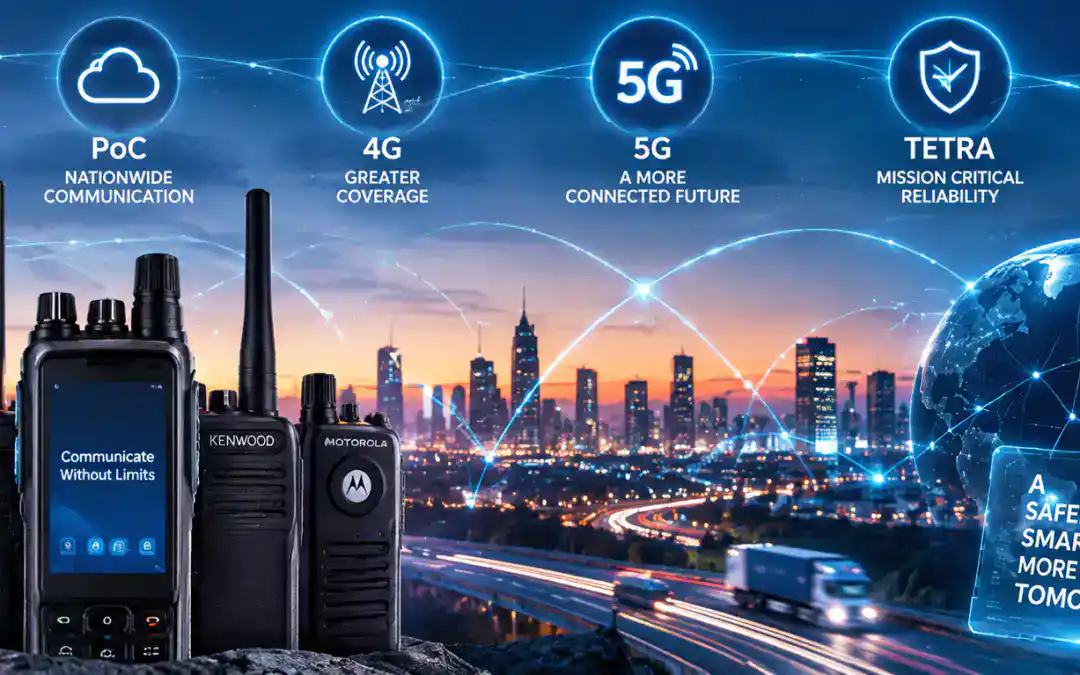
Modern professional communication systems increasingly combine DMR, TETRA, 4G, 5G, Push-to-Talk over Cellular (PoC), GPS, messaging, video, dispatch software and artificial intelligence.
Rather than replacing traditional two way radio, these technologies are increasingly working alongside it to create more capable and connected communication systems.
For businesses that rely on reliable communication — from construction and logistics to manufacturing, transport, events and infrastructureRadio infrastructure is the equipment and supporting systems behind a professional two-way radio network, including repeaters, antennas, base stations, network connections, power systems and dispatch equipment. — this represents a significant shift in what a two way radio systemA Radio System is a complete communication solution comprising two-way radios and, where required, equipment such as repeaters, antennas, base stations, mobile radios and network infrastructure. can do.
DMR remains at the heart of professional radio
Despite the growth of cellular communications and Push-to-Talk services, Digital Mobile Radio (DMR) remains an important technology for professional users.
DMR provides the characteristics businesses have traditionally valued from two way radio: instant communication, robust equipment, group calling and the ability to operate independently of the public mobile phone networkA Network is a connected system of radios, equipment and infrastructure that allows users to communicate across a defined area. Radio networks can range from simple radio-to-radio systems to large multi-site networks..
For many organisations, that makes DMR an excellent choice for day-to-day operational communications.
It can also provide features such as individual calling, group calling, emergency alerts, GPS and messaging, depending on the equipment and system being used.
The important point is that the future of professional radio isn't necessarily about choosing between traditional radio and newer technologies.
Increasingly, it's about using the right combination of technologies for the job.
Push-to-Talk over Cellular (PoC) is becoming increasingly important
Push-to-Talk over Cellular (PoC)Push-to-Talk over Cellular (PoC) provides radio-style push-to-talk communication over cellular or IP networks, allowing users to communicate across wide areas where suitable network connectivity is available. is a type of two way communication that uses mobile networks such as 4G and 5G instead of a traditional dedicated radio network.
The basic idea is similar to using a conventional two way radio: press a button, speak, and your message is transmitted instantly to other members of your group. The difference is that the communication travels over a cellular or broadbandBroadband is a high-speed data connection used by systems such as PoC radio to carry voice, video and other communications over mobile networks, Wi-Fi or IP networks. network rather than directly through a traditional radio system.
This can provide a much wider communication range. A conventional radio system may be designed to cover a particular building, site or geographical area, whereas a PoC device can potentially communicate with users across the UK — or internationally — wherever a suitable mobile or Wi-FiWi-Fi is a wireless networking technology that connects compatible devices to a local or wider network. In radio systems, it can support programming, updates, data services and IP-based communications. connection is available.
PoC systems can also provide features that go beyond traditional voice communication, including:
- GPS location tracking
- Text and multimedia messaging
- Group and individual calling
- Remote management
- Data connectivity
- Smartphone and computer integration
- Dispatch and control-room functionality
This makes PoC particularly interesting for organisations with employees working across multiple sites or travelling between locations.
However, PoC isn't simply a replacement for conventional two way radio. Because it relies on a cellular or broadband connection, its performance depends on network availability. In situations where reliable local communication is essential, a dedicated DMR radio system can still offer important advantages.
Increasingly, businesses can combine the two technologies to create a hybrid communicationHybrid Communication combines two or more communication technologies, such as two-way radio, DMR, cellular, Wi-Fi or IP networks, allowing different systems or users to communicate through a common platform. system, using traditional radio for local communication and PoC to connect teams across larger geographical areas.
The future is likely to be hybrid
The growing popularity of PoC doesn't mean that conventional radio is disappearing.
In many situations, the most effective solution may be a hybrid communications system combining professional radio with cellular connectivity.
For example, a business could use DMR radios for local communication around a site while using 4G or 5G connectivity to link different locations or remote workers.
This can provide the benefits of both technologies.
Traditional radio can provide direct, dependable communication within an operational area, while cellular connectivity can extend communication beyond the local radio network.
Modern systems are increasingly designed around this idea of interoperabilityInteroperability is the ability of different communication systems, devices or organisations to work together and exchange information. In two-way radio, it can connect different radio networks, technologies or users through compatible systems or gateways. rather than forcing organisations to choose one technology.
TETRA continues to play an important role
TETRA (Terrestrial Trunked Radio) is a professional digital radio standard developed specifically for organisations that require highly reliable, secure and resilient communications.
Unlike a standard consumer walkie-talkie, TETRA systems are designed for large organisations and demanding operational environments. They support features such as secure group communication, individual calls, emergency functions, prioritised communications and efficient use of radio spectrumSpectrum is the range of radio frequencies used for wireless communication. Two-way radios operate within specific parts of the radio spectrum, subject to frequency allocation and licensing requirements..
TETRA is particularly well established in public safety, emergency services, transport, utilities, airports and other critical infrastructure.
One of its key strengths is the ability to provide reliable communications for large numbers of users operating across a defined geographical area. TETRA networks can also continue providing communications independently of the public mobile phone networks, which is an important consideration for organisations where communication needs to remain available during emergencies or network disruption.
TETRA is not simply being left behind as 4G and 5G develop. Instead, manufacturers are increasingly combining TETRA with broadband connectivity.
Modern devices can combine TETRA radio communication with 4G or 5G, allowing users to retain the resilience and specialist features of TETRA while also gaining access to broadband services such as data, messaging, multimedia and wider-area connectivity.
This means the future isn't necessarily about TETRA versus 4G and 5G.
It is increasingly about TETRA working alongside 4G and 5G.
That hybrid approach gives organisations more flexibility, allowing them to use the most appropriate communication technology for different situations while continuing to benefit from established professional radio infrastructure.
4G and 5G are changing what a radio can be
Another important development is the convergence of radio, broadband and multimedia.
Modern professional communication devices can increasingly provide more than voice communication.
Depending on the system, users may have access to:
- Push-to-talk
- GPS location
- Text messaging
- Images
- Video
- Data
- Lone-worker features
- Emergency alerts
- Remote device management
- Broadband connectivity
This means the definition of a "two way radio" is becoming broader.
A modern communications device may look like a radio, but operate as part of a much larger communications platform.
The radio is becoming less of a standalone device and more of a gateway into a wider business communication system.
Artificial intelligence is beginning to enter professional communications
Perhaps the most interesting development is the arrival of artificial intelligence.
AI isn't replacing the two way radio.
Instead, it is being used to make the information travelling through communication systems more useful.
One of the clearest examples is radio transcription.
AI can analyse and transcribe radio traffic, potentially allowing important information to be captured automatically rather than relying on someone to listen to every transmissionTransmission is the process of sending voice, data or signalling from a radio using a radio-frequency signal to another radio, repeater or communication system. and manually record what was said.
For a busy control room, this could make a significant difference.
Instead of a dispatcher having to listen to every radio transmission and manually record important information, AI can help identify, organise and retrieve relevant details.
AI-powered translation
Translation is another area where AI is beginning to make an impact.
Real-time AI translation could allow voice communications to be translated between different languages, helping teams communicate more effectively where workers or organisations speak different languages.
The wider commercial potential is obvious.
Imagine a construction project where workers speak several different languages.
Instead of relying entirely on a colleague or interpreter to communicate routine instructions, AI-assisted translation could eventually allow communication to pass directly between people using their existing communication devices.
The technology still needs to be used carefully, particularly where safety-critical instructions are involved, but the potential is considerable.
Voice-controlled radios
AI is also making radios more interactive.
Voice assistants can allow users to interact with radio and information systems using voice commands. Depending on the application, users could potentially perform tasks such as changing radio settings, checking information, accessing location information and carrying out database searches.
This is particularly useful where a user needs to keep their hands and eyes focused on the job.
For a worker operating machinery, working at height, responding to an incident or wearing protective gloves, voice interaction can be considerably more practical than navigating a screen.
AI could eventually turn the radio into an interface for the whole operation
This is where things could become particularly interesting.
Today's typical communication chain might look like:
Worker → Radio → Dispatcher → Computer system
As communications technology develops, that could increasingly become:
Worker → Radio → AI → Business system → Answer
A worker could potentially ask a system for information using their radio and receive a response without a dispatcher having to manually perform the task.
For example:
"Where is vehicle 27?"
The system could check the relevant location platform and provide the vehicle's current location.
Or:
"Translate that message into Polish."
The communication system could translate the message and return it to the user.
These applications are still developing, but the technology is moving in this direction.
AI isn't just about the radio
One of the biggest changes taking place is that manufacturers are no longer treating the radio as a standalone device.
Instead, the radio is becoming one component of a wider communications ecosystem.
That ecosystem can include:
- Two way radios
- Smartphones
- Control rooms
- GPS
- Vehicle systems
- Body-worn cameras
- Video
- Dispatch software
- Cloud platforms
- 4G and 5G networks
- Artificial intelligence
The result is a move from radio communication towards connected operational communications.
What does this mean for businesses?
For businesses considering a new radio system, the biggest question may no longer simply be:
"Which two way radio should we buy?"
Instead, it may be:
"What communication system does our operation actually need?"
A construction company working on one site may need a straightforward DMR radio system.
A logistics company operating nationally may benefit from a combination of radio and broadband communications.
A large infrastructure organisation may require a more complex system incorporating multiple sites, GPS, control-room functionality and cellular connectivity.
An event company may need temporary radio hireRadio Hire is the temporary rental of two-way radios and related communication equipment for events, projects and operational requirements, providing professional communication without purchasing the equipment. for a specific period.
There isn't one technology that is right for every organisation.
The important thing is understanding how the technologies can work together.
Two way radio isn't disappearing — it's evolving
There has been plenty of discussion about whether mobile phones, PoC or 5G will eventually replace traditional two way radio.
The reality is more complicated.
Professional radio continues to provide advantages that ordinary smartphones don't necessarily offer, particularly for teams that need instant group communication, rugged equipment, operational simplicity and communications that aren't entirely dependent on the public mobile network.
At the same time, broadband networks offer capabilities that traditional radio systems cannot easily provide.
The future therefore looks less like:
Traditional radio → replaced by 5G
and more like:
DMR + TETRA + 4G + 5G + PoC + GPS + software + AI
Each technology can perform a different role.
What should businesses be looking at now?
The best communication system isn't necessarily the newest one.
Businesses should start by looking at how their teams actually work.
Consider:
- How large is the area that needs to be covered?
- Do workers operate across multiple sites?
- Is communication required inside buildingsAn antenna transmits and receives radio-frequency signals, allowing a two-way radio to communicate. Antenna type, frequency, height and location can all affect radio performance and coverage.?
- What happens if the mobile network goes down?
- Do workers need GPS location?
- Would messaging or data be useful?
- Are there lone-worker or emergency requirements?
- Would remote workers benefit from PoC?
- Does the business need a control room or dispatch function?
- Could different communication technologies need to work together in the future?
These questions can help determine whether a conventional DMR system, TETRA, PoC, a hybrid solution or another technology is appropriate.
The future of two way radio is connected
The biggest change taking place in professional communications isn't that the radio is disappearing.
It's that the radio is becoming one part of something much bigger.
DMR continues to provide reliable professional voice communication.
TETRA remains important for mission-critical users.
4G and 5G are extending the reach and capabilities of push-to-talk communications.
PoC is providing new options for geographically distributed teams.
And AI is beginning to transform how communication is processed, translated, searched and acted upon.
The next generation of professional radio systems will therefore be less about a single handset and more about the entire communications ecosystem around it.
For businesses, that means there are more options than ever — but also more choices to make.
The right system isn't necessarily the one with the most features.
It's the one that provides the right communication, coverageRadio Coverage is the geographical area in which a two-way radio system can provide reliable communication. Coverage depends on the radios, antennas, frequency, terrain, buildings and system infrastructure., reliability and functionality for the way your business actually operates.
DCS 2 Way Radio: Keeping Up With the Future of Communications
The world of professional two way radio is changing quickly, and at DCS 2 Way Radio we believe our customers should have access to the latest technology and the best communication solutions available.
We continue to keep up with developments across the industry, from the latest DMR two way radios and digital radio systems to PoC, 4G and 5G communications, advanced coverage solutions and emerging technologies such as AI.
However, keeping up with new technology doesn't mean automatically choosing the newest product. Every business has different communication requirements, and the latest technology isn't necessarily the right solution for every situation.
That's why we focus on understanding how our customers actually work before recommending a communication system.
Whether you need two way radio hire for a short-term project, a reliable DMR system for your business, improved radio coverage, communication across multiple sites or a more advanced hybrid solution, we can help you find the right technology for your requirements.
As the industry continues to evolve, so will we. By staying up to date with the latest developments in professional radio and communications technology, we can continue to provide our customers with reliable, practical and future-ready communication solutions.
At DCS 2 Way Radio, our aim is simple: to provide our customers with the very best technology, service and support — today and as communications technology continues to evolve.