Martyn’s Law and Schools: What Does It Mean for Education Settings?
Schools have a responsibility to prepare for a range of emergencies, from fire and medical incidents through to serious security threats. The introduction of Martyn’s Law places additional emphasis on the importance of effective preparedness, planning and communication at qualifying premises.
For schools, this means reviewing how they would respond to a serious incident and ensuring that appropriate procedures are in place for communicating with staff and others on site.
Two-way radio communication can form part of a school's wider emergency communication strategy, providing staff with a fast and reliable way to communicate across large or complex sites.
What is Martyn’s Law?
Martyn’s Law is the common name for the **Terrorism (Protection of Premises) Act 2025**. The legislation is intended to improve preparedness for, and protection from, terrorist attacks at publicly accessible premises and events.
The legislation was introduced following recommendations arising from the Manchester Arena Inquiry and is named in memory of Martyn Hett, who was killed in the 2017 Manchester Arena attack.
The legislation establishes requirements for qualifying premises and events to consider how they would respond to terrorist-related incidents.
The government currently expects Martyn’s Law to come into force in spring 2027, with further guidance and implementation information being provided ahead of commencement.
Get a Quote for School Two-Way Radios
Reliable communication is essential during lockdowns, evacuations and other emergencies. Two-way radios give authorised school staff instant communication across classrooms, buildingsAn antenna transmits and receives radio-frequency signals, allowing a two-way radio to communicate. Antenna type, frequency, height and location can all affect radio performance and coverage. and wider school sites.
Talk to DCS 2 Way Radio today for a tailored quote and find the right two-way radio solution for your school.
Does Martyn’s Law apply to schools?
Yes. Education settings, including schools, are within the scope of Martyn’s Law where they meet the relevant criteria.
For schools, the number of people who can reasonably be expected to be present at the premises at the same time is an important consideration.
Schools with fewer than 200 people reasonably expected to be present at the same time will generally fall outside the statutory requirements. Schools meeting the relevant threshold will be subject to the standard tier requirements.
Importantly, schools have specific arrangements under the legislation. Large schools do not automatically move into the enhanced tier simply because they have a very large number of pupils and staff.
Schools should therefore consider the government guidance alongside their own circumstances and existing emergency planning arrangements.
Get a No-Obligation Quote from
DCS 2 Way Radio
What will schools need to do?
For schools within the standard tier, Martyn’s Law focuses on having appropriate procedures for reducing the risk of harm and responding effectively to a terrorist-related incident.
For schools within the standard tier, Martyn’s Law focuses on having appropriate procedures for reducing the risk of harm and responding effectively to a terrorist-related incident.
The relevant procedures include:
Evacuation
Schools should have appropriate arrangements for safely moving pupils, staff and visitors away from danger.
This needs to take account of the layout of the site, alternative routes and the needs of people who may require additional assistance.
Invacuation
Invacuation involves moving people to a safer location within the premises rather than evacuating the site.
For a school, this could involve moving pupils and staff away from an external threat and into designated secure areas.
Lockdown
Lockdown procedures are designed to help protect people inside the premises during an incident where remaining inside and securing the building is safer than evacuating.
Schools may already have lockdown procedures as part of their existing emergency planning.
Communication
Effective communication is an important part of all these procedures.
Staff need to know when an emergency procedure has been activated, what action they should take and, where appropriate, how information should be passed between those responsible for managing the incident.
This can become particularly challenging on large school sites or campuses containing multiple buildings, sports facilities, playgrounds, halls and other areas.
Does Martyn’s Law require schools to buy two-way radios?
No.
Martyn’s Law does not specifically require schools to purchase two-way radios or any particular type of communication equipment.
The legislation is concerned with appropriate preparedness and procedures rather than mandating a particular technology.
However, schools may choose to use two-way radios as part of their wider communication arrangements where they provide a practical solution for the site and the school's operational requirements.
How can two-way radios support school emergency communication?
Two-way radios can provide direct communication between authorised members of staff without relying on individual mobile phone calls.
This can be particularly useful where staff need to communicate quickly with several colleagues at the same time.
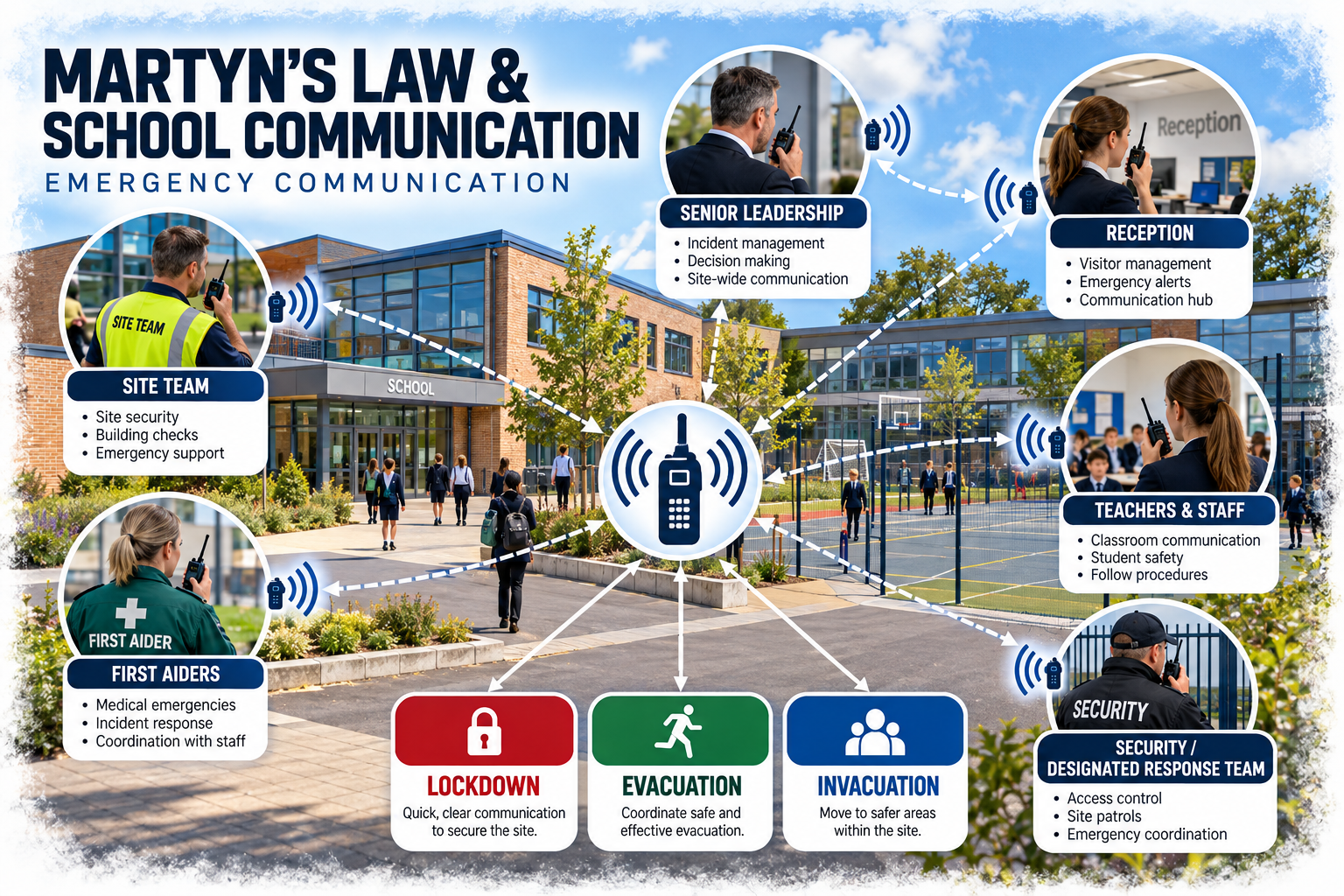
For example, during an incident, a designated member of the school's response team could communicate with reception, site management and other authorised staff simultaneously.
Potential applications include:
- Emergency communication
- Lockdown procedures
- Evacuation coordination
- Invacuation procedures
- Site security
- Communication between separate school buildings
- Communication across sports grounds and playing fields
- First-aid and medical incidents
- Missing pupil procedures
- School events and sports days
- Open days and large visitor events
- General site management
Why are radios useful on large school sites?
Schools can be surprisingly large operational environments.
A secondary school may include multiple teaching blocks, sports facilities, playing fields, reception areas, kitchens, workshops, car parks and external areas.
Staff responsible for managing an incident may therefore be spread across a considerable area.
Two-way radios provide an immediate means of communication between authorised users and can allow a designated group of staff to receive the same information simultaneously.
Unlike a series of individual telephone calls, radio communication can allow an operational team to communicate quickly while keeping everyone involved aware of important instructions.
At different points in that journey, different workers may become responsible for the movement.
Communication needs to follow the operation.
A well-designed radio systemA Radio System is a complete communication solution comprising two-way radios and, where required, equipment such as repeaters, antennas, base stations, mobile radios and network infrastructure. can provide separate talkgroups for different operational functions while allowing authorised users to communicate across groups when required.
This can be particularly valuable in larger ports where hundreds of workers may be operating simultaneously.
Radio communication for lockdown procedures
Many schools already have lockdown procedures as part of their wider safeguarding and emergency planning arrangements.
Communication is a critical part of any lockdown procedure.
Staff may need to be informed that a lockdown has been initiated and given instructions about what they should do.
On larger sites, relying entirely on staff members receiving and responding to individual mobile phone calls may not be practical.
A dedicated two-way radio system can provide another communication channelA two-way radio channel is a programmed set of communication settings, typically including frequency and signalling, that allows compatible radios to communicate with one another. for authorised staff responsible for managing the incident.
For example, a school's designated response team could use radios to communicate between:
- Senior leadership
- Reception
- Site management
- Security staff
- First aiders
- Designated emergency response personnel
The exact arrangements will depend on the school's existing emergency plan and risk assessment.
Get a No-Obligation Quote from
DCS 2 Way Radio
Radio communication during evacuation and invacuation
Communication is equally important when a school needs to move people around the site.
During an evacuation, staff may need to communicate information about routes, assembly areas or changes to the situation.
During an invacuation, the priority may instead be keeping people inside secure areas and communicating updates between members of the response team.
A reliable communication system can help those responsible for managing the incident maintain contact while carrying out these procedures.
Keep Staff Connected. Keep Your School Safe.
Reliable two-way radio communication helps schools keep staff connected and support the safety of pupils during everyday operations and emergencies. Talk to DCS 2 Way Radio today for a tailored, no-obligation quote for your school’s communication requirements.
Two-way radio hire for schools
Schools do not necessarily need to purchase a permanent radio fleet for every requirement.
There may be occasions when temporary radio communication is useful, including:
- Sports days
- School fairs
- Open days
- Large assemblies or events
- Temporary security arrangements
- Examination periods
- Building or refurbishment projects
- Contractor coordination
- School events involving multiple locations
For these situations, **two-way radio hireRadio Hire is the temporary rental of two-way radios and related communication equipment for events, projects and operational requirements, providing professional communication without purchasing the equipment.** can provide a temporary communication solution without requiring the school to purchase and maintain a permanent fleet.
The number and type of radios required will depend on the size of the site, the number of staff involved and the nature of the activity.
Choosing radios for a school
There is no single radio system that will be suitable for every school.
The right solution depends on factors such as:
- Site size
- Number of buildings
- Indoor and outdoor coverageRadio Coverage is the geographical area in which a two-way radio system can provide reliable communication. Coverage depends on the radios, antennas, frequency, terrain, buildings and system infrastructure. requirements
- Number of users
- Required range
- Existing communication systems
- Whether the radios are used primarily indoors or outdoors
- Whether the school requires enhanced features
- Whether radios are needed permanently or temporarily
For larger or more complex sites, radio coverage should be considered carefully rather than assuming that a particular radio will work throughout the entire premises.
A professional radio supplier can assess the site and recommend an appropriate communication solution.
Martyn’s Law and existing school emergency plans
Martyn’s Law should not be viewed in isolation.
Schools already have a range of policies and procedures covering areas such as fire safety, safeguarding, first aid, emergency evacuation and lockdown.
The introduction of Martyn’s Law provides an opportunity for schools to review how these arrangements work together and, importantly, how staff communicate during a serious incident.
Any radio system should therefore form part of the school's wider emergency planning rather than being treated as a replacement for established procedures.
Communication is only one part of emergency preparedness
It is important to remember that two-way radios are a communication tool, not a complete emergency response system.
Schools should consider their overall arrangements, including:
- Risk assessment
- Emergency procedures
- Staff responsibilities
- Training
- Evacuation arrangements
- Invacuation arrangements
- Lockdown procedures
- Communication methods
- Liaison with emergency services
- Regular testing and review
The appropriate arrangements will vary between schools and should reflect the individual characteristics and risks of each site.
How DCS 2 Way Radio can help
DCS 2 Way Radio provides professional two-way radio solutions for organisations that need reliable communication across their sites.
For schools and education settings, this can include both permanent radio systems and two-way radio hire for temporary requirements.
The appropriate solution depends on the school's site, operational requirements and existing emergency communication arrangements.
Our team can discuss the requirements with the school and help identify a suitable radio communication solution.
Looking at two-way radio communication for your school?
Whether you are reviewing communication arrangements for a large school site, planning an upcoming event or considering a permanent radio system, DCS 2 Way Radio can help you assess your requirements.