Understanding Ofcom Radio Licences for Business Communications
If your organisation is considering a two-way radio systemA Radio System is a complete communication solution comprising two-way radios and, where required, equipment such as repeaters, antennas, base stations, mobile radios and network infrastructure. for the first time, one of the first questions you'll encounter is whether you need a licence and, if so, which type is most suitable.
The good news is that radio licensing is usually much simpler than many businesses expect. However, selecting the correct licence can have a significant impact on the performance, reliability and coverageRadio Coverage is the geographical area in which a two-way radio system can provide reliable communication. Coverage depends on the radios, antennas, frequency, terrain, buildings and system infrastructure. of your communication system.
This guide provides an overview of the main business radio licenceA Business Radio Licence is an Ofcom authorisation allowing professional two-way radios to use specified frequencies and operating conditions for business communications in the UK. types available in the UK and explains when each may be appropriate.
Can Businesses Use Licence-Free Radios?
Licence-free radios, often referred to as walkie talkies, operate on the PMR446 frequencyAn antenna transmits and receives radio-frequency signals, allowing a two-way radio to communicate. Antenna type, frequency, height and location can all affect radio performance and coverage. band.
While these radios can be useful for recreational users and very small-scale operations, they are often unsuitable for business environments because they have several limitations:
- Limited transmissionTransmission is the process of sending voice, data or signalling from a radio using a radio-frequency signal to another radio, repeater or communication system. powerAn antenna transmits and receives radio-frequency signals, allowing a two-way radio to communicate. Antenna type, frequency, height and location can all affect radio performance and coverage.
- Reduced communication range
- Shared public frequencies
- Greater risk of interferenceRadio interference occurs when unwanted radio-frequency signals or electrical noise disrupt two-way radio communications, causing distorted audio, broken transmissions, reduced coverage or loss of communication. from other users
- Fewer advanced features
- Less flexibility for expanding systems
For many businesses, especially those operating larger sites or requiring dependable communications, a licensed radioA Licensed Radio is a two-way radio operated under an appropriate radio licence. Licensed systems can provide greater control over frequencies, coverage and infrastructure than licence-free radio services such as PMR446. system provides significantly better performance and reliability.
Why Choose a Licensed Radio System?
A licensed radio system offers several advantages:
- Greater coverage and range
- Improved signal reliability
- Access to dedicated frequencies
- Reduced interference from other users
- Support for advanced radio infrastructureRadio infrastructure is the equipment and supporting systems behind a professional two-way radio network, including repeaters, antennas, base stations, network connections, power systems and dispatch equipment.
- Better suitability for commercial operations
The right licence depends on how and where your radios will be used.
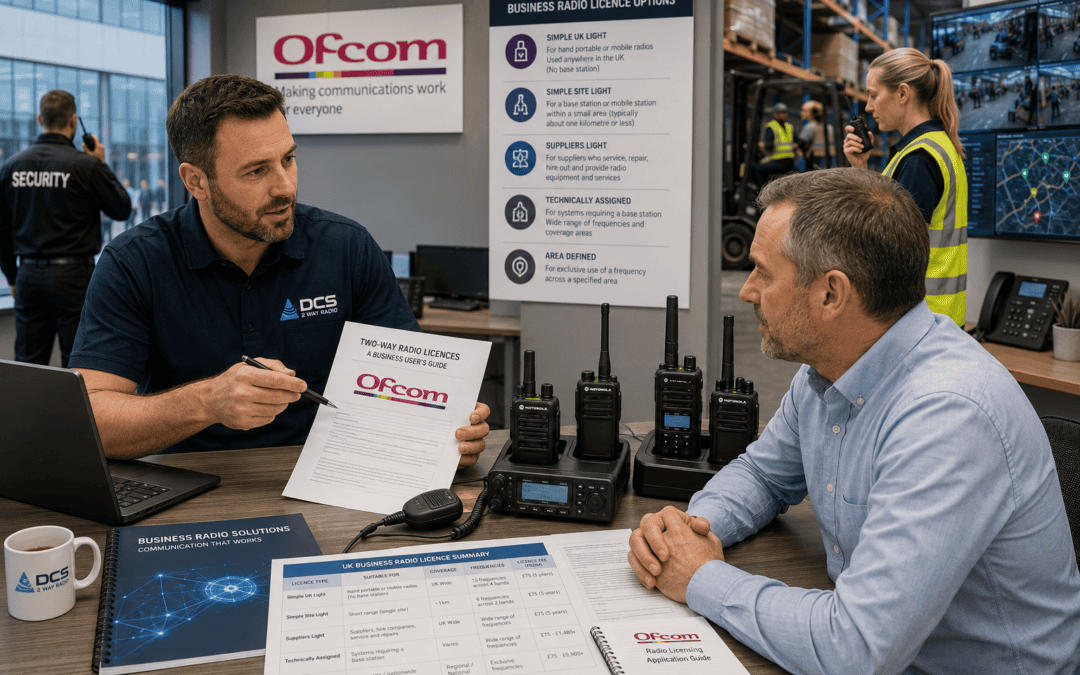
Simple UK Light Licence
A Simple UK Light licence is one of the most popular options for businesses operating mobile or handheld radios across multiple locations.
This licence is suitable when:
- You use handheld radios
- You use vehicle-mounted radios
- You do not operate a base stationA base station is a fixed two-way radio installed at a permanent location, allowing an operator to communicate with handheld or mobile radios across a site or operating area.
- Users travel throughout the UK
The licence provides access to multiple business radioBusiness Radio refers to professional two-way radio systems used by businesses and organisations for instant communication, often using licensed frequencies and equipment designed for commercial use. frequencies and allows operation nationwide.
This option is often ideal for:
- Security companies
- Facilities management providers
- Event organisers
- Mobile maintenance teams
- Transport operators
Simple Site Light Licence
Businesses operating within a single site or localised area may find a Simple Site Light licence more appropriate.
This licence is generally used where:
- A base station is required
- Communications are confined to a specific location
- Coverage requirements are relatively small
Typical users include:
- Warehouses
- Factories
- Hotels
- Schools
- Construction sites
- Business parks
The licence covers communications within a defined operating area and can provide excellent site-wide coverage.
Suppliers Light Licence
This licence is designed specifically for radio suppliers and service providers.
It enables authorised companies to:
- Service radio equipment
- Carry out repairs
- Programme radios
- Demonstrate equipment
- Provide radio hireRadio Hire is the temporary rental of two-way radios and related communication equipment for events, projects and operational requirements, providing professional communication without purchasing the equipment. services
As a professional radio communications provider, DCS 2 Way Radio operates under the appropriate licensing arrangements required to support customers across a wide range of industries.
Technically Assigned Licences
For organisations requiring more specialised radio systems, a Technically Assigned licence offers greater flexibility and control.
These licences are often used when businesses require:
- Larger coverage areas
- Dedicated frequencies
- Enhanced networkA Network is a connected system of radios, equipment and infrastructure that allows users to communicate across a defined area. Radio networks can range from simple radio-to-radio systems to large multi-site networks. performance
- Radio repeaters
- Complex communications infrastructure
Coverage can range from a single building to an entire county depending on operational requirements.
Technically Assigned licences are commonly used by:
- Airports
- Transport operators
- Large industrial sites
- Utility companies
- Local authorities
- Large security operations
Because these licences are individually engineered by OfcomOfcom (Office of Communications) is the UK's communications regulator. For two-way radio users, Ofcom manages and regulates access to radio spectrum and the use of radio frequencies in the UK., costs vary depending on factors such as location, coverage area and frequencyFrequency is the number of cycles a radio wave completes each second, measured in Hertz. In two-way radio, frequency determines where a transmission operates within the radio spectrum. demand.
Area Defined Licences
Businesses requiring exclusive use of specific frequencies across large geographical areas may benefit from an Area Defined licence.
These licences provide:
- Exclusive frequency access
- Large-area coverage
- Enhanced control over communications infrastructure
Coverage areas can include:
- Individual regions
- Countries within the UK
- Nationwide operations
Area Defined licences are typically used by larger organisations operating extensive communications networks.
How Do You Apply for a Licence?
The application process varies depending on the licence type.
Some licences can be issued immediately through Ofcom's online licensing system, while others require a more detailed technical assessment before approval.
Many businesses find the process confusing initially, particularly when trying to determine which licence type best matches their requirements.
We Can Help
Choosing the correct radio licence is just one part of designing an effective communication system.
At DCS 2 Way Radio, we regularly help businesses navigate the licensing process and can advise on:
- The most appropriate licence type
- Coverage requirements
- Radio equipment selection
- Repeaters and infrastructure
- Ofcom applications
- System design and implementation
Our team can help ensure your organisation receives a communication solution that is both compliant and fit for purpose.
Need Advice?
If you're unsure which licence your organisation requires, speak to our experienced team today.
Call 0800 294 7766 for free, impartial advice and guidance on business radio licensing and two-way radio systems.