Why Gatwick Chose Digital Over Analogue Radio System
Are you considering the switch from an analogue radioAnalogue radio uses continuously varying radio signals to transmit voice communication. It remains widely used for reliable two-way communication across business, industry, events, security and other applications.radio systemA Radio System is a complete communication solution comprising two-way radios and, where required, equipment such as repeaters, antennas, base stations, mobile radios and network infrastructure. to digital? Contact our two way radio experts for free advice on 0800 294 7766.
New digital two way radio system doubles Gatwick’s network capacity
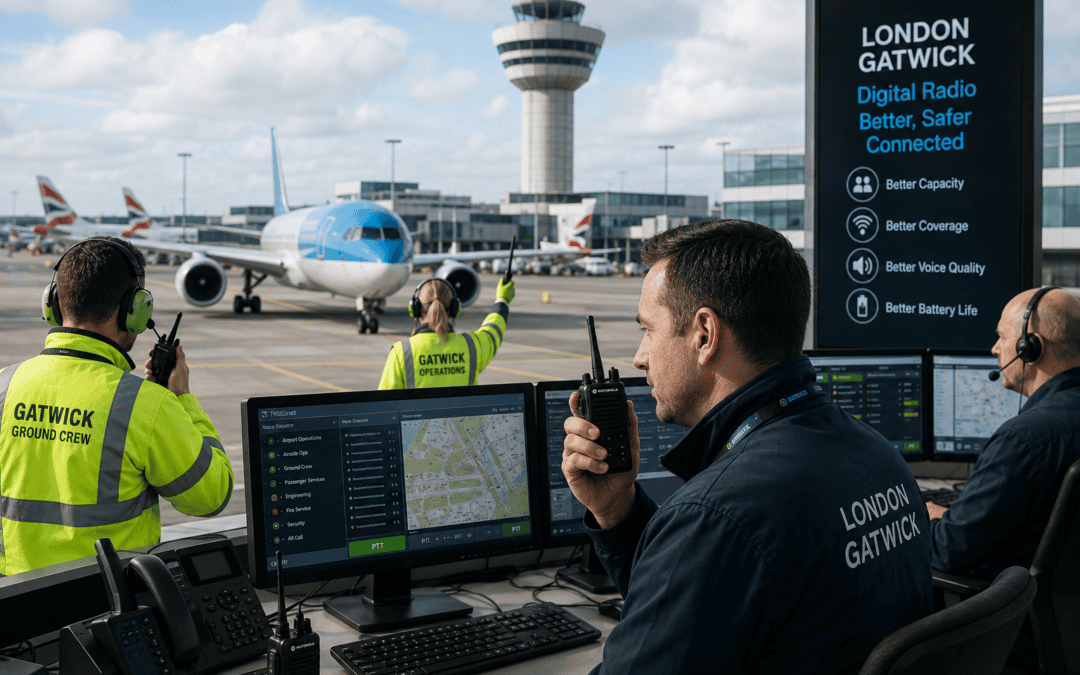
Gatwick Airport control towerIn a significant announcement in the world of two way radio, communications giant Motorola SolutionsMotorola Solutions is a global communications technology company that develops professional two-way radios, radio systems, dispatch platforms and other communication and safety technologies. recently announced the launch of its MOTOTRBO Capacity Max system at London Gatwick Airport. Gatwick is the latest, and possibly one of the biggest so far, in a long line of organisations choosing to update their existing analogue systems.
While analogue technology has been around for many decades, it appears to be coming to the end of the line in its capabilities. Gatwick itself admits that it is experiencing the limitations of its previous analogue system. By contrast, digital radio technology is thought to be heralding a new era in radio technology. Gatwick’s recent changes illustrate perfectly the benefits that digital radio technology provides. Let’s take a look at the key points in relation to Gatwick.
Better Capacity
Digital radio is much more efficient than analogue. In the case of a 12.5Hz channelA two-way radio channel is a programmed set of communication settings, typically including frequency and signalling, that allows compatible radios to communicate with one another., it would only be possible to run one analogue channel, but it is possible to run two digital channels using the same frequencyAn antenna transmits and receives radio-frequency signals, allowing a two-way radio to communicate. Antenna type, frequency, height and location can all affect radio performance and coverage.. Indeed, Motorola claims that Gatwick’s new Digital Mobile Radio (DMR)Digital Mobile Radio (DMR) is an ETSI digital radio standard for professional two-way communications, supporting voice, group calling, data and other features on compatible radio systems. will double the capacity of the existing analogue networkA Network is a connected system of radios, equipment and infrastructure that allows users to communicate across a defined area. Radio networks can range from simple radio-to-radio systems to large multi-site networks. and is fully scalable, meaning it is ready and able to cope with the demands of Gatwick’s ongoing growth.
Better Coverage
Analogue radio works through picking up radio waves from a transmitter to a receiverA Receiver is the part of a two-way radio that detects and processes incoming radio signals, converting them into audible voice or usable data for the user. in a process called modulationAnalogue radio uses continuously varying radio signals to transmit voice communication. It remains widely used for reliable two-way communication across business, industry, events, security and other applications.. This works wonderfully, except that the wave become weaker towards the edge of a transmitter’s range and is prone to interferenceRadio interference occurs when unwanted radio-frequency signals or electrical noise disrupt two-way radio communications, causing distorted audio, broken transmissions, reduced coverage or loss of communication..
Digital technology works by fragmenting the signal and sending it in a binary code of 0 and 1 digits. It is not impeded by interference and can reach its receiver in the same quality as when it left the transmitter, right to the edge of a transmitter’s range. This will provide enhanced voice and data communications to 1,300 users both airside and groundside at Gatwick.
Better Voice Quality
For the same reasons that digital radio technology provides better coverageRadio Coverage is the geographical area in which a two-way radio system can provide reliable communication. Coverage depends on the radios, antennas, frequency, terrain, buildings and system infrastructure. and capacity, it also means better voice quality. A digital signal transmits over a much wider band of frequencyFrequency is the number of cycles a radio wave completes each second, measured in Hertz. In two-way radio, frequency determines where a transmission operates within the radio spectrum., meaning that it has greater scope for avoiding interference along the way. Even if it does encounter interference, the receiver is able to piece together the fragments to reproduce the signal clearly.
Better Battery Life
Digital radio technology is much more energy efficient than analogue, so doesn’t drain a receiver’s battery as quickly. Motorola claims that digital technology could allow a battery to last up to 40% longer.
Motorola also highlights all the added benefits that the new two way radios give Gatwick, not least the ability to update hardware via WiFi, resulting in software updates that can be sent to equipment quickly and with less load on the radio network. Some other benefits include:
TRBOnet PLUS, a dispatcher application that enables voice recording, mapping and event logging in the control room
iBeacon indoor positioning, which allows alerts to be sent to individual radios based on location.
central controllers can dispatch the closest employee to an incident, saving staff valuable time
hardware is connected to WiFi, software updates can be sent to equipment quickly and with less load on the radio network.
The major factor persuading many organisations to transition from analogue to digital is that devices can work both on existing analogue networks and, in Gatwick’s case, on the new Motorola Capacity Max system. The benefits of being able to retain the original analogue systems while transitioning to digital are huge and makes the impact of introducing new technology much less of a burden.
Find out how we can equip you with an analogue or digital two way radio system.
To enquire more about any of DCS 2 Way Radio’s radio communication services, please call 0800 294 7766 or contact us for more information.