Martyn's Law Explained
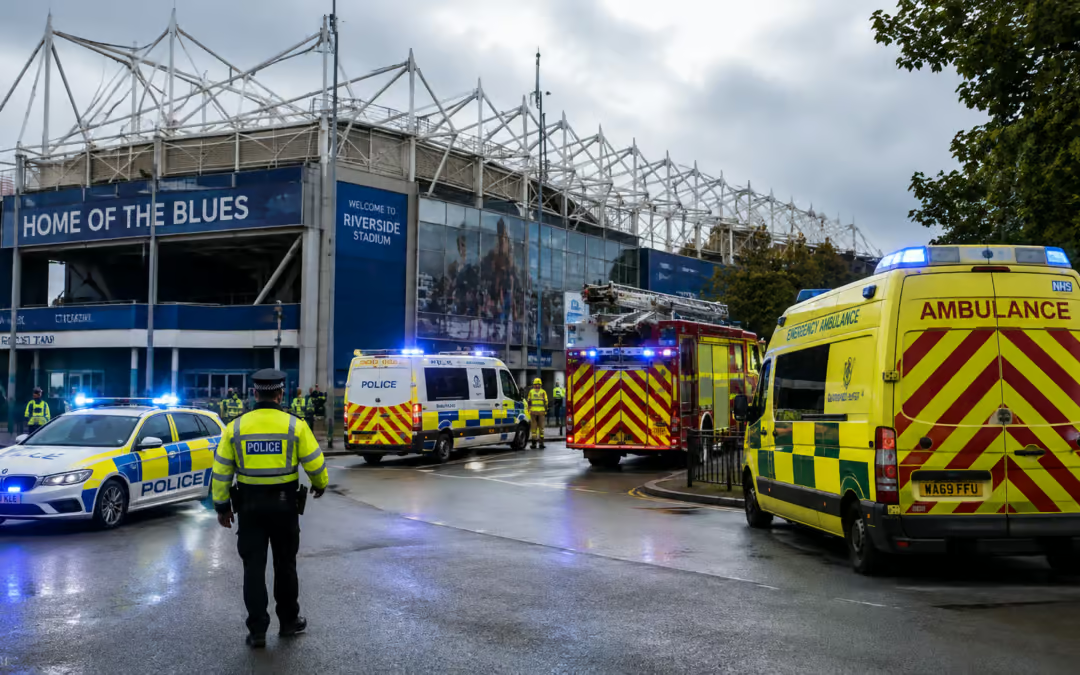
The introduction of Martyn's Law represents a significant change in how venues and event organisers in the UK must approach protection against terrorism. For stadiums, arenas, festivals and other publicly accessible locations, effective communication is an important part of preparing for serious incidents and coordinating an appropriate response.
Professional two-way radio communications can play an important role within these arrangements, providing security teams, event staff, stewards and control rooms with a fast and reliable method of communication when every second matters.
What Is Martyn's Law?
Martyn's Law is the commonly used name for the Terrorism (Protection of Premises) Act 2025. The legislation is intended to improve the protection of publicly accessible premises and events from terrorist attacks.
The legislation was named in memory of Martyn Hett, who was killed in the 2017 Manchester Arena terrorist attack.
The Act introduces requirements for certain premises and events to consider and implement measures designed to reduce the risk of terrorism and improve preparedness.
The requirements vary according to the type and size of premises or event, meaning organisations need to understand which category they fall into and what obligations apply to them.
For stadiums, arenas and major events, this can involve significant planning around security, emergency procedures, staff responsibilities, communication and coordination.
Why Communication Matters During a Major Incident
Emergency procedures are only effective if the people responsible for carrying them out can communicate quickly.
A stadium or large event can involve hundreds or thousands of people performing different roles. Security personnel may be positioned throughout the venue, while event control, stewards, medical teams, facilities staff and management may all need to communicate simultaneously.
During a serious incident, communication may need to happen between:
-
Security teams
-
Event control rooms
-
Stewards
-
Police and emergency services
-
Medical teams
-
Facilities and operations teams
-
Venue management
-
Traffic management teams
-
Evacuation teams
A delay in passing important information can affect how quickly teams respond.
This is where a properly designed two-way radio systemA Radio System is a complete communication solution comprising two-way radios and, where required, equipment such as repeaters, antennas, base stations, mobile radios and network infrastructure. for events can provide a major operational advantage.
Why Two-Way Radios Are Important for Stadiums and Events
Unlike mobile phones, professional two-way radios are designed around instant push-to-talk communication.
A user can press the transmit button and communicate with their designated team without finding a contact, dialling a number or waiting for someone to answer.
This makes radios particularly useful in environments where teams need to exchange short, operational messages quickly.
For example:
"Security to control — entrance four is now closed."
Control can immediately respond and coordinate the next action.
For large venues, radios can also be organised into separate communication groups. Security, operations, medical teams and event management can have their own channels while maintaining the ability to communicate with control when necessary.
Radio Communication and Event Control Rooms
The control room is often at the centre of a venue's operational communication system.
A professional radio networkA Network is a connected system of radios, equipment and infrastructure that allows users to communicate across a defined area. Radio networks can range from simple radio-to-radio systems to large multi-site networks. can allow the control room to communicate with different teams across the site and maintain an overview of developing situations.
Depending on the system, communications can be organised into different talk groups, allowing information to reach the people who need it without unnecessarily disrupting other teams.
For example, a stadium might operate separate groups for:
Security
Security personnel can communicate incidents, suspicious activity and access-control issues.
Stewards
Stewards can report crowd-management issues and request assistance.
Medical
Medical teams can coordinate responses to injuries and medical emergencies.
Operations
Facilities and operational teams can deal with building, powerAn antenna transmits and receives radio-frequency signals, allowing a two-way radio to communicate. Antenna type, frequency, height and location can all affect radio performance and coverage., access and maintenance issues.
Event Management
Senior management can communicate with control and other operational departments.
This structure can make a large communication network much easier to manage.
Professional Radios vs Mobile Phones
Mobile phones have an important role in emergency planning, but they are not necessarily the most effective primary communication tool for every operational team.
Professional two-way radios provide several advantages in a stadium or event environment.
Instant Group Communication
A radio can allow one person to communicate with an entire team simultaneously.
No Dialling
Users simply select the appropriate channelA two-way radio channel is a programmed set of communication settings, typically including frequency and signalling, that allows compatible radios to communicate with one another. or talk groupA Talk Group is a predefined group of users or radios within a two-way radio system that share a common communication group, allowing teams to communicate without involving other users. and press the push-to-talk button.
Designed for Operational Use
Professional radios are built for demanding working environments and can be used with accessories such as remote speaker microphones and discreet earpieces.
Centralised Communication
Radio systems can be designed around an event control room, allowing communication between multiple teams.
Reduced Reliance on Individual Phones
Staff do not need to use their personal mobile phones to communicate operational information.
Dedicated Communication Groups
Different departments can have separate talk groups while remaining part of the wider communication network.
Digital Two-Way Radios for Events
Modern professional event radio systems are typically digital.
Digital Mobile Radio (DMR)Digital Mobile Radio (DMR) is an ETSI digital radio standard for professional two-way communications, supporting voice, group calling, data and other features on compatible radio systems. systems can provide features such as group calling, individual calling, emergency alerts and other functionality depending on the equipment and configuration.
For larger venues, digital systems can also provide greater flexibility when organising users into different communication groups.
This can be particularly useful when a stadium is operating an event with multiple departments working simultaneously.
Radio Coverage Across Large Venues
One of the most important considerations when planning radio communications is coverageRadio Coverage is the geographical area in which a two-way radio system can provide reliable communication. Coverage depends on the radios, antennas, frequency, terrain, buildings and system infrastructure..
A radio that works effectively in an open area may behave differently inside a large stadium or arena.
Concrete structures, steelwork, underground areas, tunnels, buildingsAn antenna transmits and receives radio-frequency signals, allowing a two-way radio to communicate. Antenna type, frequency, height and location can all affect radio performance and coverage. and other physical obstacles can affect radio signals.
For this reason, large venues may require additional infrastructureRadio infrastructure is the equipment and supporting systems behind a professional two-way radio network, including repeaters, antennas, base stations, network connections, power systems and dispatch equipment. such as a radio repeaterA Repeater receives a two-way radio transmission and retransmits it, usually from an elevated location, to extend the coverage and reliability of a radio communication system. or other coverage solution.
A repeater receives a radio transmissionTransmission is the process of sending voice, data or signalling from a radio using a radio-frequency signal to another radio, repeater or communication system. and retransmits it, helping extend communication across a larger area.
Before supplying radios for a large event, a professional radio provider should consider:
-
Venue size
-
Building construction
-
Indoor and outdoor areas
-
Underground areas
-
Parking areas
-
Entrances and exits
-
Back-of-house areas
-
Control rooms
-
Emergency assembly areas
-
Expected number of users
The objective should be reliable communication throughout the areas where staff need to operate.
Communication During Evacuation
If an evacuation or major incident occurs, coordination becomes particularly important.
Different teams may have different responsibilities. Security may need to manage access points, stewards may be directing members of the public, medical teams may be responding to casualties and event control may be coordinating information.
A professional radio network allows these teams to remain connected.
Rather than relying on everyone receiving the same message through a general communication channel, teams can be organised according to their responsibilities.
This can help reduce unnecessary radio traffic while ensuring critical information reaches the appropriate people.
Lone Worker and Emergency Features
Some professional radio systems also provide additional safety features.
Depending on the equipment and configuration, these can include:
-
Emergency buttons
-
Lone workerA Lone Worker is someone who works without direct supervision or immediate assistance nearby. Compatible two-way radios can provide safety features such as timed check-ins, emergency alerts and GPS location. functionality
-
Man-down alerts
-
GPS location
-
Priority calls
-
Remote monitoring
-
Individual and group calling
These features can provide additional protection for personnel working alone or in higher-risk areas.
They should, however, be considered as part of a wider safety and emergency-response strategy rather than as a replacement for established procedures.
Radio Communications Should Form Part of a Wider Security Plan
It is important to understand that two-way radios do not make a venue compliant with Martyn's Law by themselves.
The legislation covers much broader requirements around preparedness and protective security.
Radio communications should instead be considered one component of a venue's wider operational and emergency arrangements.
A suitable communication system can support the implementation of those arrangements by helping staff communicate, coordinate responsibilities and respond to incidents effectively.
The precise requirements for a particular premises or event should always be assessed against the legislation and relevant government guidance.
Planning Radio Hire for an Event
For temporary events, hiring professional radios can be more practical than purchasing equipment.
A radio hireRadio Hire is the temporary rental of two-way radios and related communication equipment for events, projects and operational requirements, providing professional communication without purchasing the equipment. provider can supply the required number of radios for the duration of the event and configure them before deployment.
When planning two-way radio hire for a stadium or event, organisers should consider:
Number of Users
How many members of staff need radios?
Communication Groups
Which teams need to communicate with each other?
Coverage
Will radios need to work throughout the stadium, surrounding areas and external facilities?
Event Duration
How many days will the equipment be required?
Accessories
Will security staff require discreet earpieces? Will supervisors need remote speaker microphones?
Battery Requirements
Will radios need to operate across long shifts? Are spare batteries or additional charging facilities required?
Emergency Procedures
How will radio communications fit into the venue's existing emergency plans?
Answering these questions before the event allows the radio system to be configured around the actual operational requirements.
How DCS 2 Way Radio Can Help
For stadiums, arenas and event organisers, choosing the right communication system is about more than simply supplying a number of handsets.
The radio network needs to work in the environment where it will be used and support the way teams actually operate.
DCS 2 Way Radio provides professional two-way radio hire for events and businesses across the UK, with solutions ranging from straightforward handheld radio hire to larger communication systems incorporating additional coverage infrastructure.
For larger venues and complex events, the radio requirements can be assessed around the site, number of users, communication groups and operational responsibilities.
Preparing for Safer Events
Martyn's Law places greater emphasis on preparedness and protective security for qualifying premises and events.
Effective communication should be an important consideration within that preparation.
Professional two-way radios can provide stadiums, arenas and event organisers with an immediate communication system that connects security, stewards, medical teams, operations and event control.
The right solution will depend on the venue, event and operational requirements, but reliable communication can help teams coordinate more effectively when normal conditions change quickly.
For organisations planning an event or reviewing their existing communication arrangements, professional two-way radio hire can provide a flexible way to establish a dedicated communications network without the cost of purchasing a permanent fleet.