
The Complete Guide to Two-Way Radios & Professional Mobile Radio (PMR)
Part 5 - Chapter 16
Industry Applications
Industry Applications
How Professional Radio Systems Support Different Industries
Professional radio communication is used across thousands of organisations throughout the UK every day. From coordinating warehouse operations and managing hotel maintenance teams to supporting major infrastructureRadio infrastructure is the equipment and supporting systems behind a professional two-way radio network, including repeaters, antennas, base stations, network connections, power systems and dispatch equipment. projects and delivering emergency response, two-way radios remain one of the most effective tools for instant operational communication.
Although the underlying technology may be similar, every industry has its own communication challenges. A hospital requires rapid coordination between departments, while a construction site must ensure workers remain connected across constantly changing environments. A logistics business may need to communicate with drivers across the country, whereas a hotel often focuses on discreet communication between housekeeping, maintenance and management.
Understanding these different operational requirements helps organisations select communication systems that improve efficiency, enhance safety and support excellent customer service.
This chapter explores how professional radio systems are used across a range of industries, highlighting common communication challenges and the technologies typically deployed.
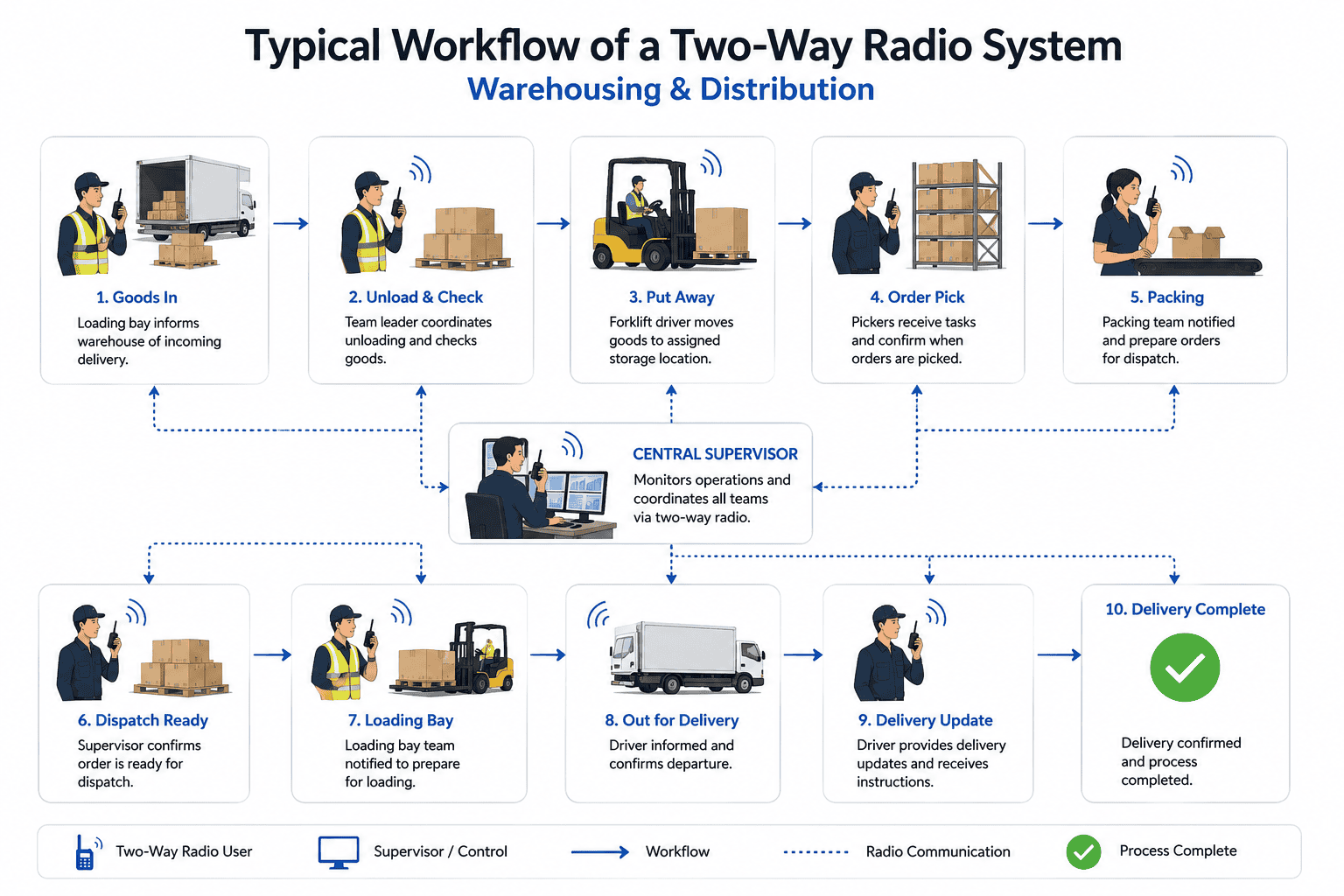
Warehousing and Distribution
Warehouses are fast-moving environments where delays in communication can quickly affect productivity.
Radio systems help teams coordinate:
- Goods receiving
- Order picking
- Stock replenishment
- Forklift operations
- Loading bays
- Maintenance
- Health and safety
Because warehouses often contain steel shelving, machinery and large internal spaces, digital UHF systems with repeaters are commonly used to ensure reliable coverageRadio Coverage is the geographical area in which a two-way radio system can provide reliable communication. Coverage depends on the radios, antennas, frequency, terrain, buildings and system infrastructure..
Typical Features
- Talk groups for departments
- Emergency buttons
- Headsets for forklift operators
- Dispatch integration
- GPS for yard vehicles (where appropriate)
Business Benefits
- Faster order fulfilment
- Reduced downtime
- Improved stock movement
- Better staff coordination
Logistics and Transport
Logistics organisations often combine on-site radio systems with nationwide communication.
Typical users include:
- Warehouse teams
Drivers
Fleet managers
Operations controllers
Loading staff
Hybrid communicationHybrid Communication combines two or more communication technologies, such as two-way radio, DMR, cellular, Wi-Fi or IP networks, allowing different systems or users to communicate through a common platform. systems combining DMR and PoC are increasingly common.
Typical Features
Vehicle-mounted radios
GPS tracking
Dispatch software
Nationwide PoC coverage
Incident managementIncident Management is the process of coordinating people, communications and resources during an incident. Two-way radios can provide rapid communication between teams, control rooms and responders.
Business Benefits
Improved delivery coordination
Better route management
Reduced communication delays
Enhanced fleet visibility
Construction
Construction sites present unique communication challenges.
Working environments change frequently as projects progress.
Teams may include:
- Site managers
- Groundworkers
- Crane operators
- Plant operators
- Contractors
- Health and safety personnel
Rugged radios with high ingress protection (IP) ratings are typically preferred.
Typical Features
- Emergency alarms
- Lone WorkerA Lone Worker is someone who works without direct supervision or immediate assistance nearby. Compatible two-way radios can provide safety features such as timed check-ins, emergency alerts and GPS location. monitoring
- Noise-cancelling audiaterproof construction
- Remote speaker microphones
Business Benefits
- Improved site safety
- Faster coordination
- Reduced project delays
- Better contractor management
Manufacturing
Manufacturing facilities depend on continuous communication between production teams.
Departments commonly include:
- Production
- Maintenance
- Engineering
- Quality control
- Warehouse
- Management
Reliable communication helps minimise production interruptions.
Typical Features
- Multiple talk groups
- Digital repeaters
- Control room dispatch
- Text messaging
- Emergency calling
Business Benefits
- Reduced downtime
- Faster maintenance response
- Improved production efficiency
- Better cross-department coordination
Hospitality
Hotels and hospitality venues rely heavily on discreet communication.
Typical users include:
- Reception
- Housekeeping
- Maintenance
- Security
- Food and beverage
- Management
Compact radios with discreet earpieces are widely used.
Typical Features
- Lightweight handhelds
- Bluetooth®Bluetooth® is a short-range wireless technology used with compatible two-way radios to connect accessories such as headsets, earpieces and microphones without a physical cable. earpieces
- Silent messaging
- Departmental talk groups
Business Benefits
- Faster guest service
- Improved maintenance response
- Better housekeeping coordination
- Enhanced customer experience
Retail
Retail communication focuses on customer service, stock management and security.
Common users include:
- Store managers
- Sales assistants
- Warehouse staff
- Security
- Customer service
Typical Features
- Lightweight radios
- Compact accessories
- Department talk groups
- Emergency alerts
Business Benefits
- Improved customer assistance
- Faster stock replenishment
- Better loss prevention
- Enhanced operational efficiency
Security
Security organisations require dependable communication at all times.
Typical deployments include:
- Static guarding
- Mobile patrols
- Control rooms
- Event security
- Corporate security
Security teams often operate in challenging environments where communication supports both operational effectiveness and staff safety.
Typical Features
- EncryptionEncryption protects two-way radio communications by converting voice or data into a secure form that can only be understood by authorised radios with the correct encryption capability and keys.
- GPS tracking
- Emergency buttons
- Lone Worker monitoring
- Dispatch integration
Business Benefits
- Faster incident response
- Improved officer safety
- Better operational oversight
- Enhanced accountability
Healthcare
Hospitals and healthcare facilities rely on rapid communication between multiple departments.
Typical users include:
- Estates teams
- Porters
- Security
- Facilities management
- Maintenance
- Emergency planning teams
Clinical communication requirements are often managed through separate systems, while professional radios support operational services.
Typical Features
- Digital UHF coverage
- Hospital-wide repeaters
- Emergency calling
- Priority users
- Dispatch systems
Business Benefits
- Faster maintenance response
- Improved patient support services
- Better emergency coordination
- Increased operational efficiency
Education
Schools, colleges and universities use radios to coordinate daily operations.
Typical users include:
- Site managers
- Caretakers
- Security
- Reception
- Facilities teams
- Event staff
Typical Features
- Compact handhelds
- Department talk groups
- Emergency alerts
- Indoor coverage optimisation
Business Benefits
- Faster response to incidents
- Improved campus management
- Better safeguarding support
- Enhanced communication during events
Airports
Airports are among the most communication-intensive environments.
Users may include:
- Airside operations
- Baggage handling
- Engineering
- Security
- Fire services
- Terminal management
Systems typically require extensive infrastructure and carefully managed radio networks.
Typical Features
- Multi-site DMR
- Dispatch systems
- GPS
- Emergency functionality
- Integration with operational systems
Business Benefits
- Efficient airside coordination
- Improved passenger services
- Faster operational response
- Enhanced safety
Rail
Rail operators require reliable communication across extensive infrastructure.
Typical users include:
- Track maintenance
- Engineering
- Signalling support
- Operations
- Security
- Contractors
Typical Features
- Wide-area coverage
- Emergency alerts
- Rugged equipment
- GPS tracking
- Hybrid communication
Business Benefits
- Improved worker safetyWorker Safety refers to measures used to protect employees from workplace risks. Two-way radios can support worker safety through instant communication, emergency alerts, Lone Worker and Man Down functions.
- Faster maintenance
- Better operational coordination
- Reduced service disruption
Utilities
Utility providers often operate nationally.
Users include:
- Field engineers
- Supervisors
- Control rooms
- Emergency response teams
Hybrid PMR and PoC systems are increasingly common.
Typical Features
- Vehicle radios
- Nationwide coverage
- GPS
- Lone Worker functionality
- Dispatch software
Business Benefits
- Improved resource allocation
- Faster fault response
- Better engineer safety
- Increased operational visibility
Ports and Maritime
Ports are large operational environments where communication is essential.
Typical users include:
- Dock operations
- Crane operators
- Vessel coordination
- Security
- Maintenance
Typical Features
- High-power infrastructure
- Weather-resistant equipment
- Dispatch integration
- GPS
Business Benefits
- Faster cargo handling
- Improved safety
- Better vessel coordination
- Reduced operational delays
Events
Temporary events require communication systems that can be deployed quickly.
Typical users include:
- Event organisers
- Security
- Medical teams
- Traffic management
- Production crews
- Volunteers
Hire solutions are particularly popular in this sector.
Typical Features
- Temporary repeaters
- Hire fleets
- Emergency channels
- Control room dispatch
Business Benefits
- Improved crowd management
- Faster incident response
- Better team coordination
- Safer event operations
Facilities Management
Facilities management companies often support multiple client sites.
Users include:
- Engineers
- Cleaning teams
- Security
- Supervisors
Hybrid communication is increasingly common.
Typical Features
- Smartphone integration
- GPS
- Dispatch
- PoC
- DMR
Business Benefits
- Improved engineer deployment
- Faster maintenance response
- Better client service
- Increased workforce visibility
Agriculture
Large farms and agricultural businesses frequently rely on radio communication where mobile phone coverage may be inconsistent.
Typical users include:
- Farm managers
- Machinery operators
- Livestock teams
- Maintenance staff
Typical Features
- VHF radios
- Vehicle-mounted equipment
- Weather-resistant construction
- Long battery life
Business Benefits
- Improved operational coordination
- Faster equipment support
- Better worker safety
- Efficient seasonal operations
Choosing by Industry Isn't Enough
Although industry examples provide useful guidance, every organisation is different.
For example:
- Two warehouses may have very different building layouts.
- Two construction companies may operate completely different project types.
- Two hospitals may require different coverage strategies.
Communication systems should therefore be designed around operational requirements rather than industry labels alone.
Key Takeaways
- Professional radio systems are used across virtually every business sector.
- Each industry has unique communication challenges that influence system design.
- Modern technologies such as DMR, PoC and hybrid communication support a wide range of operational requirements.
- Safety features, dispatch systems and GPS tracking are increasingly important across many industries.
- The most effective communication systems are tailored to the organisation's specific operational needs rather than simply its industry sector.
Expert Insight
- Industry experience provides valuable guidance, but no two organisations communicate in exactly the same way.
- Successful communication projects begin by understanding how people work, where they work and what information they need to share.
- Technology should always be adapted to operational processes not the other way around.
Business Example
A national facilities management company supports commercial offices, hospitals, retail parks and industrial estates across the UK. Rather than deploying identical communication systems at every location, it adopts a tailored approach.
On larger client sites, engineers use DMR radios connected to local repeaters for dependable on-site communication. Mobile supervisors travelling between locations use PoC devices to remain connected nationwide, while the operations centre coordinates all activity through a cloud-based dispatch platform.
By selecting communication technology based on operational requirements at each site, the company improves response times, increases engineer productivity and delivers a more consistent service to its clients.
Business Perspective
Professional radio systems continue to play a critical role across almost every sector of the UK economy. Whether supporting manufacturing, healthcare, logistics, construction or hospitality, effective communication enables organisations to operate more safely, respond more quickly and coordinate resources more efficiently. The industries may differ, but the objective remains the same: ensuring the right information reaches the right people at the right time.
Frequently Asked Questions
Which industries use professional two-way radios?
Professional radios are widely used in logistics, warehousing, manufacturing, construction, healthcare, hospitality, retail, security, education, transport, utilities, agriculture, events and many other sectors.
Are radios still used in the age of smartphones?
Yes. Professional radios provide instant group communication, excellent reliability, long battery life and operational features that smartphones alone often cannot replicate. Many organisations now use hybrid systems that combine both technologies.
What type of radio is best for warehouses?
Many warehouses benefit from digital UHF radios with repeaterA Repeater receives a two-way radio transmission and retransmits it, usually from an elevated location, to extend the coverage and reliability of a radio communication system. infrastructure to provide reliable coverage throughout buildingsAn antenna transmits and receives radio-frequency signals, allowing a two-way radio to communicate. Antenna type, frequency, height and location can all affect radio performance and coverage. containing steel racking and machinery.
Why are PoC radios popular in logistics?
PoC devices provide nationwide communication over mobile broadbandBroadband is a high-speed data connection used by systems such as PoC radio to carry voice, video and other communications over mobile networks, Wi-Fi or IP networks. networks, making them well suited to organisations with drivers and geographically dispersed teams.
Can communication systems be customised for different departments?
Yes. Modern radio systems allow organisations to create separate talk groups, user permissions and operational features tailored to the needs of individual teams.
What People Say About DCS 2 Way Radio
Contact the UK's Premier Two Way Radio Experts Today