Phonetic Alphabet
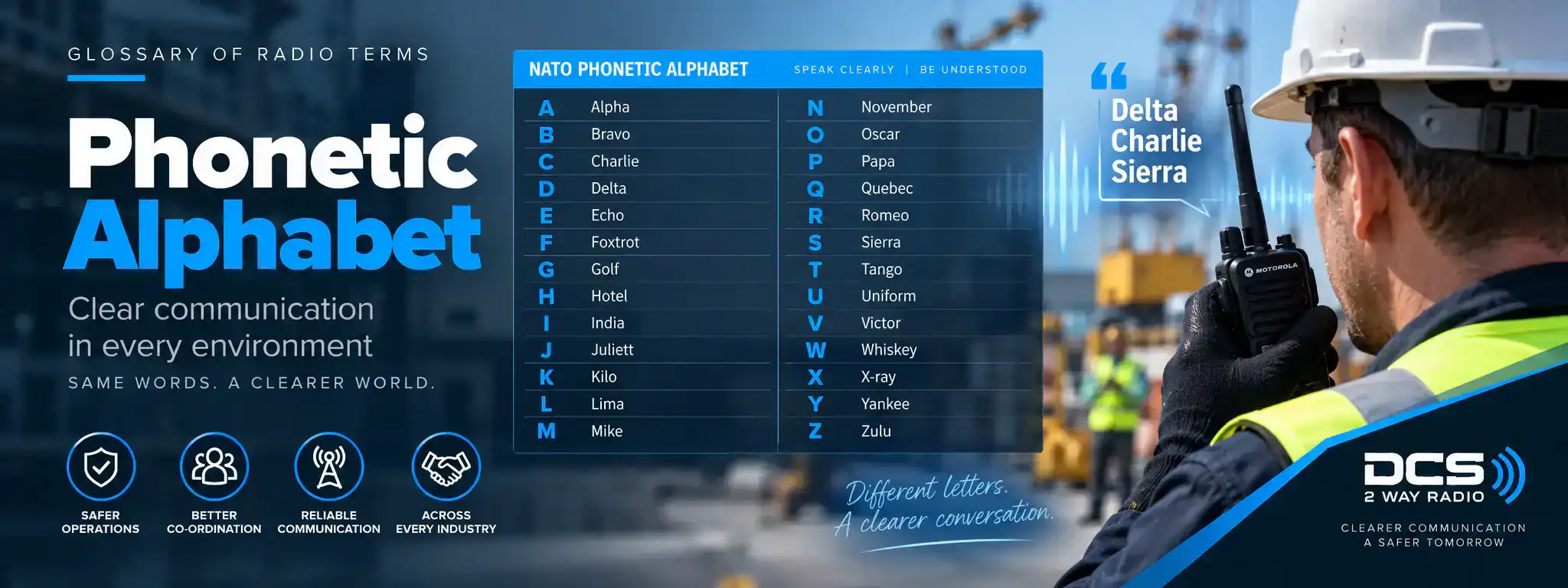
The phonetic alphabet is a standard system used to spell letters clearly when communicating by voice, particularly over two-way radio. Instead of saying individual letters that could be confused with one another, radio users use specific words such as Alpha, Bravo, Charlie and Delta to represent each letter.
The internationally recognised system used for professional radio communication is commonly known as the NATO Phonetic Alphabet or the International Radiotelephony Spelling Alphabet.
What is the phonetic alphabet?
The phonetic alphabet assigns a specific spoken word to each letter of the English alphabet. This helps reduce misunderstandings when radio signals are unclear, background noise is present or several letters sound similar when spoken.
For example, instead of saying the letters D-C-S, a radio user could say:
“Delta Charlie Sierra.”
This makes each letter much easier to distinguish.
NATO phonetic alphabet
The NATO Phonetic Alphabet uses the following words:
| Letter |
Phonetic Word |
Letter |
Phonetic Word |
| A |
Alfa |
N |
November |
| B |
Bravo |
O |
Oscar |
| C |
Charlie |
P |
Papa |
| D |
Delta |
Q |
Quebec |
| E |
Echo |
R |
Romeo |
| F |
Foxtrot |
S |
Sierra |
| G |
Golf |
T |
Tango |
| H |
Hotel |
U |
Uniform |
| I |
India |
V |
Victor |
| J |
Juliett |
W |
Whiskey |
| K |
Kilo |
X |
X-ray |
| L |
Lima |
Y |
Yankee |
| M |
Mike |
Z |
Zulu |
These words are internationally recognised and are widely used in aviation, maritime communications, emergency services, military communications and professional radio operations.
Why is the phonetic alphabet used on two-way radio?
Radio communication can be affected by distance, interferenceRadio interference occurs when unwanted radio-frequency signals or electrical noise disrupt two-way radio communications, causing distorted audio, broken transmissions, reduced coverage or loss of communication., background noise, poor signal strength and other environmental factors.
Some letters can also sound very similar when spoken. For example, B, C, D, E and G can potentially be misunderstood in noisy conditions.
Using words such as Bravo, Charlie, Delta, Echo and Golf makes the individual letters much easier to distinguish.
This is particularly useful when communicating information such as vehicle registrations, reference numbers, names, locations, call signs and equipment identifiers.
Phonetic alphabet and radio procedure
Clear communication is an important part of professional two-way radio procedure.
When spelling information over the radio, the phonetic alphabet should be used where there is a reasonable possibility that a letter could be misunderstood.
For example, a radio operator might say:
“Unit Alpha Seven, proceed to Gate Bravo.”
This makes the letters and identifiers clearer than simply saying “Unit A7” or “Gate B”.
Phonetic alphabet and call signs
Two-way radio systems may use call signs to identify individual users, vehicles, teams or locations.
Call signs can contain letters and numbers, making the phonetic alphabet useful when communicating them verbally.
For example, a security team could use a call sign such as Kilo Two, while a vehicle might be identified as Charlie Five.
The exact call-sign system depends on the organisation and how its radio networkA Network is a connected system of radios, equipment and infrastructure that allows users to communicate across a defined area. Radio networks can range from simple radio-to-radio systems to large multi-site networks. is configured.
Phonetic alphabet and emergency communications
Clear communication becomes particularly important during an emergency.
Radio users may need to communicate locations, access points, vehicle registrations, names or other critical information quickly. Using the phonetic alphabet can reduce the risk of individual letters being misunderstood.
It is therefore commonly incorporated into radio communication procedures used by organisations such as security teams, emergency response personnel and event operations.
Phonetic alphabet in logistics and transport
The phonetic alphabet can be useful in logistics, warehousing and transport environments where radio users regularly communicate vehicle numbers, loading areas, gates, locations and operational instructions.
For example, a warehouse operator could identify a loading area as “Bay Charlie” rather than simply saying “Bay C”.
This can help avoid confusion when several people are communicating over the same radio channelA two-way radio channel is a programmed set of communication settings, typically including frequency and signalling, that allows compatible radios to communicate with one another..
Phonetic alphabet for construction sites
Construction sites can be noisy environments with heavy machinery, vehicles and equipment operating nearby.
Radio users may need to communicate site locations, access points, equipment identifiers or team call signs. Using the phonetic alphabet can make individual letters easier to understand over the radio.
For example:
“Meet at Gate Delta.”
is less likely to be misunderstood than simply saying:
“Meet at Gate D.”
Phonetic alphabet and events
Event radio users can also benefit from phonetic communication.
Large events may have multiple teams communicating across the same radio systemA Radio System is a complete communication solution comprising two-way radios and, where required, equipment such as repeaters, antennas, base stations, mobile radios and network infrastructure., including security, stewards, production, transport, facilities and management.
Using consistent radio terminology and the phonetic alphabet can help teams communicate locations and identifiers clearly, particularly when working in busy or noisy environments.
Phonetic alphabet and security
Security personnel frequently use two-way radios while working across large buildingsAn antenna transmits and receives radio-frequency signals, allowing a two-way radio to communicate. Antenna type, frequency, height and location can all affect radio performance and coverage., sites and events.
The phonetic alphabet can be used when communicating names, locations, vehicle registrations, access points or other information that contains letters.
Combined with clear radio procedure, it can help security teams communicate information accurately and efficiently.
Phonetic alphabet vs phonetics
The term phonetic alphabet can sometimes be confused with phonetics, which is the study of speech sounds.
In radio communication, the phrase usually refers to the spelling alphabet in which each letter is represented by a distinctive word.
The NATO Phonetic Alphabet is therefore not intended to show how words are pronounced. Its purpose is to make individual letters easier to understand when they are spoken.
Why are some spellings unusual?
Some of the words in the NATO Phonetic Alphabet use specific international spellings.
For example, Alfa is the official spelling rather than “Alpha”, and Juliett uses two Ts. X-ray is also written with a hyphen.
These forms were selected as part of the international standard to support consistent pronunciation across different languages and accents.
Using numbers with the phonetic alphabet
The phonetic alphabet is primarily used for letters, but radio communication also uses standardised pronunciation for numbers where necessary.
Depending on the radio procedure being followed, numbers may be spoken individually rather than as a complete number.
For example, a radio user may communicate a reference such as A27 as:
“Alpha Two Seven.”
The exact procedure can vary according to the organisation and operating environment.
Phonetic alphabet and professional radio training
Professional radio users can benefit from training in standard radio procedure, including the correct use of the phonetic alphabet.
Training can cover how to identify yourself, make calls, pass information, acknowledge messages, spell words and repeat important information when necessary.
Consistent procedures help different members of a team understand radio messages in the same way.
Phonetic alphabet and DCS 2 Way Radio
At DCS 2 Way Radio, clear communication is at the heart of professional two-way radio systems.
Whether radios are being used for construction, logistics, warehousing, security, events, transport or industrial operations, clear radio procedure helps teams communicate effectively.
The phonetic alphabet is a simple but important part of professional radio communication, helping users spell letters clearly when accuracy matters.
Related radio terms
- Two Way Radio
- Call Sign
- Channel
- Talk GroupA Talk Group is a predefined group of users or radios within a two-way radio system that share a common communication group, allowing teams to communicate without involving other users.
- Push-to-Talk (PTT)Push-to-Talk (PTT) is the button or control used to activate a two-way radio's transmitter. Press it to speak and release it to listen.
- Radio Procedure
- Emergency CallAn Emergency Call is a priority two-way radio function that allows a user to quickly request assistance and, on supported systems, establish an urgent voice communication with a dispatcher or control room.
- Worker SafetyWorker Safety refers to measures used to protect employees from workplace risks. Two-way radios can support worker safety through instant communication, emergency alerts, Lone Worker and Man Down functions.
- Security RadioA Security Radio is a professional two-way radio used by security personnel to communicate quickly and reliably, with features such as group calling, emergency alerts, Lone Worker and Man Down.
- Warehouse RadioA Warehouse Radio is a professional two-way radio used by warehouse, distribution and logistics teams for instant communication across storage areas, loading bays, yards and operational facilities.
- Construction RadiosConstruction Radios are professional two-way radios designed for communication across building sites and infrastructure projects. They provide instant communication between site managers, supervisors, contractors, plant operators and ground workers.
- Event Radio HireEvent Radio Hire provides temporary professional two-way radios and communication equipment for events, helping organisers, security, production and other teams stay connected.
- Radio HireRadio Hire is the temporary rental of two-way radios and related communication equipment for events, projects and operational requirements, providing professional communication without purchasing the equipment.