
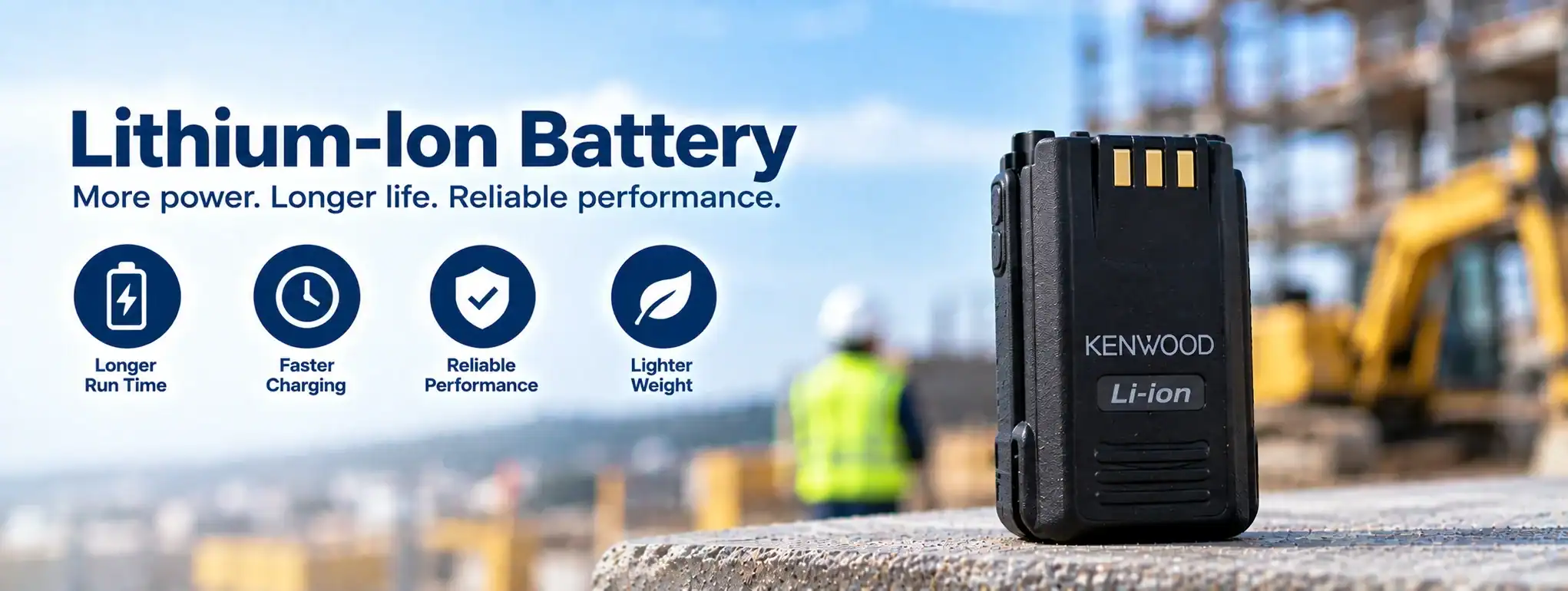
Lithium-Ion Battery
A Lithium-Ion Battery is a rechargeable battery commonly used to powerAn antenna transmits and receives radio-frequency signals, allowing a two-way radio to communicate. Antenna type, frequency, height and location can all affect radio performance and coverage. modern two-way radios and other portable electronic equipment.
Lithium-ion batteries, often abbreviated to Li-ion, can provide a high energy capacity in a relatively compact and lightweight package. They are widely used in professional handheld radios because they can provide useful operating time without adding excessive weight to the radio.
What is a lithium-ion battery?
A lithium-ion battery stores electrical energy chemically and releases it when the radio is operating.
A typical radio battery pack contains multiple components, including:
- Lithium-ion cells
- Protective circuitry
- Battery contacts
- Housing
- Temperature monitoring components where applicable
The battery is designed to work with a specific radio and charging system.
Lithium-ion batteries in two-way radios
Lithium-ion batteries are commonly used in professional handheld two-way radios.
They provide power for functions such as:
- Transmitting
- Receiving
- Display operation
- GPS
- Bluetooth
- Data communication
- Emergency functions
Battery consumption depends heavily on how the radio is used.
Lithium-ion vs older battery technologies
Lithium-ion batteries have largely replaced older rechargeable battery technologies such as Nickel-Metal Hydride (NiMH) and Nickel-Cadmium (NiCd) in modern portable radios.
Advantages can include:
- High energy density
- Lower weight
- Compact size
- Good rechargeable performance
- No traditional memory-effect concerns associated with older battery technologies
The exact performance depends on the battery and radio.
Lithium-ion battery capacity
Battery capacity is commonly expressed in mAh (milliamp-hours).
A higher-capacity battery can potentially provide longer operating time, although capacity is not the only factor affecting battery life.
Radio power consumption, transmit time, temperature and battery condition can all affect how long a radio operates.
Lithium-ion battery life
Battery life refers to how long the radio can operate between charges.
Operating time depends on factors such as:
- Transmit time
- Receive time
- Standby time
- Transmit power
- GPS usage
- Bluetooth usage
- Display usage
- Battery capacity
- Temperature
- Battery age
A radio that spends most of its time transmitting will normally consume considerably more energy than one that spends most of its time in standby.
Lithium-ion battery lifespan
A lithium-ion battery has a finite service life.
Repeated charging and discharging gradually reduces its ability to hold a full charge.
Over time, users may notice:
- Shorter operating time
- Faster battery depletion
- Increased charging frequencyAn antenna transmits and receives radio-frequency signals, allowing a two-way radio to communicate. Antenna type, frequency, height and location can all affect radio performance and coverage.
- Reduced overall capacity
Battery lifespan varies according to usage, storage conditions, charging practices and battery quality.
Lithium-ion battery charging
Lithium-ion batteries require a suitable charging system.
Professional two-way radio batteries can be charged using:
- Single-unit chargers
- Multi-unit charging docks
- Vehicle chargers
- Approved desktop chargers
- Other manufacturer-approved charging equipment
The charger should be compatible with the specific battery and radio.
Lithium-ion battery charging docks
A Charging DockA Charging Dock is a dedicated cradle used to recharge a two-way radio or compatible battery, providing a convenient way to keep radios charged and ready for use. can allow one or more radio batteries to be charged simultaneously.
Multi-unit charging docks are particularly useful for organisations operating fleets of handheld radios.
They can ensure that radios are ready for use at the beginning of a shift or working day.
Lithium-ion battery and radio hire
For Radio HireRadio Hire is the temporary rental of two-way radios and related communication equipment for events, projects and operational requirements, providing professional communication without purchasing the equipment., spare lithium-ion batteries can be useful where radios are used for long shifts or extended events.
For example, a hire operation may provide:
Radio + Battery + Charger + Spare Battery
This allows a depleted battery to be replaced while the other battery is being recharged.
Lithium-ion battery and shift work
Organisations operating radios across multiple shifts may require additional batteries or charging facilities.
A suitable charging arrangement can help ensure that radios remain available throughout the working day.
For demanding operations, battery capacity and expected transmit time should be considered when selecting equipment.
Lithium-ion battery and transmit time
Radio transmissionTransmission is the process of sending voice, data or signalling from a radio using a radio-frequency signal to another radio, repeater or communication system. consumes significantly more power than standby operation.
Frequent or extended transmissions can therefore reduce operating time.
A radio used heavily for voice communication may require more frequent charging than one used occasionally.
Lithium-ion battery and GPS
GPS can increase power consumption on compatible radios.
Where GPS location updates are transmitted regularly, battery life can be shorter than when GPS is disabled or used less frequently.
The effect varies between radio models and configuration.
Lithium-ion battery and Bluetooth
Bluetooth®Bluetooth® is a short-range wireless technology used with compatible two-way radios to connect accessories such as headsets, earpieces and microphones without a physical cable. can also consume additional battery power when enabled and actively connected to accessories.
The effect depends on the radio, Bluetooth implementation and connected accessory.
Lithium-ion battery and display use
Radios with larger or colour displays can use more power when the display is active.
Display brightness, timeout settings and usage patterns can therefore affect battery life.
Lithium-ion battery and cold weather
Low temperatures can temporarily reduce the available performance of lithium-ion batteries.
In cold conditions, users may experience reduced operating time or lower available battery capacity.
Battery performance normally improves as the battery returns to a more suitable operating temperature.
Lithium-ion battery and heat
Excessive heat can damage lithium-ion batteries and reduce their service life.
Batteries should be stored, charged and used according to the manufacturer’s specified temperature limits.
They should not be deliberately exposed to excessive heat.
Lithium-ion battery storage
When radios or batteries are not being used for an extended period, they should be stored according to the manufacturer’s recommendations.
Storage conditions can affect battery lifespan.
Important considerations include:
- Temperature
- Humidity
- Charge level
- Physical protection
- Length of storage
Lithium-ion battery safety
Lithium-ion batteries contain significant stored energy and should be handled correctly.
Users should:
- Use compatible batteries.
- Use an appropriate charger.
- Inspect batteries regularly.
- Keep damaged batteries out of service.
- Follow manufacturer charging instructions.
- Avoid exposing batteries to excessive heat.
- Store batteries appropriately.
Damaged lithium-ion batteries
A lithium-ion battery that is swollen, cracked, leaking, severely damaged or unusually hot should not continue to be used.
It should be removed from service and handled in accordance with the manufacturer’s and relevant disposal guidance.
Users should not attempt to repair damaged lithium-ion battery packs themselves.
Lithium-ion battery and water
A battery should only be used in the environmental conditions specified by the manufacturer.
Even if a radio has a suitable IP Rating, the battery, charging arrangement and connectorsAn antenna transmits and receives radio-frequency signals, allowing a two-way radio to communicate. Antenna type, frequency, height and location can all affect radio performance and coverage. must also be appropriate for the intended environment.
Charging wet equipment can create additional safety risks.
Lithium-ion battery and intrinsically safe radios
Where an Intrinsically Safe RadioAn Intrinsically Safe Radio is a two-way radio designed and certified for use in specified hazardous areas where flammable gases, vapours or combustible dust could create a risk of explosion. is required, the battery is part of the certified equipment configuration.
A standard lithium-ion battery must not simply be substituted for a certified battery.
Only the battery and accessories approved for the particular intrinsically safe radio should be used.
Lithium-ion battery and radio accessories
The battery is an integral part of the radio systemA Radio System is a complete communication solution comprising two-way radios and, where required, equipment such as repeaters, antennas, base stations, mobile radios and network infrastructure..
Other accessories such as:
- Chargers
- Charging docks
- Vehicle chargers
- Battery eliminators
- Carrying equipment
must be compatible with the particular radio and battery.
Lithium-ion battery eliminators
A Battery EliminatorA battery eliminator replaces a two-way radio's rechargeable battery, allowing the radio to operate from an external power supply for extended or fixed-location use. is an accessory that allows certain radios to be powered from an external supply rather than their normal rechargeable battery.
Battery eliminators are generally intended for specific applications and should only be used where compatible with the radio.
Lithium-ion battery and battery eliminator
A battery eliminator should not be confused with a lithium-ion battery.
The lithium-ion battery provides portable power, while a battery eliminator can provide external power for compatible equipment.
Lithium-ion battery and charging cycles
A charging cycle generally refers to the equivalent of using a full battery capacity and subsequently recharging it.
A battery does not necessarily need to be completely discharged before being recharged.
Modern lithium-ion batteries can generally be recharged as required, subject to the manufacturer’s instructions.
Lithium-ion battery memory effect
Lithium-ion batteries do not have the same traditional memory-effect characteristics associated with older NiCd batteries.
Users therefore generally do not need to deliberately discharge a lithium-ion radio battery completely before recharging it.
The manufacturer’s charging guidance should always take precedence.
Lithium-ion battery and battery management
Professional radio batteries may incorporate electronic battery-management features.
These can monitor information such as:
- Battery condition
- Charging
- Temperature
- Remaining capacity
The exact functionality varies between manufacturers and battery designs.
Lithium-ion battery indicators
Compatible radios can display an indication of remaining battery capacity.
Some professional radio systems can provide more detailed battery information through radio-management software.
Battery indicators are estimates and actual remaining operating time depends on how the radio is being used.
Lithium-ion battery and fleet management
Where supported, Fleet ManagementFleet Management is the process of managing a two-way radio fleet, including equipment, users, programming, maintenance, firmware, security and radio system configuration. or radio-management systems can help organisations manage batteries across a large fleet of radios.
This can assist with identifying batteries that may require replacement or monitoring radio readiness.
The exact capabilities depend on the software and radio system.
Lithium-ion battery replacement
Lithium-ion batteries are replaceable components on many professional handheld radios.
A replacement battery should match the exact radio model and manufacturer’s specifications.
Using an incompatible battery can create performance, reliability or safety problems.
Lithium-ion battery and radio manufacturers
Different manufacturers use different battery designs and connectors.
A battery designed for one radio model should not be assumed to be compatible with another manufacturer’s radio.
Compatibility should always be checked before purchasing or fitting a replacement battery.
Lithium-ion battery and radio hire fleets
Radio-hire companies typically manage batteries as part of their equipment fleet.
Batteries may be:
- Charged before hire
- Tested
- Labelled
- Inspected
- Rotated between users
- Replaced when their capacity declines
Good battery management helps ensure hired radios provide reliable operating time.
Lithium-ion battery and long shifts
For users working long shifts, battery requirements should be considered when selecting a radio system.
Possible solutions include:
- Higher-capacity batteries
- Spare batteries
- Multi-unit charging docks
- Vehicle charging
- Shift-based charging arrangements
The appropriate approach depends on the working pattern.
Lithium-ion battery and emergency communication
A radio’s emergency functions depend on the battery being sufficiently charged.
An Emergency ButtonAn Emergency Button is a dedicated two-way radio control that allows users to quickly send an emergency alert to a dispatcher, control room or authorised radio users. or Emergency AlarmAn Emergency Alarm allows a two-way radio user to quickly alert a dispatcher, control room or other authorised users that assistance may be required. cannot operate if the radio has lost power.
For safety-critical applications, battery condition and charging procedures should therefore form part of the wider radio-management process.
Lithium-ion battery disposal
Lithium-ion batteries should not normally be disposed of with ordinary household or general waste.
They should be recycled or disposed of through an appropriate battery-recycling or waste-management service in accordance with local requirements.
Choosing a lithium-ion battery
When selecting a replacement or additional radio battery, consider:
- Radio model compatibility.
- Battery capacity.
- Expected operating time.
- Working temperature.
- Environmental requirements.
- Charging equipment.
- Manufacturer approval.
- Whether hazardous-area certification is required.
- Expected shift length.
- Availability of spare batteries.
Lithium-ion batteries and DCS
DCS can supply compatible rechargeable batteries and charging solutions for professional two-way radios.
For businesses using radios throughout long shifts or demanding working environments, selecting the appropriate battery capacity and charging arrangement can help maintain reliable radio availability.
The correct battery depends on the radio model, operating conditions and required usage time.
From events and festivals to construction and security, hire two way radios to give your team reliable communication when it matters.