
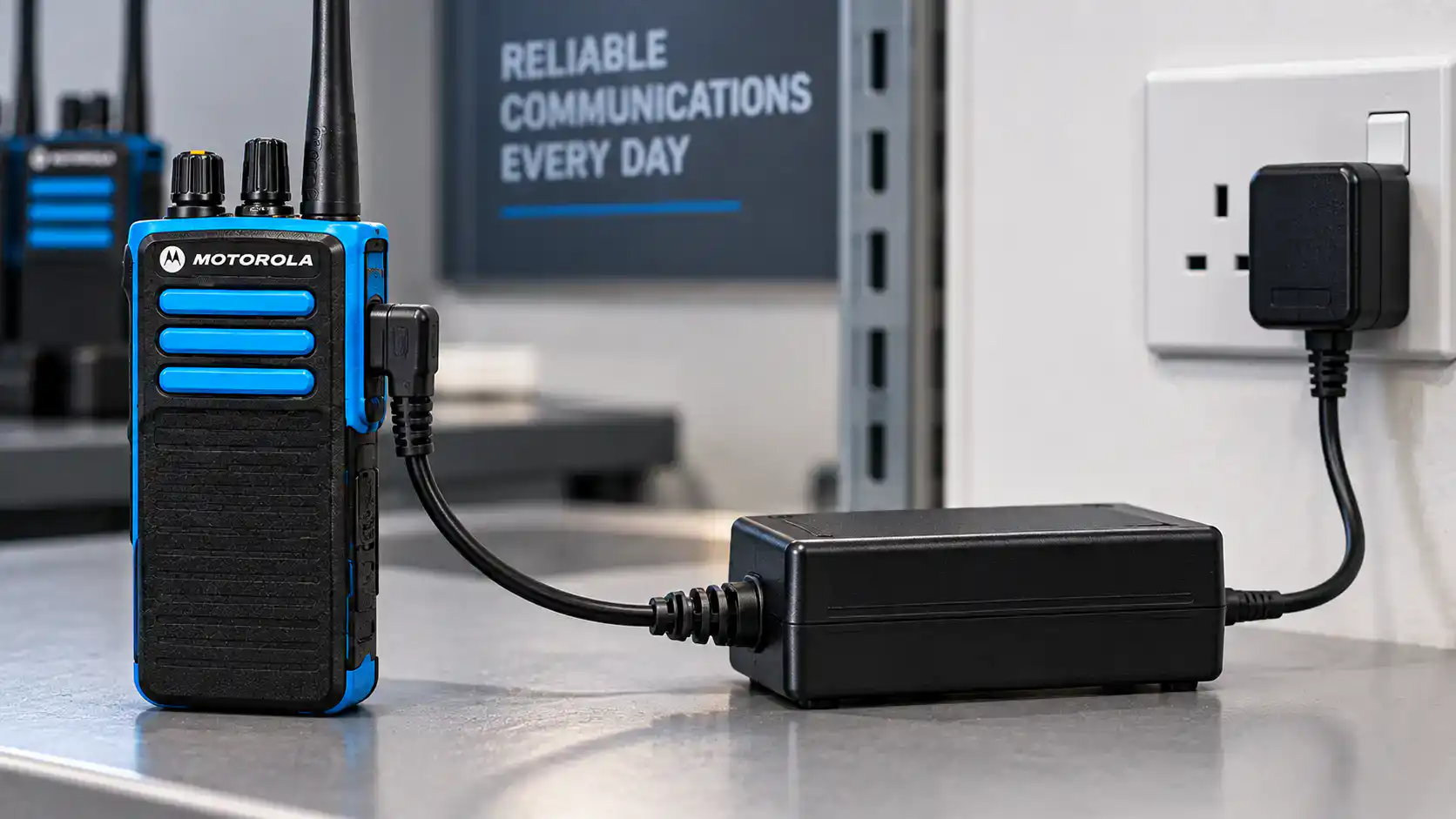
Battery Eliminator
A battery eliminator is an accessory that allows a two-way radio to be powered from an external powerAn antenna transmits and receives radio-frequency signals, allowing a two-way radio to communicate. Antenna type, frequency, height and location can all affect radio performance and coverage. source instead of its normal rechargeable battery.
A battery eliminator is typically designed to fit into the radio’s battery compartment in place of the standard battery pack. It connects the radio to an external power supply, allowing the radio to operate for extended periods without relying on its internal or removable battery.
Battery eliminators are particularly useful when a radio is being used as a base stationA base station is a fixed two-way radio installed at a permanent location, allowing an operator to communicate with handheld or mobile radios across a site or operating area., in a vehicle or at a fixed operating position where a continuous power supply is available.
How does a battery eliminator work?
A battery eliminator is designed to provide the radio with the electrical power it normally receives from its battery.
The eliminator usually takes power from an external source, such as a mains power supply or vehicle electrical system, and supplies the appropriate voltage to the radio.
The exact design varies between radio manufacturers and models. Some battery eliminators incorporate voltage regulation or other circuitry to ensure that the radio receives a suitable and stable supply.
In simple terms:
External power supply → battery eliminator → two-way radio
The battery eliminator effectively replaces the radio’s normal battery pack while allowing the radio to remain powered from the external source.
Battery eliminator vs battery charger
A battery eliminator and a battery charger perform different functions.
A battery charger supplies electrical energy to a rechargeable battery so that the battery can be used later.
A battery eliminator provides power directly to the radio and does not normally charge the radio’s battery.
A radio connected through a battery eliminator therefore operates from the external power supply rather than drawing its operating power from the installed battery.
Some equipment may combine external power and battery backup capabilities, but this depends on the specific radio and accessory.
Battery eliminators for base stations
Battery eliminators can be useful when a portable two-way radio needs to operate from a fixed location for long periods.
For example, a handheld radio could be positioned in an office, security room, reception area or control point and powered continuously using a suitable battery eliminator.
This can provide a practical alternative to repeatedly removing and recharging the radio’s battery.
However, where a radio is intended to operate permanently from a fixed location, a purpose-designed base station may be a more appropriate solution depending on the application.
Battery eliminators for vehicle use
Some battery eliminators are designed for use with a vehicle power supply.
A compatible eliminator can allow a portable radioA Portable Radio is a battery-powered two-way radio designed to be carried and operated by an individual, providing mobile communication for professional and operational users. to receive power from the vehicle’s electrical system rather than relying solely on its rechargeable battery.
This can be useful when a portable radio needs to remain powered for long periods while being used inside a vehicle.
The external power arrangement must be suitable for the radio and vehicle. A battery eliminator designed for one radio model should not be assumed to be compatible with another.
Battery eliminators and radio transmit power
A battery eliminator does not necessarily increase the transmit power or range of a two-way radio.
Its primary purpose is to provide a suitable external power source.
Radio performance remains dependent on the radio itself, its antennaAn antenna transmits and receives radio-frequency signals, allowing a two-way radio to communicate. Antenna type, frequency, height and location can all affect radio performance and coverage., operating frequencyAn antenna transmits and receives radio-frequency signals, allowing a two-way radio to communicate. Antenna type, frequency, height and location can all affect radio performance and coverage., transmitter characteristics and the surrounding environment.
However, a stable external power supply can help ensure that the radio has an appropriate power source during extended operation.
Battery eliminator compatibility
Battery eliminators are generally designed for particular radio models or product families.
Important compatibility considerations include:
- Radio make and model
- Battery compartment design
- Required voltage
- Current requirements
- Connector type
- External power source
- Vehicle or mains operation
- Physical fit
- Manufacturer approval
Using an unsuitable power supply or battery eliminator could damage the radio or create a safety risk.
For professional radio equipment, the manufacturer’s specifications should always be checked before using an external power accessory.
Battery eliminators and radio hire
Battery eliminators can sometimes be useful as part of a temporary radio systemA Radio System is a complete communication solution comprising two-way radios and, where required, equipment such as repeaters, antennas, base stations, mobile radios and network infrastructure. where one radio needs to remain at a fixed operating position.
For example, an event control point may require a radio that remains powered throughout the event rather than relying on a rechargeable battery.
A suitable battery eliminator can allow a compatible portable radio to operate from a continuous external supply while other staff use battery-powered handheld radios around the site.
DCS can advise on suitable radio accessories where a fixed or extended-power application requires an alternative to normal battery operation.
Battery eliminators and battery backup
A battery eliminator itself does not necessarily provide backup power.
If the external power source fails, the radio may stop operating unless the system has been designed to switch to a battery or other backup supply.
For communications that are particularly important, the power arrangement should therefore be considered as part of the overall radio system.
Possible solutions can include a backup battery, uninterruptible power supply or another suitable standby power system, depending on the installation.
Using the correct battery eliminator
A battery eliminator should always be matched to the radio for which it was designed.
The correct accessory ensures that the radio receives the appropriate electrical supply and that the physical connection is secure.
Generic or incorrectly specified power accessories should not be used simply because they appear to fit the radio.
For professional two-way radio systems, using manufacturer-approved or appropriately specified equipment is the safest approach.
Need to equip your team quickly? Hire radios from DCS and keep everyone connected wherever the work takes place.