
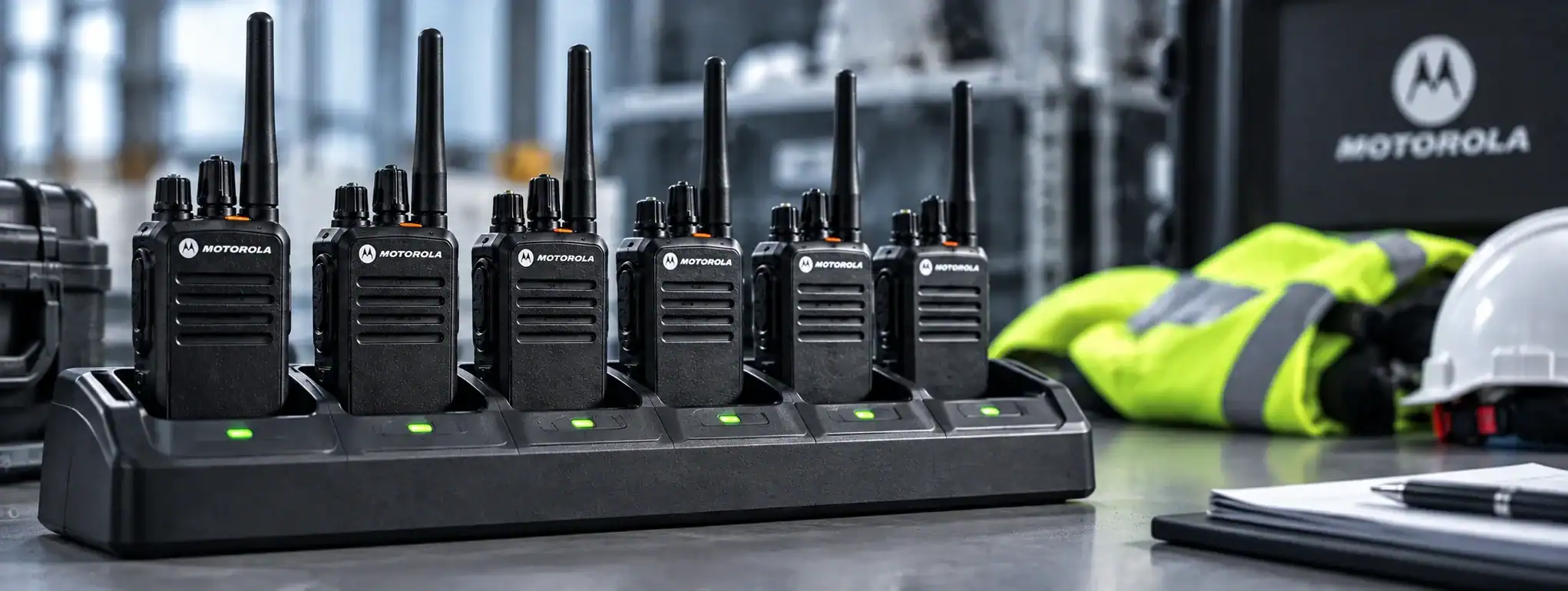
Charging Dock
A Charging Dock is a device used to recharge the battery of a two-way radio when the radio is placed into a dedicated charging cradle or slot. Charging docks provide a convenient way to keep radios charged and ready for use, particularly in workplaces where radios are returned to a central location at the end of a shift or between periods of use.
A charging dock is normally designed specifically for a particular radio model or range of compatible batteries. It connects to a mains powerAn antenna transmits and receives radio-frequency signals, allowing a two-way radio to communicate. Antenna type, frequency, height and location can all affect radio performance and coverage. supply or other suitable power source and transfers electrical power to the radio or battery through dedicated charging contacts.
Charging docks are commonly used with professional two-way radios in environments such as security, construction, manufacturing, hospitality, transport, warehousing and events.
How does a Charging Dock work?
A radio is placed into the charging dock so that its charging contacts align with the contacts in the dock.
The dock supplies the appropriate charging current to the radio’s battery through these contacts.
A typical charging arrangement is:
Mains power → charging dock → radio battery
The charging circuitry controls the charging process and, on compatible systems, can reduce or stop the charging current when the battery reaches its appropriate charge level.
The exact charging process depends on the radio, battery technology and charger design.
Charging Dock vs standard charger
A charging dock is generally designed to hold the radio securely while it charges.
A standard radio charger may simply connect to the radio using a charging connector or cable.
A dock can therefore make it quicker and easier for users to return a radio to its charging position.
For businesses with multiple radios, several individual charging docks can also be mounted together or incorporated into a multi-way charging station.
Single Charging Dock
A single charging dock is designed to charge one radio or battery at a time.
It can be useful where an individual user needs a dedicated charging location or where only a small number of radios are in use.
For example, a small security team might have individual charging docks positioned at a security office or control point.
Multi-way Charging Dock
A multi-way charging dock allows several radios or batteries to be charged simultaneously from one charging unit.
These are particularly useful for businesses and organisations operating larger numbers of radios.
A multi-way charging station can provide a central location where radios are returned after use, reducing the risk of radios being left uncharged or misplaced.
Charging Dock for spare batteries
Some charging docks are designed to charge spare batteries separately from the radio.
This can be useful where radios are used continuously across shifts and a spare battery needs to be available while the main battery is being used.
A charging system may therefore include separate positions for:
- Radios
- Spare batteries
- Multiple radios and batteries
The exact arrangement depends on the charger and radio model.
Charging Docks and professional two-way radios
Professional radio manufacturers commonly provide dedicated charging docks designed for their equipment.
The dock must be compatible with the radio or battery being charged.
Different radio models can use different battery designs, charging contacts and charging requirements, so a charger designed for one radio should not automatically be assumed to be suitable for another.
Using the correct manufacturer-approved or compatible charging equipment helps ensure that the battery is charged correctly.
Charging Dock and battery types
Charging docks can be used with different rechargeable battery technologies depending on the radio.
Professional two-way radios commonly use rechargeable battery packs based on technologies such as lithium-ion (Li-ion).
The charging characteristics depend on the battery chemistry, capacity and charger design.
The charger should always be suitable for the specific battery being used.
Charging Dock indicators
Many charging docks include indicators that show the charging status.
Depending on the model, these may indicate:
- Charging
- Fully charged
- Battery fault
- No battery detected
- Charging error
The meaning of the indicators varies between manufacturers, so users should refer to the equipment instructions for the particular dock.
Charging Dock and battery management
Proper charging is an important part of maintaining a professional radio fleet.
A suitable charging dock can make it easier for users to return radios to a known charging location after use.
For organisations with multiple radios, establishing a consistent charging routine can help ensure that radios are available with sufficient battery capacity at the start of each shift.
Battery condition should also be monitored because rechargeable batteries gradually lose capacity through normal use and ageing.
Charging Docks in radio hire
Charging docks are commonly supplied with two-way radios that are hired for events, construction projects, security operations and other temporary activities.
A hire package may include a dedicated charging dock or multi-way charger for the number of radios being supplied.
At the end of a shift or operational period, users can return the radios to the charging station so that they are ready for the next period of use.
For larger radio hireRadio Hire is the temporary rental of two-way radios and related communication equipment for events, projects and operational requirements, providing professional communication without purchasing the equipment. operations, multiple charging stations may be provided to accommodate the complete fleet.
Charging Dock and continuous radio operations
Charging docks can be particularly useful for organisations operating radios across multiple shifts.
For example, one group of workers can return their radios to the charging station at the end of a shift while the next group receives fully charged equipment.
Where radios are required continuously, spare batteries and additional charging positions can help maintain availability without taking radios out of service for extended periods.
Charging Dock safety
Charging equipment should be used in accordance with the manufacturer’s instructions.
Radios and batteries should be inspected for signs of damage, overheating or other faults.
Damaged batteries should not be used or charged.
Charging equipment should also be kept in an appropriate environment and protected from conditions that could damage the charger, radio or battery.
Specialist charging equipment may be required for radios used in hazardous environments, and equipment intended for ATEX applications must meet the relevant requirements.
Charging Dock and ATEX radios
Standard charging equipment should not automatically be assumed to be suitable for an ATEX-certified radio or battery.
Where radios are used in potentially explosive atmospheres, the charging arrangements must be appropriate for the specific equipment and operating environment.
In some applications, charging may need to take place outside the hazardous area.
The manufacturer’s instructions and applicable hazardous-area requirements should always be followed.
Charging Dock maintenance
Charging docks require relatively little maintenance, but the charging contacts should be kept clean and free from contamination.
Dust, dirt or corrosion on the contacts can prevent a radio from making a reliable electrical connection.
Users should also check that the dock, power supply and cables are not damaged.
If a radio repeatedly fails to charge, the problem may be caused by the battery, radio, charging contacts, power supply or charging dock.
Charging Dock and radio fleet management
For larger organisations, charging docks can form part of an overall radio fleet-management process.
A dedicated charging area can provide a central location where radios are:
- Stored
- Charged
- Collected
- Returned
- Checked
- Prepared for the next shift
This can help improve radio availability and reduce the likelihood of users starting a shift with an insufficiently charged battery.
Choosing a Charging Dock
The correct charging dock depends on the radio equipment and how it is being used.
Important considerations include:
- Radio model
- Battery type
- Number of radios
- Number of batteries
- Charging capacity
- Available power supply
- Single or multi-way charging
- Requirement for spare-battery charging
- Charging location
- Shift patterns
- Environmental conditions
For professional radio systems, the charger should be matched to the radio and battery specification.
Charging Docks and DCS
DCS can supply charging docks and multi-way charging systems for compatible professional two-way radios.
When specifying a radio systemA Radio System is a complete communication solution comprising two-way radios and, where required, equipment such as repeaters, antennas, base stations, mobile radios and network infrastructure., the charging requirements should be considered alongside the radios, batteries and accessories.
For larger radio fleets, an appropriate charging arrangement can help ensure that equipment is stored securely and remains ready for use.