
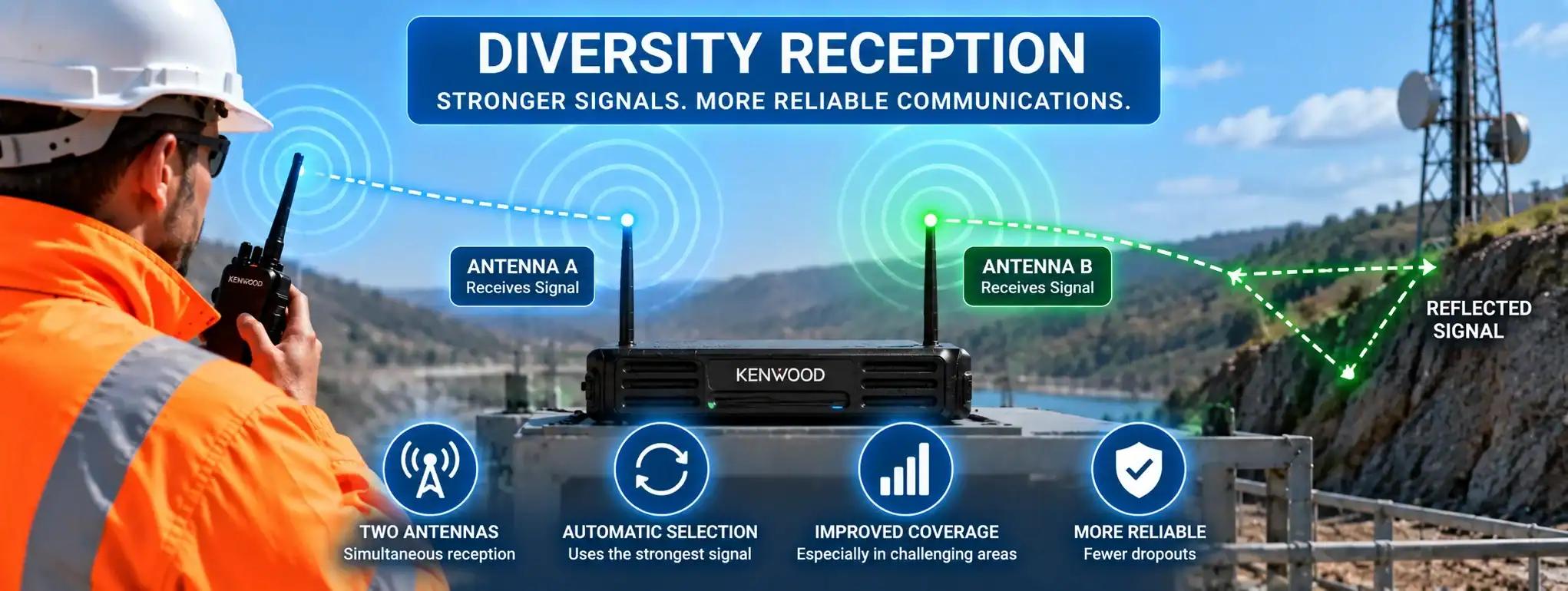
Diversity Reception
Diversity Reception is a radio reception technique that uses two or more antennas, or two or more receiving paths, to improve the reliability and quality of a radio signal. The radio or receiving system compares the available signals and uses the one that provides the best reception.
It is particularly useful in environments where radio signals can be affected by reflections, buildingsAn antenna transmits and receives radio-frequency signals, allowing a two-way radio to communicate. Antenna type, frequency, height and location can all affect radio performance and coverage., vehicles, machinery and other obstructions.
Diversity Reception is commonly used in professional radio equipment and infrastructureRadio infrastructure is the equipment and supporting systems behind a professional two-way radio network, including repeaters, antennas, base stations, network connections, power systems and dispatch equipment. where maintaining reliable communications is important.
How does Diversity Reception work?
A conventional radio receiverA Receiver is the part of a two-way radio that detects and processes incoming radio signals, converting them into audible voice or usable data for the user. normally receives a signal through a single antennaAn antenna transmits and receives radio-frequency signals, allowing a two-way radio to communicate. Antenna type, frequency, height and location can all affect radio performance and coverage..
A diversity receiver can use two or more receiving antennas positioned in different locations or orientations.
A simplified arrangement is:
Antenna A + Antenna B → Receiver → Best available signal
The receiver monitors the signals arriving through the different antennas and selects or combines them according to the particular diversity technique being used.
Because the antennas experience slightly different radio conditions, one may receive a stronger or cleaner signal than the other at a particular moment.
Why is Diversity Reception useful?
Radio signals do not always travel directly from the transmitter to the receiver.
Signals can reflect from buildings, walls, vehicles and other structures. These reflected signals can sometimes combine with the direct signal in a way that causes the received signal to weaken at a particular location.
This can create areas of poor reception or temporary signal fading.
Using multiple receiving paths reduces the likelihood that all available signals will be affected by the same problem at the same time.
Diversity Reception and multipath fading
Multipath fading occurs when a radio signal reaches the receiving antenna through several different paths.
For example, a signal may travel directly from a radio to a receiver while another part of the signal reflects from a building.
The different signals can arrive at the receiver at slightly different times and phases.
Depending on their relationship, they can reinforce each other or partially cancel each other.
This can result in rapid changes in signal strength as a radio user moves around an environment.
Diversity Reception can help reduce the effects of this type of fading.
Antenna diversity
Antenna diversity uses two or more antennas connected to a receiving system.
The antennas are normally separated by a suitable distance or positioned differently so that they experience different radio conditions.
If one antenna happens to be in a signal fade, another antenna may still receive a usable signal.
The receiver can then select the stronger or better-quality signal.
Spatial diversity
Spatial diversity is a form of diversity reception in which antennas are physically separated.
Because each antenna occupies a different position, the radio signals arriving at each antenna can be affected differently by reflections and obstructions.
Spatial separation can therefore improve the probability that at least one receiving path has a good signal.
This technique can be particularly useful in buildings and other environments where multipath effects are significant.
Diversity Reception and repeater systems
Diversity Reception can be used in radio infrastructure such as repeaters and base stations.
A repeaterA Repeater receives a two-way radio transmission and retransmits it, usually from an elevated location, to extend the coverage and reliability of a radio communication system. receiver may use multiple antennas or receiving paths to improve its ability to receive transmissions from mobile or handheld radios.
Improving the receiver’s ability to hear incoming transmissions can contribute to the overall reliability of the radio systemA Radio System is a complete communication solution comprising two-way radios and, where required, equipment such as repeaters, antennas, base stations, mobile radios and network infrastructure..
The exact design depends on the repeater and antenna system.
Diversity Reception at a base station
A Base StationA base station is a fixed two-way radio installed at a permanent location, allowing an operator to communicate with handheld or mobile radios across a site or operating area. may use multiple receiving antennas or receivers as part of a diversity system.
This can be particularly useful where the base station needs to receive signals from radios operating throughout a large or complex coverageRadio Coverage is the geographical area in which a two-way radio system can provide reliable communication. Coverage depends on the radios, antennas, frequency, terrain, buildings and system infrastructure. area.
The antennas may be installed at suitable positions to provide different reception characteristics.
Diversity Reception and handheld radios
Diversity Reception is less commonly associated with a basic handheld two-way radio using a single antenna.
Some specialist or advanced radio equipment can incorporate multiple receiving paths, but the availability and implementation depend on the radio design.
Diversity is more commonly encountered in fixed radio infrastructure, base stations, repeaters and specialised receiving equipment.
Diversity Reception and mobile radios
Mobile radioA Mobile Radio is a two-way radio designed to be installed in a vehicle. It normally uses the vehicle's power supply and an external antenna to provide reliable communication while travelling or working in the field. systems can also use diversity techniques where suitable equipment and antenna arrangements are available.
A vehicle may have multiple antennas or a receiver system designed to use different receiving paths.
This can help in environments where reflections from buildings, other vehicles or structures cause changing signal conditions.
Diversity Reception and digital radio
Diversity Reception can be used with digital radio systems.
Digital systems are still affected by multipath propagation and signal fading, even though the transmitted information is digital.
Using multiple receiving paths can improve the likelihood of maintaining a usable digital signal.
This can be particularly beneficial where radio users operate inside large buildings or dense urban environments.
Diversity Reception and DMR
DMR (Digital Mobile Radio) systems can use diversity techniques within suitable infrastructure and equipment.
For example, a DMR repeater or base station may use multiple receiving paths to improve reception of signals from handheld or mobile radios.
Diversity Reception is not itself a requirement of the DMR standard; it is a radio-system design technique that may be incorporated into compatible equipment.
Diversity Reception and analogue radio
Diversity Reception can also be used with analogue radioAnalogue radio uses continuously varying radio signals to transmit voice communication. It remains widely used for reliable two-way communication across business, industry, events, security and other applications. systems.
The underlying principle remains the same: multiple receiving paths provide the receiver with more than one opportunity to obtain a usable signal.
The technique can therefore be applied to both analogue and digital radio systems.
Diversity Reception and radio coverage
Diversity Reception can improve reception reliability, but it does not automatically increase the geographical coverage of a radio system.
There is an important distinction between:
Coverage: the area in which the radio system can provide communication.
Reception reliability: how consistently a usable signal can be received within that area.
Diversity can improve reliability within an existing coverage area, particularly where fading and multipath are causing problems.
Diversity Reception and dead spots
A Dead SpotA Dead Spot is an area where two-way radio communication is weak, unreliable or unavailable. Dead spots can be caused by buildings, terrain, distance, interference or inadequate radio coverage. is an area where reliable radio communication cannot be maintained.
Diversity Reception can sometimes reduce small or intermittent dead spots caused by multipath fading.
However, it cannot necessarily overcome a genuine coverage limitation caused by distance, terrain or significant physical obstruction.
Where a dead spot is caused by insufficient coverage, other solutions such as a repeater, additional radio site or improved antenna position may be required.
Diversity Reception and antenna positioning
The effectiveness of diversity depends partly on how the antennas are positioned.
Antennas may be separated horizontally or vertically, depending on the system design.
The appropriate spacing and positioning depend on the radio frequencyAn antenna transmits and receives radio-frequency signals, allowing a two-way radio to communicate. Antenna type, frequency, height and location can all affect radio performance and coverage., antenna characteristics, environment and diversity technique being used.
Professional radio engineers can determine suitable antenna arrangements as part of system design.
Diversity Reception and polarisation
Antenna polarisation can also be considered when designing a diversity system.
Using antennas with different orientations can result in different responses to incoming radio signals.
In some applications, polarisation diversity can therefore provide another way of obtaining more independent receiving paths.
The appropriate arrangement depends on the radio system and operating environment.
Diversity Reception and signal selection
A diversity receiver may use different methods to determine which signal to use.
One approach is selection diversity, where the receiver monitors multiple signals and selects the one with the best measured characteristics.
Other systems can combine signals from multiple receiving paths.
The exact technique depends on the equipment.
Diversity Reception and signal combining
Some diversity systems combine information from multiple receiving paths rather than simply selecting one antenna.
Combining can potentially produce a better-quality received signal than relying on one receiving path alone.
The implementation is dependent on the receiver design and the type of radio system.
Diversity Reception and buildings
Diversity Reception can be particularly useful inside large buildings.
Signals can reflect from:
- Walls
- Floors
- Ceilings
- Steel structures
- Machinery
- Vehicles
- Other large objects
These reflections can create rapidly changing signal conditions.
Multiple receiving antennas can provide different reception paths and help reduce the impact of these variations.
Diversity Reception and warehouses
Large warehouses can contain extensive metal racking, machinery and storage structures that produce significant signal reflections.
A diversity receiver at a fixed radio installation can potentially provide more consistent reception from handheld radios operating around the warehouse.
The effectiveness depends on the specific building and radio system.
Diversity Reception and urban environments
Dense urban environments can create complex radio propagation conditions.
Buildings and other structures can reflect radio signals, producing multipath effects.
Diversity techniques can help receivers cope with these changing signal conditions.
They are therefore useful in some professional radio systems operating in cities and built-up areas.
Diversity Reception and radio system design
Diversity Reception is one of many techniques that can be used when designing a reliable professional radio system.
Other considerations include:
- FrequencyFrequency is the number of cycles a radio wave completes each second, measured in Hertz. In two-way radio, frequency determines where a transmission operates within the radio spectrum. selection
- Antenna height
- Antenna position
- Transmit powerAn antenna transmits and receives radio-frequency signals, allowing a two-way radio to communicate. Antenna type, frequency, height and location can all affect radio performance and coverage.
- Receiver sensitivity
- Repeater location
- Site selection
- Coverage testing
- InterferenceRadio interference occurs when unwanted radio-frequency signals or electrical noise disrupt two-way radio communications, causing distorted audio, broken transmissions, reduced coverage or loss of communication. management
Diversity should be considered as part of the complete radio system rather than as a replacement for proper coverage planning.
Diversity Reception limitations
Diversity Reception cannot overcome every radio coverage problem.
It is most useful where multiple receiving paths experience different signal conditions, particularly because of multipath fading.
If there is no usable signal at any of the receiving antennas, diversity cannot create one.
Similarly, a major physical obstruction or insufficient repeater coverage may require a different engineering solution.
Diversity Reception and coverage testing
Testing is important when determining whether diversity is providing a useful improvement.
Engineers can compare radio performance with different receiving configurations and identify areas where multipath fading is affecting communications.
This can help determine whether antenna diversity or another coverage solution would provide the best result.
Diversity Reception and professional radio systems
Diversity Reception is generally a specialist radio engineering technique rather than a feature that users need to operate manually.
When properly designed, the system can automatically select or combine the best available receiving signal.
This allows radio users to continue communicating without having to know which antenna or receiving path is being used.
Diversity Reception and DCS
DCS can assess radio coverage and reception requirements when designing professional two-way radio systems.
Where multipath fading or difficult radio propagation is affecting communications, suitable antenna arrangements, repeater infrastructure or diversity reception techniques may be considered as part of the overall system design.