
The Complete Guide to Two-Way Radios & Professional Mobile Radio (PMR)
Part 3 - Chapter 13
Dispatch & Control Room Systems
Dispatch & Control Room Systems
The Operational Hub of Professional Radio Communications
While handheld radios are the most visible part of a communication system, the true operational intelligence often resides elsewhere—in the control room.
Whether managing a busy airport, coordinating a nationwide logistics fleet, overseeing a hospital's estates team or directing security personnel at a major event, control rooms play a vital role in ensuring information reaches the right people at the right time.
Modern dispatch systems have evolved far beyond simple desktop radios. Today's solutions combine voice communications with GPS tracking, digital mapping, messaging, call logging, incident managementIncident Management is the process of coordinating people, communications and resources during an incident. Two-way radios can provide rapid communication between teams, control rooms and responders. and business software integration. They provide supervisors with real-time visibility of operations, enabling faster decision-making and more effective resource deployment.
For organisations responsible for coordinating multiple teams or responding to time-critical incidents, dispatch systems have become an indispensable part of professional communication networks.
This chapter explores how dispatch and control room systems work, the technologies involved and how they help organisations improve efficiency, safety and operational oversight.
What Is a Dispatch System?
A dispatch system is a central communication platform that enables supervisors, controllers and managers to coordinate radio users across an organisation.
Depending on the size and complexity of the operation, a dispatch system may include:
- Desktop radio consoles
- Computer software
- Digital mapping
- GPS tracking
- Call logging
- Incident management tools
- Messaging systems
- NetworkA Network is a connected system of radios, equipment and infrastructure that allows users to communicate across a defined area. Radio networks can range from simple radio-to-radio systems to large multi-site networks. monitoring
- Reporting dashboards
Rather than simply listening to radio traffic, dispatch operators gain a comprehensive overview of operational activity.
Did You Know?
Some dispatch systems can automatically display a user's live GPS location and nearby CCTV feeds when an emergency alarmAn Emergency Alarm allows a two-way radio user to quickly alert a dispatcher, control room or other authorised users that assistance may be required. is triggered, helping operators respond more quickly and effectively.
The Role of the Control Room
The control room acts as the central point for communication and coordination.
Its responsibilities often include:
- Receiving incident reports
- Allocating resources
- Monitoring radio traffic
- Tracking personnel
- Coordinating emergency responses
- Managing operational priorities
- Recording communications
- Escalating incidents
In many organisations, the control room operates continuously throughout the day and night.
How Dispatch Systems Work
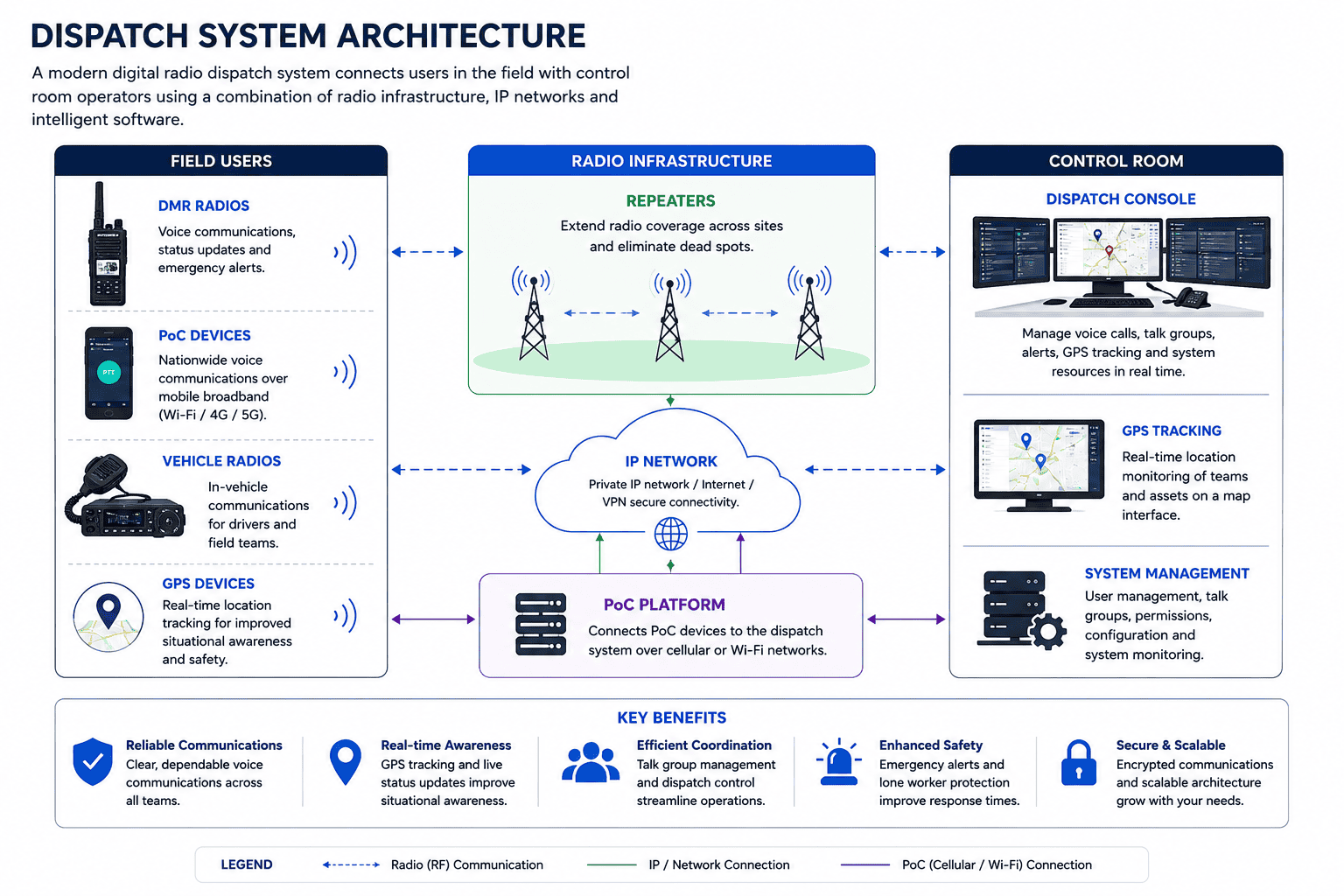
A modern dispatch platform connects directly to the organisation's communication network.
When a user transmits:
- The radio message reaches the communication network.
- The dispatch console receives the transmissionTransmission is the process of sending voice, data or signalling from a radio using a radio-frequency signal to another radio, repeater or communication system..
- The operator can hear the message.
- The software identifies the transmitting user.
- Additional information such as GPS location or talk groupA Talk Group is a predefined group of users or radios within a two-way radio system that share a common communication group, allowing teams to communicate without involving other users. may also be displayed.
This allows operators to make informed decisions quickly.
Dispatch Consoles
The dispatch console is the operator's primary interface.
It may consist of:
- Multiple computer monitors
- Desktop microphones
- Loudspeakers
- Touchscreen controls
- Headsets
- Foot switches
- Communication software
Unlike traditional desktop radios, modern consoles provide a complete operational view rather than simply voice communication.
Expert Insight
Effective dispatch is about more than voice communication. Combining live GPS tracking, operational data and job information gives dispatch operators the visibility they need to make faster decisions, improve coordination and respond more effectively to incidents.
User Identification
Every professional radio can be assigned a unique identifier.
When a transmission is received, the dispatch system can display:
- User name
- Radio ID
- Department
- Vehicle number
- Call sign
- Operational status
This eliminates uncertainty about who is transmitting.
GPS Tracking
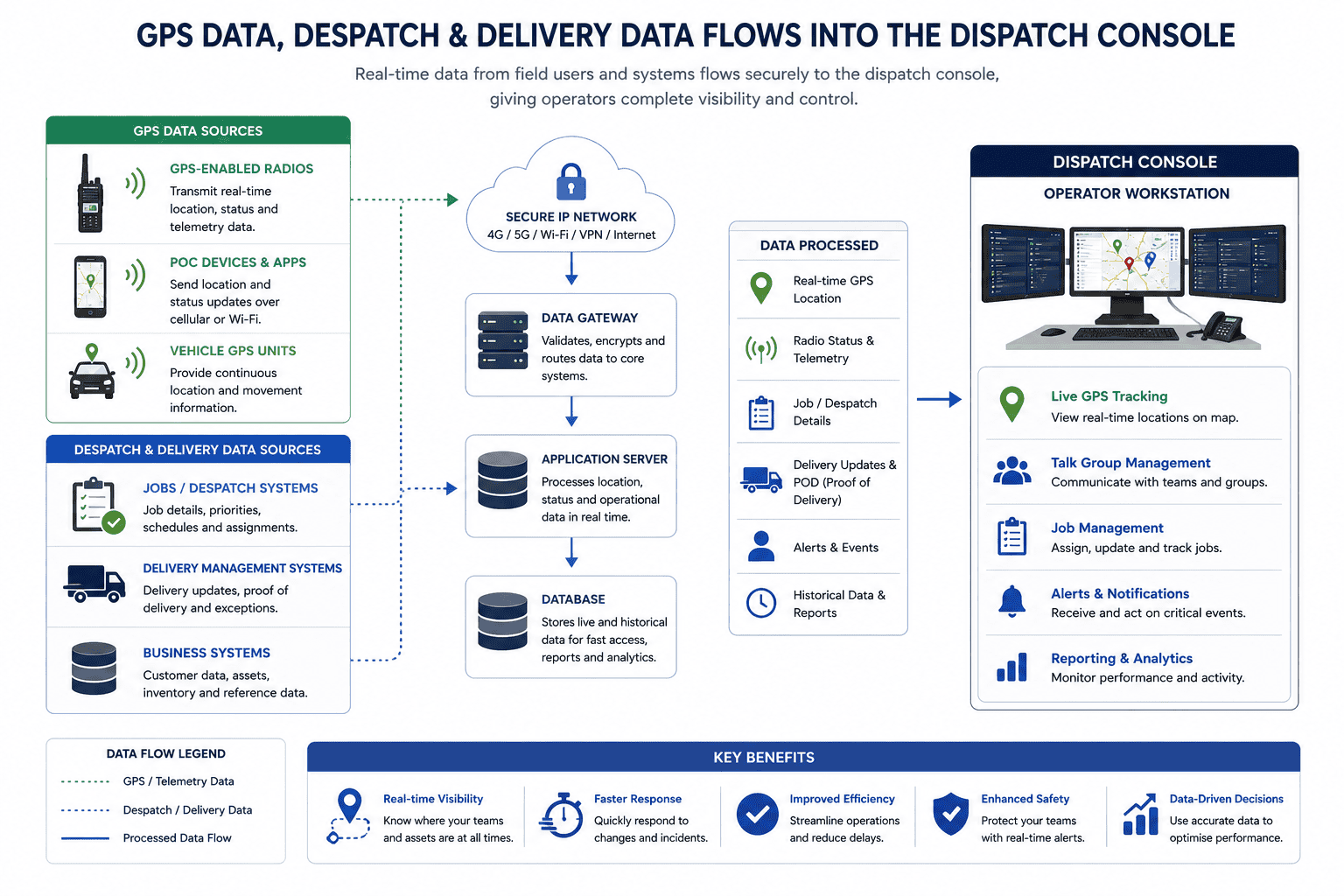
GPS integration is one of the most valuable features of modern dispatch systems.
Supervisors can monitor:
- Field engineers
- Security officers
- Vehicle fleets
- Delivery drivers
- Maintenance teams
Location data supports:
- Faster incident response
- Improved dispatch decisions
- Staff safety
- Operational efficiency
Digital Mapping
Most dispatch platforms include interactive maps.
These allow operators to:
- View staff locations
- Monitor vehicle movements
- Identify nearby personnel
- Display site plans
- Track incident locations
For organisations operating across large geographic areas, mapping significantly improves situational awareness.
Talk Group Management
Large organisations often require different departments to communicate independently while remaining connected through the same radio network. Digital Mobile Radio (DMR)Digital Mobile Radio (DMR) is an ETSI digital radio standard for professional two-way communications, supporting voice, group calling, data and other features on compatible radio systems. allows this by using talk groups, enabling teams to communicate efficiently without unnecessary radio traffic from other departments.
Each talk group functions as a dedicated communication channelA two-way radio channel is a programmed set of communication settings, typically including frequency and signalling, that allows compatible radios to communicate with one another., ensuring messages are delivered only to the users who need to hear them. This improves coordination, reduces congestion and makes managing large workforces significantly easier.
| Talk Group | Typical Users |
|---|---|
| Security | Security Officers |
| Maintenance | Engineers |
| Warehouse | Operations Team |
| Management | Supervisors |
| Emergency | Incident Response Team |
Control room and dispatch operators can monitor multiple talk groups simultaneously, allowing them to coordinate communications across different departments and quickly switch between groups when responding to incidents or changing operational priorities.
Individual and Group Communication
Dispatch systems support different communication methods.
Individual Calls
The operator contacts a specific user.
Useful for:
- Confidential conversations
- Technical support
- Individual instructions
Did You Know?
DCS 2 Way Radio provides everything needed to deploy a complete business communication system, including equipment, installation, system configuration, user training and ongoing technical support.
Group Calls
A message is broadcast to an entire team.
Examples include:
- Warehouse operations
- Security patrols
- Event staff
- Engineering teams
All-Call
Some systems allow authorised users to broadcast to every connected radio.
Typically reserved for:
- Major incidents
- Emergency announcements
- Site evacuations
Emergency Alarm Handling
When a user activates an emergency buttonAn Emergency Button is a dedicated two-way radio control that allows users to quickly send an emergency alert to a dispatcher, control room or authorised radio users., the dispatch system may automatically:
- Highlight the alert.
- Display the user's identity.
- Show GPS location.
- Prioritise the communication.
- Record the incident.
This enables operators to respond rapidly and coordinate assistance.
Lone Worker Monitoring
Dispatch platforms often monitor Lone WorkerA Lone Worker is someone who works without direct supervision or immediate assistance nearby. Compatible two-way radios can provide safety features such as timed check-ins, emergency alerts and GPS location. alerts generated by compatible radios.
If an employee:
- Misses a scheduled welfare check
- Fails to respond
- Triggers an automatic alarm
the operator receives an immediate notification.
This capability supports organisations with employees working alone or in remote locations.
Man Down Alerts
Where compatible radios include motion sensors, dispatch systems can display:
- Man DownMan Down is a safety feature on some professional two-way radios that can detect a possible fall or unusual radio position and automatically raise an alert if the user does not respond. alerts
- User identity
- Last known location
- Time of activation
This information helps emergency responders reach the affected individual more quickly.
Call Recording
Many organisations record radio communications.
Recording can assist with:
- Incident investigations
- Training
- Quality assurance
- Compliance
- Operational review
Depending on the organisation, recordings may be searchable by:
- User
- Time
- Talk group
- Incident number
Organisations should ensure recording practices comply with applicable legal and privacy requirements.
Messaging
Many dispatch systems support text communication.
Operators can send:
- Job details
- Addresses
- Instructions
- Status requests
- Operational updates
This is particularly useful where spoken communication may be inappropriate or unnecessary.
Incident Management
Some dispatch platforms include incident management tools.
Operators can:
- Create incident records
- Allocate personnel
- Record actions taken
- Monitor progress
- Close incidents
- Generate reports
This creates a structured record of operational activity.
Integration with Business Systems
Modern dispatch platforms increasingly integrate with wider organisational systems.
Examples include:
CCTV
Operators can automatically display nearby camera feeds when incidents occur.
Access Control
Door access events may trigger communication workflows.
Fire Alarm Systems
Alarm activations can generate automatic notifications.
Building Management Systems
Facilities teams can receive alerts from critical infrastructureRadio infrastructure is the equipment and supporting systems behind a professional two-way radio network, including repeaters, antennas, base stations, network connections, power systems and dispatch equipment..
Fleet Management
Vehicle information can be displayed alongside radio communications.
Workforce Management
Job allocation and communication become closely integrated.
Multi-Site Operations
Many organisations operate from multiple locations.
Modern dispatch systems allow operators to coordinate:
- Regional offices
- Warehouses
- Distribution centres
- Construction sites
- Remote engineers
through a single communication platform.
Supporting Business Continuity
Dispatch systems contribute significantly to organisational resilience.
They provide:
- Central oversight
- Faster decision-making
- Better resource allocation
- Operational visibility
- Improved incident response
During major incidents, these capabilities become particularly valuable.
Common Industries Using Dispatch Systems
Dispatch platforms are widely used across numerous sectors.
Logistics
Coordinating warehouse operations and vehicle fleets.
Security
Monitoring patrol officers and managing incidents.
Healthcare
Supporting estates teams, facilities management and security.
Utilities
Dispatching engineers across wide geographical areas.
Manufacturing
Coordinating production, maintenance and quality teams.
Construction
Managing multiple contractors and site supervisors.
Hospitality
Supporting maintenance, housekeeping and security.
Events
Coordinating organisers, contractors, medical teams and emergency services.
Choosing the Right Dispatch Solution
When evaluating dispatch systems, organisations should consider:
- Number of users
- Number of sites
- GPS requirements
- Reporting needs
- Integration requirements
- Future growth
- Mobile workforce
- Communication technologies in use
The chosen platform should support both current operational needs and future expansion.
The Future of Dispatch
Dispatch technology continues to evolve rapidly.
Emerging developments include:
- Artificial intelligence-assisted dispatch
- Automatic voice transcription
- Predictive incident analysis
- Integrated video communication
- Wearable device support
- Drone integration
- Enhanced cloud services
These technologies will continue improving operational awareness and decision-making.
Key Takeaways
- Dispatch systems provide centralised control of professional communication networks.
- Modern platforms integrate voice, GPS, mapping, messaging and incident management.
- Control rooms improve coordination, resource allocation and operational visibility.
- Emergency alerts, Lone Worker monitoring and Man Down detection strengthen employee safety.
- Integration with CCTV, access control and business software enhances operational efficiency.
- Dispatch systems support organisations ranging from single-site operations to nationwide enterprises.
Expert Insight
- The value of a dispatch system lies not only in communication but in visibility.
- Knowing who is available, where they are located and what they are doing enables organisations to make better operational decisions. As businesses become more distributed, dispatch platforms are increasingly acting as operational command centres rather than simply radio consoles.
Business Perspective
A professional radio systemA Radio System is a complete communication solution comprising two-way radios and, where required, equipment such as repeaters, antennas, base stations, mobile radios and network infrastructure. becomes significantly more powerful when combined with an effective dispatch platform.
By bringing together communication, location information and operational intelligence, dispatch systems help organisations coordinate resources more effectively, improve response times and maintain greater control over day-to-day operations.
For businesses managing multiple teams or complex environments, dispatch technology represents a strategic investment in operational efficiency and resilience.
Frequently Asked Questions
What is a radio dispatch system?
A radio dispatch system is a central communication platform that enables operators to manage radio users, monitor activity, track locations and coordinate operational responses.
Do all businesses need a dispatch system?
No. Smaller organisations using only a few radios may not require one. Dispatch systems become increasingly valuable as the number of users, sites and operational complexity grows.
Can dispatch software track radio users?
Many modern systems support GPS tracking, allowing authorised operators to view the location of compatible radios and vehicles.
Are radio conversations recorded?
Many organisations choose to record communications for operational review, training or compliance purposes. Recording capabilities depend on the dispatch platform and organisational requirements.
Can dispatch systems work with PoC and DMR?
Yes. Many modern dispatch platforms support hybrid communicationHybrid Communication combines two or more communication technologies, such as two-way radio, DMR, cellular, Wi-Fi or IP networks, allowing different systems or users to communicate through a common platform. environments, enabling operators to communicate with DMR radios, PoC devices, vehicle units and smartphone applications from a single interface.