

H.J. Heinz Case Study
The Client
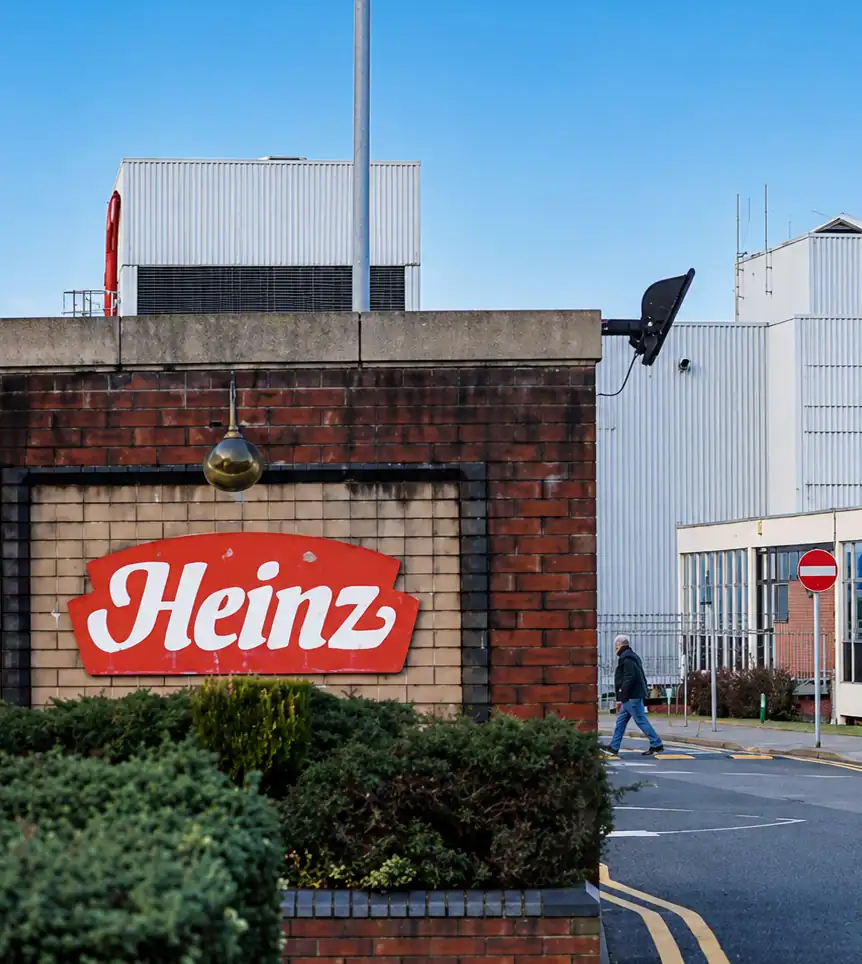
The H. J. Heinz factory in Wigan, Greater Manchester is the largest food processing plant in Europe, as well as being the largest H. J. Heinz facility worldwide. The 55-acre food manufacturing facility was opened in 1959 and employs 1,200 staff members.
As a large and extremely fast-paced site that produces between 1.5 million and 3 million cans of Heinz Baked Beans each day, it is paramount that reliable means of communication are present across the site.
The Challenge
The Requirement
Prior to engaging DCS 2 Way Radio, H. J. Heinz's Wigan facility was operating an ageing digital radio communication system consisting of Motorola DP3400 and DP3600 series handheld radios. While these radios had provided reliable service for many years, both models have now been discontinued and were becoming increasingly difficult and costly to maintain. The site was also utilising a Motorola DR3000 repeaterA Repeater receives a two-way radio transmission and retransmits it, usually from an elevated location, to extend the coverage and reliability of a radio communication system. to extend radio coverageRadio Coverage is the geographical area in which a two-way radio system can provide reliable communication. Coverage depends on the radios, antennas, frequency, terrain, buildings and system infrastructure. across the facility.
As the equipment aged, staff began experiencing a growing number of issues that were affecting day-to-day communications. Battery performance had deteriorated significantly, resulting in reduced operating times and the need for more frequent charging. In addition, many of the handheld radios were suffering from wearAn antenna transmits and receives radio-frequency signals, allowing a two-way radio to communicate. Antenna type, frequency, height and location can all affect radio performance and coverage. and tear to critical components, including volume controls and channelA two-way radio channel is a programmed set of communication settings, typically including frequency and signalling, that allows compatible radios to communicate with one another. selector switches. These faults often made the radios difficult to operate and reduced their overall reliability.
Given the importance of clear and dependable communication within a busy food manufacturing environment, these issues presented a challenge for both operational efficiency and staff safety.
H. J. Heinz required a modern replacement solution that would provide greater reliability, improved performance and access to the latest safety features available within today's digital radio technology.
Following a detailed site surveyA Site Survey is an assessment of a location to determine whether a two-way radio system will provide the required coverage, reliability and performance. and equipment audit, DCS 2 Way Radio was able to recommend a future-proof communication solution that would not only replace the ageing infrastructureRadio infrastructure is the equipment and supporting systems behind a professional two-way radio network, including repeaters, antennas, base stations, network connections, power systems and dispatch equipment. but also deliver enhanced coverage, improved audio quality and increased reliability throughout the facility.
The Solution
Our Recommendation
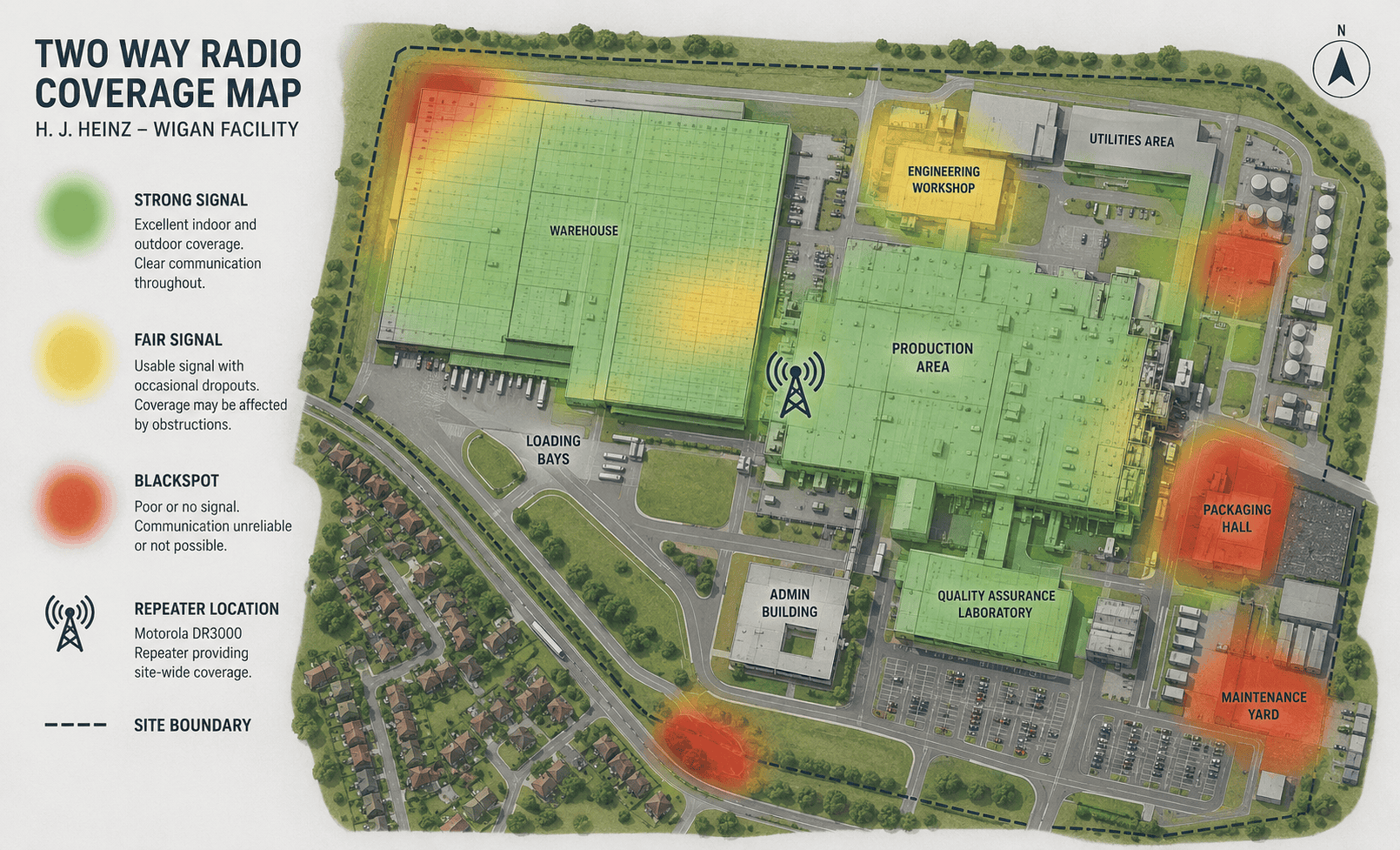
DCS 2 Way Radio carried out a comprehensive audit of the client’s existing two-way radio systemA Radio System is a complete communication solution comprising two-way radios and, where required, equipment such as repeaters, antennas, base stations, mobile radios and network infrastructure., alongside a detailed survey of the entire factory site. During the assessment, our engineers identified several communication black spots across the facility that were impacting day-to-day operations and staff safety.
The investigation revealed that the coverage issues were primarily caused by ageing radio equipment, large machinery and structural obstacles blocking radio signals, as well as a lack of regular system maintenance. These factors combined to create areas where communication was unreliable or, in some cases, completely unavailable.
Following the audit, DCS 2 Way Radio was able to provide a detailed report outlining the weaknesses within the existing system and recommend a modern communication solution designed to deliver reliable coverage throughout the factory. By addressing these issues, the client was able to improve communication between departments, enhance operational efficiency, and ensure staff could remain connected across the entire site.
The Implementation
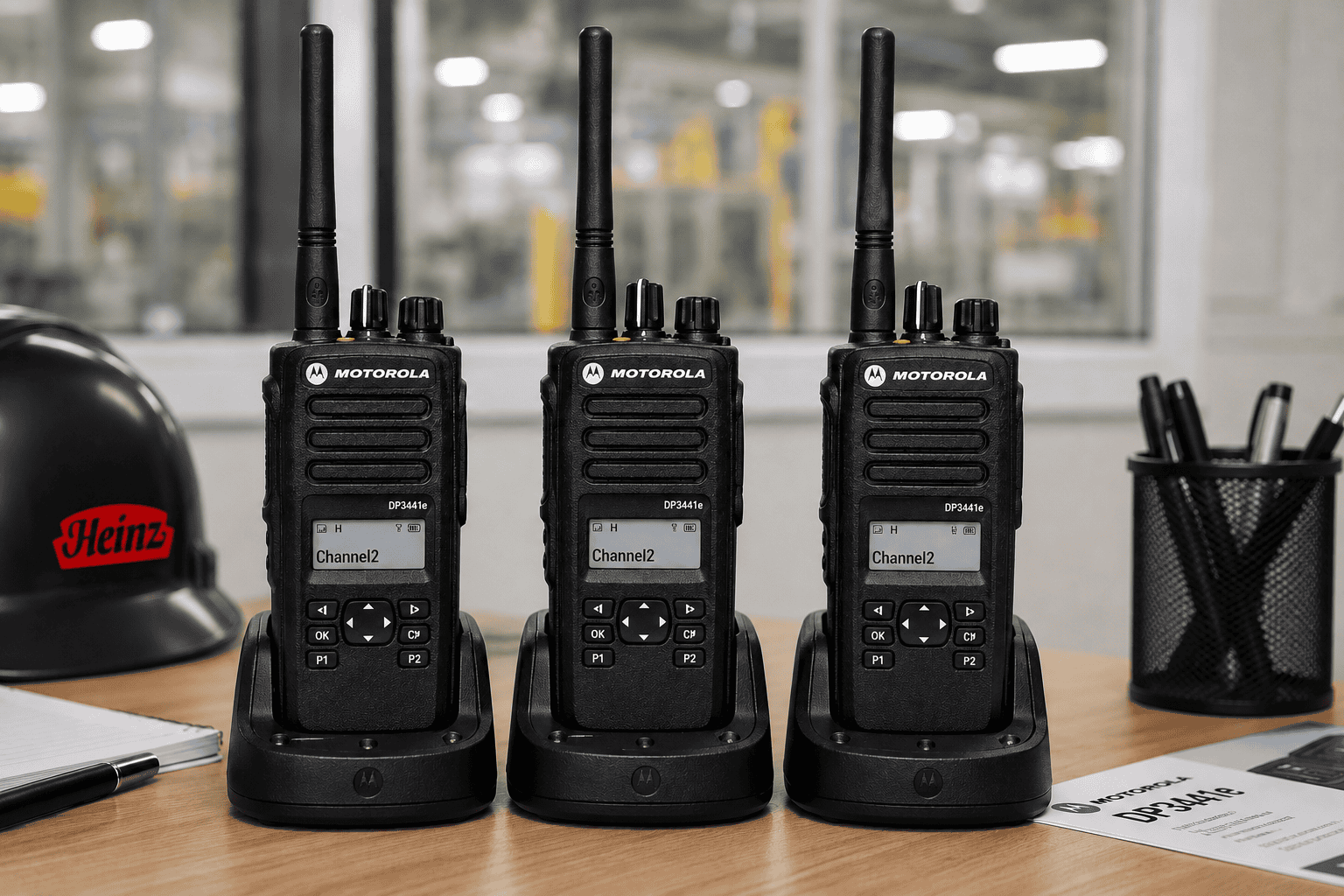
We upgraded them to the more advanced, higher tier Motorola DP3441e digital handheld radio which utilises their existing Motorola DR3000 repeater base stationA base station is a fixed two-way radio installed at a permanent location, allowing an operator to communicate with handheld or mobile radios across a site or operating area. to achieve effective coverage throughout the factory site.
The DP3441e handheld radio is proving to be an excellent all-round radio, with its main benefits being:
- Leading coverage performance
- Enhanced audio quality
- Integrated Wi-FiWi-Fi is a wireless networking technology that connects compatible devices to a local or wider network. In radio systems, it can support programming, updates, data services and IP-based communications. and Bluetooth 4.0
- Lightweight, compact design for
- convenient portability
- Indoor location tracking
- IP68 rating for protection against dust and water
Your content goes here. Edit or remove this text inline or in the module Content settings. You can also style every aspect of this content in the module Design settings and even apply custom CSS to this text in the module Advanced settings.
The Results
Deployment
By upgrading to a modern, high-performance two-way radio system, H. J. Heinz has significantly improved communications across its food processing facility while also enhancing staff safety. The new radio solution provides a range of advanced features specifically designed for demanding industrial environments, including an emergency alarmAn Emergency Alarm allows a two-way radio user to quickly alert a dispatcher, control room or other authorised users that assistance may be required. button, lone workerA Lone Worker is someone who works without direct supervision or immediate assistance nearby. Compatible two-way radios can provide safety features such as timed check-ins, emergency alerts and GPS location. monitoring, and man downMan Down is a safety feature on some professional two-way radios that can detect a possible fall or unusual radio position and automatically raise an alert if the user does not respond. functionality.
These safety features are particularly important in large manufacturing and processing facilities where employees may work alone or in isolated areas. In the event of an incident, staff can quickly raise an alarm, allowing supervisors and colleagues to respond immediately. This helps H. J. Heinz maintain high health and safety standards while providing additional reassurance for employees working throughout the site.
To meet the client's requirements, DCS 2 Way Radio supplied the Motorola DP3441e digital handheld radio. Compact, durable and packed with advanced functionality, the DP3441e is ideally suited to busy food production environments. Its robust push-to-talk technology delivers clear, reliable communications even in challenging conditions, ensuring staff can stay connected at all times.
The upgraded radio system has provided H. J. Heinz with dependable site-wide communications, improved worker safetyWorker Safety refers to measures used to protect employees from workplace risks. Two-way radios can support worker safety through instant communication, emergency alerts, Lone Worker and Man Down functions., and a future-proof solution capable of supporting the ongoing needs of a modern food manufacturing operation.
After Care
At DCS 2 Way Radio, we are committed to ensuring that every communication solution we provide is perfectly tailored to our client's operational requirements. Following the installation and commissioning of the new two-way radio system, our team delivered comprehensive training to ensure staff were confident using the equipment and fully understood the available features and functionality.
Rather than simply completing the installation and leaving the site, we encouraged the client to use the new radio system in their day-to-day operations for a period of one month. This allowed staff to gain real-world experience of the equipment and identify any additional requirements that may arise during normal working conditions.
After the evaluation period, DCS 2 Way Radio returned to the site to conduct a follow-up review and gather feedback from both management and operational staff. The feedback was extremely positive, with users highlighting the improved communication and reliability provided by the new system. During the review, it became apparent that additional radios would further enhance communication between key personnel.
To accommodate this requirement, DCS 2 Way Radio supplied and programmed three additional two-way radios, seamlessly integrating them into the existing system. This ensured complete compatibility across the networkA Network is a connected system of radios, equipment and infrastructure that allows users to communicate across a defined area. Radio networks can range from simple radio-to-radio systems to large multi-site networks. and provided the client with a communication solution that fully met their operational needs while allowing for future expansion as required.
DCS 2 Way Radio offers DMR radio hire services for organisations requiring professional digital radio communications.
Radios
%
Coverage
%