Airwave
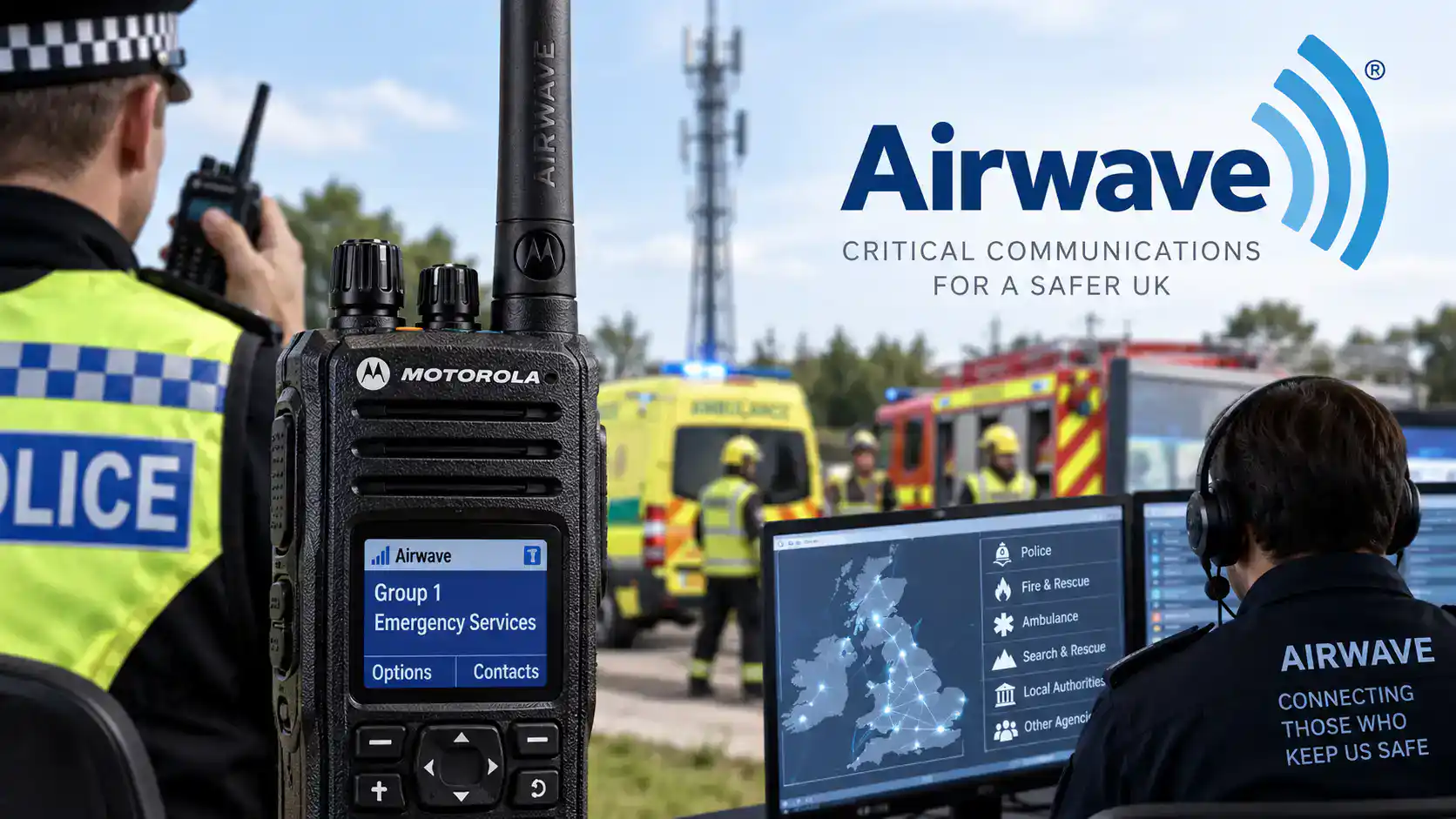
Airwave is a dedicated digital radio communications networkA Network is a connected system of radios, equipment and infrastructure that allows users to communicate across a defined area. Radio networks can range from simple radio-to-radio systems to large multi-site networks. used by the emergency services and other public-safety organisations in Great Britain. The network provides secure, resilient voice and data communications for organisations including the police, fire and rescue services and ambulance services.
Airwave is based on TETRA (Terrestrial Trunked Radio) technology and was developed as a nationwide public-safety communications system rather than as a conventional business two-way radio network. It provides emergency-service users with dedicated radio communications, including group calling, individual calling and other features designed for operational and mission-critical communications.
What is the Airwave network?
Airwave was commissioned by the Home Office in 2000 following a national procurement exercise. The network was designed to provide a common communications platform for emergency services across Great Britain, replacing a number of separate and less interoperable radio systems.
The network consists of dedicated radio infrastructureRadio infrastructure is the equipment and supporting systems behind a professional two-way radio network, including repeaters, antennas, base stations, network connections, power systems and dispatch equipment., including radio sites and base stations, together with the systems and services required to manage communications between users and control rooms.
Airwave allowed emergency-service organisations to communicate using a common national digital radio platform while maintaining the operational features required by individual services.
Who uses Airwave?
Airwave has been used by a wide range of public-safety organisations.
Its principal users include:
- Police forces
- Fire and rescue services
- Ambulance services
- National Police Air Service
- Other public-safety and emergency-service organisations
- Approved organisations that share the network where appropriate
The network has supported hundreds of organisations and tens of thousands of operational users across Great Britain.
What technology does Airwave use?
Airwave uses TETRA, a digital trunked radio technology developed for professional and public-safety communications.
TETRA provides features that are particularly suited to large radio networks, including efficient use of radio spectrumSpectrum is the range of radio frequencies used for wireless communication. Two-way radios operate within specific parts of the radio spectrum, subject to frequency allocation and licensing requirements., group communications, individual calls, status messaging and other operational functions.
Airwave was designed as a dedicated public-safety network, with its infrastructure and services built around the requirements of emergency-service communications.
Airwave and secure communications
Security is an important characteristic of the Airwave network.
The system was designed to provide secure communications for emergency-service users, allowing authorised personnel to communicate using a dedicated network rather than relying on ordinary consumer mobile phone services.
Airwave radio communications can also use encryptionEncryption protects two-way radio communications by converting voice or data into a secure form that can only be understood by authorised radios with the correct encryption capability and keys. and other security measures appropriate to the system and equipment being used.
The security of an operational communications system depends on the complete system architecture, equipment, configuration, access controls and operational procedures rather than simply the type of radio technology used.
Airwave group calling
One of the important capabilities of Airwave is group communication.
Emergency-service personnel can communicate with defined groups of users, allowing information to be shared quickly between teams without requiring each user to make an individual telephone-style call.
For example, an incident can require several officers, firefighters or ambulance personnel to communicate as a coordinated operational group.
This type of immediate group communication is one of the key characteristics of professional digital trunked radio systems such as TETRA.
Airwave and control rooms
Airwave is also connected to emergency-service control-room operations.
Control-room personnel can communicate with radio users in the field, helping them coordinate resources and manage incidents.
The ability to connect operational radio users with control-room staff is an important part of a public-safety communications system, particularly where personnel are working across large geographic areas or responding to rapidly developing incidents.
Is Airwave a two-way radio system?
Yes, but Airwave is considerably more than a collection of conventional two-way radios.
Users operate compatible TETRA radios to communicate over the Airwave network. However, the wider system includes dedicated network infrastructure, radio sites, control-room systems and other supporting technology.
This makes Airwave a national professional radio network, rather than a simple radio-to-radio communication system.
A conventional business radioBusiness Radio refers to professional two-way radio systems used by businesses and organisations for instant communication, often using licensed frequencies and equipment designed for commercial use.radio systemA Radio System is a complete communication solution comprising two-way radios and, where required, equipment such as repeaters, antennas, base stations, mobile radios and network infrastructure. may allow users to communicate directly with each other or through a local repeaterA Repeater receives a two-way radio transmission and retransmits it, usually from an elevated location, to extend the coverage and reliability of a radio communication system.. Airwave operates on a much larger scale, providing managed communications across Great Britain.
Airwave compared with conventional business radio
Airwave and conventional business two-way radio systems use different approaches to communications.
A typical business radio system may consist of handheld radios, mobile radios, base stations and, where required, repeaters to provide coverageRadio Coverage is the geographical area in which a two-way radio system can provide reliable communication. Coverage depends on the radios, antennas, frequency, terrain, buildings and system infrastructure. across a particular site or area.
Airwave is a dedicated nationwide public-safety network designed around the requirements of emergency-service organisations.
The two should therefore not be considered interchangeable. Airwave provides a level of network infrastructure, management, resilience and public-safety functionality that is very different from a standard business radio installation.
Airwave and the Emergency Services Network
The Emergency Services Network (ESN) is the programme intended to replace Airwave.
ESN is being developed as a modern public-safety communications system using commercial 4G and, as the programme develops, 5G capabilities. It is intended to provide secure voice, video and data services and give emergency-service personnel greater access to information while working in the field.
The original plans envisaged Airwave being replaced much earlier, but the ESN programme has experienced significant delays.
As of 2026, Airwave remains in operation while ESN is developed and rolled out. Current government programme documentation describes ESN as the replacement for Airwave and indicates that Airwave will continue until it is safe to transition users to the new system.
Why is Airwave being replaced?
Airwave was designed primarily around highly reliable digital voice communications and has provided emergency services with dependable communications for many years.
However, the technology is now ageing and does not provide the same level of broadbandBroadband is a high-speed data connection used by systems such as PoC radio to carry voice, video and other communications over mobile networks, Wi-Fi or IP networks. data capability available through modern 4G and 5G networks.
The replacement ESN is intended to support a wider range of communications, including mission-critical voice, video and data, while making greater use of commercial mobile-network infrastructure.
The replacement is therefore not simply a change from one type of radio to another. It represents a move from a dedicated TETRA public-safety radio network towards a broadband-based communications platform.
Is Airwave still used?
Yes. Airwave is still being used by emergency-service organisations in Great Britain while the transition to ESN takes place.
The timetable for replacing Airwave has changed several times because of delays to the ESN programme. The current programme is focused on completing ESN and transitioning users safely before Airwave can be shut down.
This means that Airwave remains an important part of the UK’s emergency communications infrastructure even though it is ultimately intended to be replaced.
Airwave and DCS Two-Way Radio
Airwave is a specialist national public-safety communications network and is not a service offered as a conventional business radio hireRadio Hire is the temporary rental of two-way radios and related communication equipment for events, projects and operational requirements, providing professional communication without purchasing the equipment. system.
DCS supplies two-way radio equipment and communications systems for businesses, organisations and events. These systems can include conventional analogue or digital radios, repeaters, base stations and other radio infrastructure depending on the application.
Where organisations need reliable communications across a site or operational area, the appropriate radio solution depends on factors such as coverage, number of users, terrain, buildingsAn antenna transmits and receives radio-frequency signals, allowing a two-way radio to communicate. Antenna type, frequency, height and location can all affect radio performance and coverage., required features and licensing requirements.
When your team needs dependable communications without buying equipment, reliable radio hire offers a flexible solution.