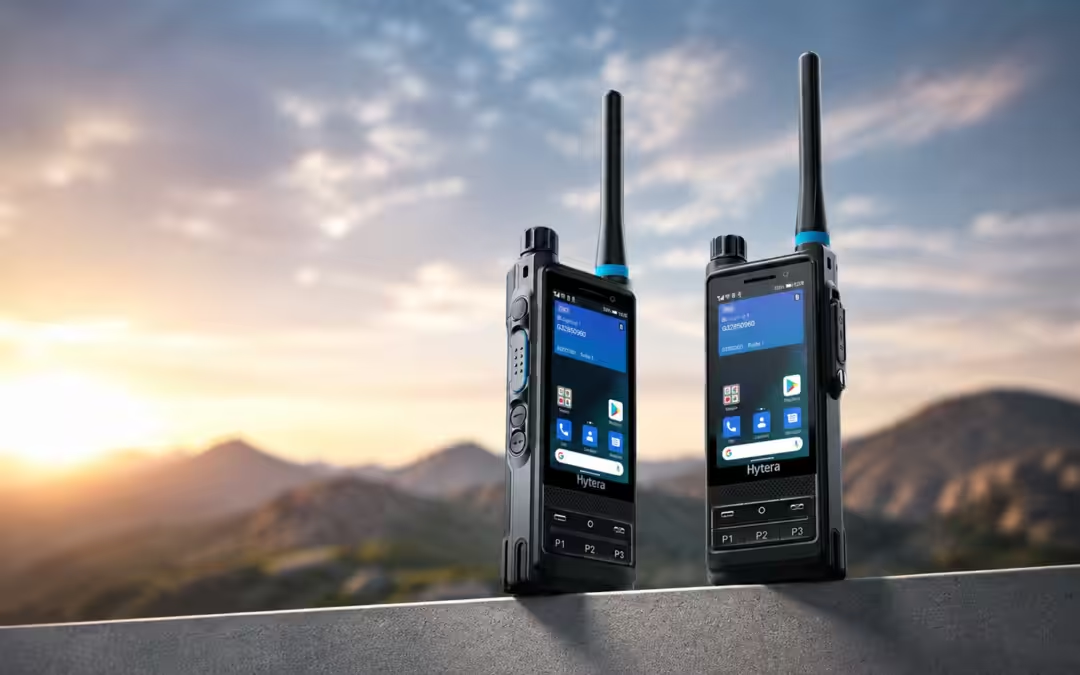
Hytera Launches New PTC680 800M Hybrid Two-Way Radio
The world of professional two-way radio continues to evolve, with Hytera announcing the launch of its new PTC680 800M, a rugged dual-mode radio designed to combine mission-critical TETRA communications with LTE broadbandBroadband is a high-speed data connection used by systems such as PoC radio to carry voice, video and other communications over mobile networks, Wi-Fi or IP networks. connectivity.
The new radio is aimed at organisations operating in demanding environments where reliable voice communications remain essential, but where users are increasingly looking for access to data, applications, images and video from the same device.
Hytera says the PTC680 800M has been designed for transportation, municipal utilities and public safety organisations, particularly those operating in high-density environments where large numbers of users may need to communicate at the same time.
Combining TETRA Radio with LTE Broadband
The key feature of the PTC680 800M is its ability to combine 800 MHz TETRA and LTE in a single device.
TETRA has long been used for mission-critical communications where reliable group voice communication is essential. However, modern operational teams increasingly need more than voice alone.
LTE connectivity allows the PTC680 800M to extend communications beyond the coverageRadio Coverage is the geographical area in which a two-way radio system can provide reliable communication. Coverage depends on the radios, antennas, frequency, terrain, buildings and system infrastructure. of a private TETRA networkA Network is a connected system of radios, equipment and infrastructure that allows users to communicate across a defined area. Radio networks can range from simple radio-to-radio systems to large multi-site networks. and provide access to broadband services and digital applications.
This represents an important development in professional radio communications. Rather than replacing established TETRA systems, hybrid devices such as the PTC680 800M are designed to bring traditional narrowbandNarrowband describes a radio communication system that uses a relatively small amount of frequency spectrum to transmit information. It is widely used in professional two-way radio to make efficient use of available radio channels. radio together with modern broadband capabilities.
More Than Just Voice Communications
One of the biggest changes taking place in professional two-way radio is the move towards devices capable of handling multiple forms of communication.
According to Hytera, the PTC680 800M can provide access to applications including dispatch, GIS, work-order systems, inspection applications and incident-management tools.
For frontline workers, this could mean receiving an assignment, accessing information about a job and reporting progress without having to carry a separate smartphone or tablet alongside their radio.
The device also incorporates front and rear cameras, allowing users to capture and transmit images and video in real time.
This could be particularly useful when teams need to give supervisors or control room staff a visual understanding of what is happening at a location.
For example, a frontline worker could potentially transmit an image of damaged infrastructureRadio infrastructure is the equipment and supporting systems behind a professional two-way radio network, including repeaters, antennas, base stations, network connections, power systems and dispatch equipment., an incident scene or equipment requiring attention, allowing those coordinating the response to make better-informed decisions.
Why Hybrid Radio Communications Matter
The launch highlights a broader change in the professional two-way radio market.
For many organisations, replacing an established radio communications system is neither practical nor desirable. TETRA and other professional mobile radioA Mobile Radio is a two-way radio designed to be installed in a vehicle. It normally uses the vehicle's power supply and an external antenna to provide reliable communication while travelling or working in the field. technologies continue to provide important capabilities for group communications, particularly in environments where reliable and immediate voice communication is critical.
At the same time, modern operations increasingly depend upon broadband data.
The result is a growing demand for hybrid communications, where radio and cellular connectivity can work together.
Rather than viewing two-way radio and 4G or 5G as competing technologies, the latest generation of professional communication equipment increasingly treats them as complementary technologies.
The radio provides the dedicated communications capabilities that operational teams rely on, while broadband connectivity can provide access to applications, multimedia and additional information.
Designed for Demanding Working Environments
The PTC680 800M is designed as a rugged device rather than a conventional consumer smartphone.
Hytera states that the PTC680 platform has an IP68 rating and is designed to withstand demanding working conditions, including exposure to dust and water and drops from up to 1.5 metres.
The device also incorporates professional audio technology designed for use in noisy environments.
This distinction is important for organisations considering the future of workplace communications.
A consumer smartphone may provide excellent broadband connectivity, but it is not necessarily designed around the same operational requirements as a professional two-way radio.
Dedicated push-to-talk controls, group communications, rugged construction and professional audio remain important considerations for workers who need to communicate while carrying out practical tasks.
Cameras, GPS and Applications in One Device
The PTC680 platform illustrates how the definition of a two-way radio is changing.
Alongside its radio communications capabilities, the device incorporates positioning technology, Wi-FiWi-Fi is a wireless networking technology that connects compatible devices to a local or wider network. In radio systems, it can support programming, updates, data services and IP-based communications., LTE connectivity, cameras and support for applications.
Hytera states that the device supports GPS, Galileo, GLONASS, QZSS, BDS and A-GPS for outdoor positioning, alongside technologies for indoor positioning.
The PTC680 can also support applications developed for the platform, potentially allowing organisations to build communications around the particular requirements of their workforce.
This creates the possibility of a single frontline device handling several functions that would traditionally have required multiple pieces of equipment.
Managing Large Radio Fleets
For larger organisations, managing hundreds or thousands of devices can be just as important as the capabilities of the individual radio.
Hytera's Smart MDM platform is designed to allow organisations to manage radio fleets remotely.
Functions include batch configuration, remote software upgrades, permission management, device monitoring and fault alerts.
For organisations operating across multiple sites, the ability to manage devices centrally can help reduce the amount of time required to configure and maintain individual radios.
What Does This Mean for the Future of Two-Way Radio?
The PTC680 800M is another indication that professional two-way radio is moving beyond the traditional concept of a voice-only handheld.
The underlying requirement for reliable push-to-talk and group communications remains, but the information being exchanged is becoming increasingly diverse.
Voice can now be accompanied by:
- Images
- Video
- GPS location information
- Digital work instructions
- Dispatch information
- GIS data
- Incident reports
- Business applications
- Broadband connectivity
This does not necessarily mean that traditional two-way radio is becoming obsolete.
Instead, the industry appears to be moving towards **converged communications**, where established professional radio networks can work alongside LTE and, increasingly, 5G broadband technologies.
For businesses and organisations that depend on reliable communications, the important question may therefore be less about choosing between radio and cellular communications and more about determining how the two technologies can work together.
The Two-Way Radio Market Continues to Evolve
Hytera's launch of the PTC680 800M is another example of how rapidly professional communications are developing.
Two-way radios remain an important tool for industries ranging from transportation and utilities to security, events, construction and emergency response. However, the latest equipment demonstrates that the technology is no longer limited to simple voice communication.
The future of professional radio is likely to involve a combination of reliable push-to-talk communications, digital radio networks, broadband connectivity and real-time data.
For organisations reviewing their communications requirements, this means there are now more options available than simply choosing between a conventional radio and a smartphone.
The latest generation of professional two-way radios is beginning to bridge the gap between the two.