
Royal Wolverhampton NHS Trust Case Study
The Client
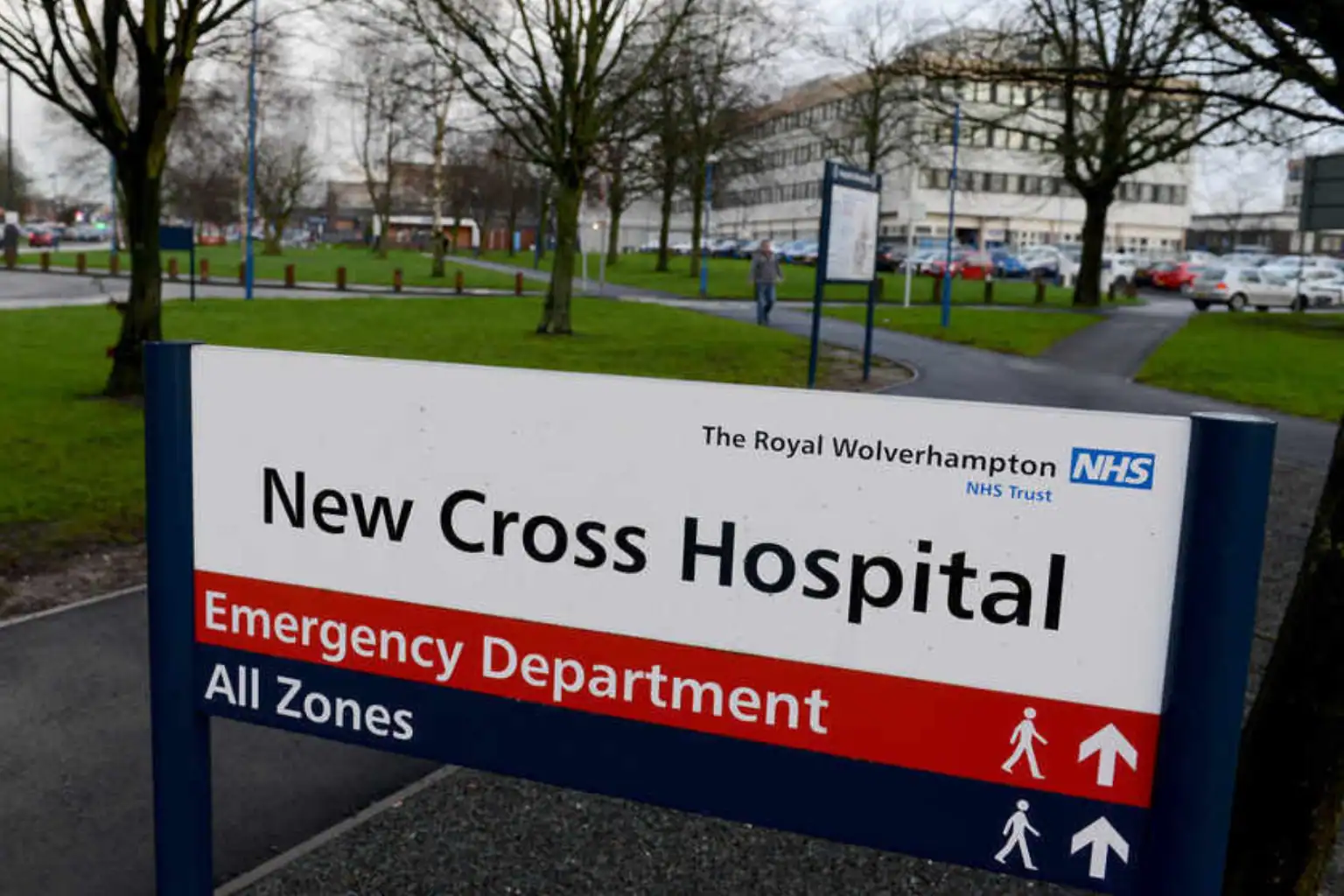
The Royal Wolverhampton NHS Trust is one of the largest acute and community healthcare providers in the West Midlands, employing more than 8,000 members of staff across three major hospital sites. As part of the Trust, New Cross Hospital provides a comprehensive range of healthcare services including Accident & Emergency, specialist wards, operating theatres, outpatient departments and essential support services.

Running a busy hospital requires seamless communication between numerous departments. Security teams, estates and maintenance personnel, emergency planning staff and senior management all rely on instant communication to respond quickly to incidents, coordinate daily operations and maintain a safe environment for patients, visitors and staff.
As the hospital continued to expand and new buildingsAn antenna transmits and receives radio-frequency signals, allowing a two-way radio to communicate. Antenna type, frequency, height and location can all affect radio performance and coverage. were added to the site, it became clear that the existing analogue radioAnalogue radio uses continuously varying radio signals to transmit voice communication. It remains widely used for reliable two-way communication across business, industry, events, security and other applications.radio systemA Radio System is a complete communication solution comprising two-way radios and, where required, equipment such as repeaters, antennas, base stations, mobile radios and network infrastructure. was no longer capable of meeting the Trust's operational requirements.
The Challenge
The hospital's existing analogue radio system consisted of portable radios operating through a single analogue repeaterA Repeater receives a two-way radio transmission and retransmits it, usually from an elevated location, to extend the coverage and reliability of a radio communication system., providing just one shared communication channelA two-way radio channel is a programmed set of communication settings, typically including frequency and signalling, that allows compatible radios to communicate with one another. across the entire site.
With multiple departments all attempting to use the same channel, radio traffic often became congested, making communication less efficient during busy periods.
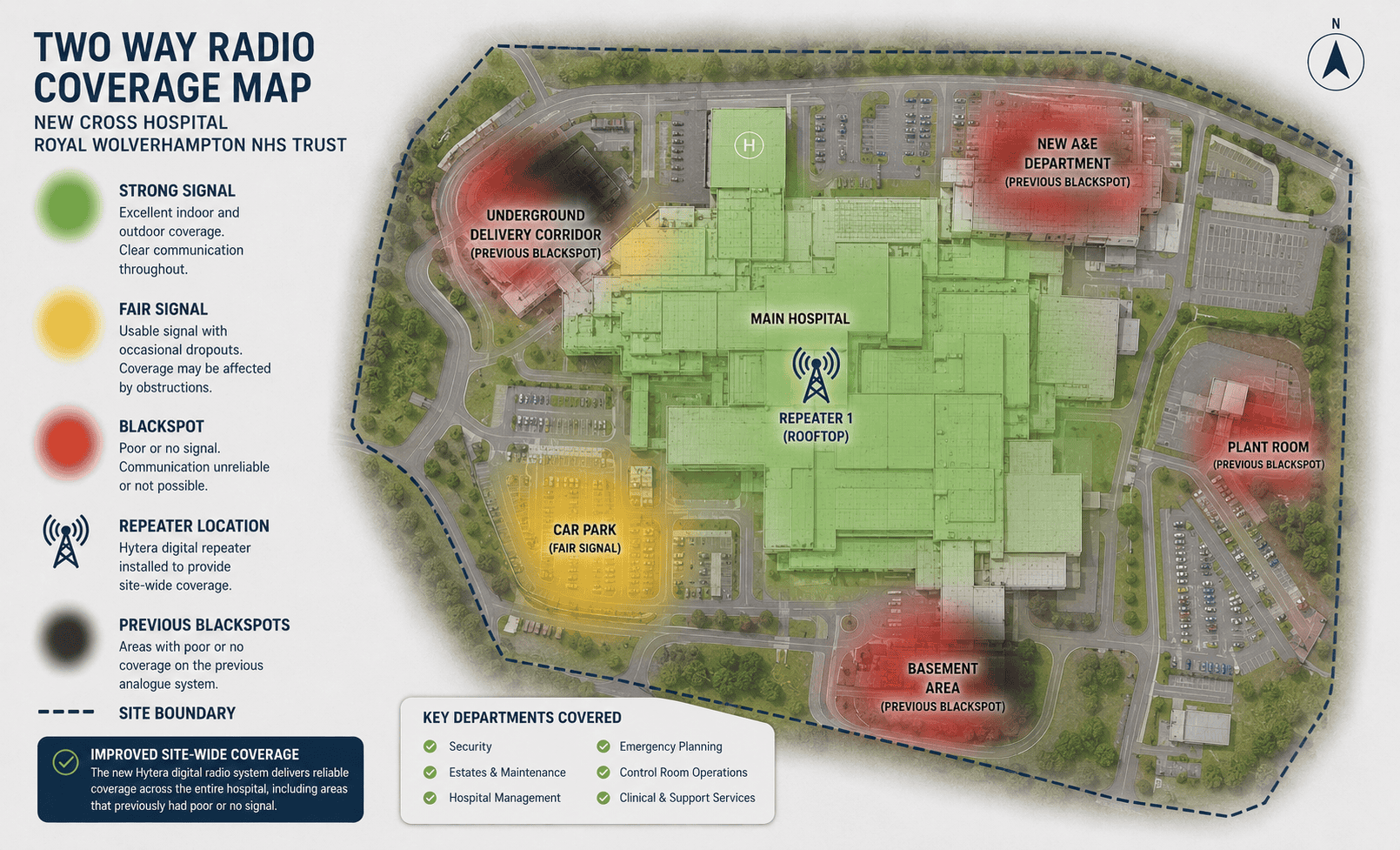
CoverageRadio Coverage is the geographical area in which a two-way radio system can provide reliable communication. Coverage depends on the radios, antennas, frequency, terrain, buildings and system infrastructure. was also becoming a serious concern. Staff regularly experienced poor reception within the underground delivery corridor, where vital supplies entered the hospital, and communications were almost impossible inside the newly constructed Accident & Emergency department — one of the most important operational areas on site.
The Trust required a communications solution that would:
- Deliver reliable coverage throughout the hospital campus.
- Eliminate radio blackspots in underground corridors, service areas and new buildings.
- Provide dedicated communication channels for different departments.
- Improve emergency response and incident coordination.
- Deliver a scalable platform capable of expanding as the hospital grows.
Above all, the Trust wanted complete confidence that staff could communicate instantly wherever they were working across the hospital.
The Solution
Our Recommendation
Following a detailed consultation and site surveyA Site Survey is an assessment of a location to determine whether a two-way radio system will provide the required coverage, reliability and performance., DCS 2 Way Radio designed and supplied a complete Hytera digital radio system specifically tailored to the operational needs of New Cross Hospital.
Rather than adopting a single radio model, different handsets were selected to suit the requirements of individual departments.
The solution included:
- Hytera PD685 radios for senior hospital management, providing caller identification, full keypad functionality and individual radio calling.
- Hytera PD605 digital radios for the hospital's security team, offering rugged IP67 protection and emergency features.
- Hytera PD505 radios for the emergency planning department.
- A Hytera MD785 desktop control station within the hospital control room, allowing operators to monitor communications, identify users and coordinate emergency incidents efficiently.
The new digital infrastructureRadio infrastructure is the equipment and supporting systems behind a professional two-way radio network, including repeaters, antennas, base stations, network connections, power systems and dispatch equipment. replaced the ageing analogue system whilst significantly improving coverage, increasing channel capacity and providing a communications platform capable of supporting future expansion.
Dedicated communication channels were programmed for:
- Security
- Estates & Maintenance
- Hospital Management
- Emergency Planning
- Control Room Operations
This ensured every department could communicate efficiently without competing for a single shared radio channel.
Deployment
Because New Cross Hospital operates twenty-four hours a day, careful planning was essential to ensure installation caused minimal disruption to patients, visitors and frontline healthcare services.
Working closely with the Trust's Estates and Facilities team, our engineers scheduled the installation around operational requirements, allowing the new digital infrastructure to be commissioned without affecting critical hospital services.
Each radio was individually programmed, labelled and configured for its assigned department before being issued to users.
Extensive coverage testing was then carried out throughout the hospital, including:
- Accident & Emergency
- Underground delivery corridors
- Plant rooms
- Service corridors
- Clinical departments
- External service roads
- Administration buildings
This ensured every critical area achieved dependable communications before the system was officially handed over.
The Results
The improvements were immediate.
Communication issues that had previously affected the underground delivery corridor and the newly constructed A&E department were completely eliminated, allowing staff to remain connected in areas where reliable communications are essential.
The introduction of dedicated departmental channels dramatically reduced radio congestion, enabling security personnel, estates teams, hospital management and emergency planning staff to communicate independently whilst remaining fully coordinated during major incidents.
The improved digital audio quality also ensured messages were received clearly, reducing repeated transmissions and improving operational efficiency across the hospital.
Perhaps most importantly, the new system provides a scalable communications platform that can continue expanding alongside the hospital as new buildings, departments and operational requirements are introduced.
After Care
Our support continues long after the initial installation.
DCS 2 Way Radio continues to provide ongoing technical support, preventative maintenance, software updates, radio servicing and system reprogramming whenever the hospital's operational requirements evolve.
As the Royal Wolverhampton NHS Trust continues investing in new facilities and expanding healthcare services, additional radios, repeaters and communication channels can easily be integrated into the existing digital infrastructure, ensuring the communications system continues to grow alongside the hospital.
By delivering a modern Hytera digital radio solution, we've helped New Cross Hospital improve operational efficiency, strengthen emergency response procedures and provide dependable communications across one of the West Midlands' busiest healthcare environments.
Conclusion
The Royal Wolverhampton NHS Trust project demonstrates how upgrading from an ageing analogue radio system to a modern digital communications platform can transform operational efficiency across a busy healthcare environment. By eliminating radio coverage blackspots, increasing communication capacity and introducing dedicated channels for key departments, the Trust now benefits from faster coordination, improved emergency response and reliable communications throughout the hospital campus.
If you're an NHS Trust, hospital, healthcare centre or private medical facility looking to improve communications, eliminate coverage issues or upgrade an existing radio system, get in touch with DCS 2 Way Radio today. Our experienced team will work with you to design a reliable communications solution tailored specifically to your healthcare environment.
We offer two way radio hire UK services with equipment selected to meet the requirements of your medical facility.
Radios
%
Coverage
%