


Coventry Airport Limited Case Study
The Client
Coventry Airport Limited operates Coventry Airport in Warwickshire, providing a busy operational environment where effective communication between teams is essential to the safe and efficient running of the airfield.
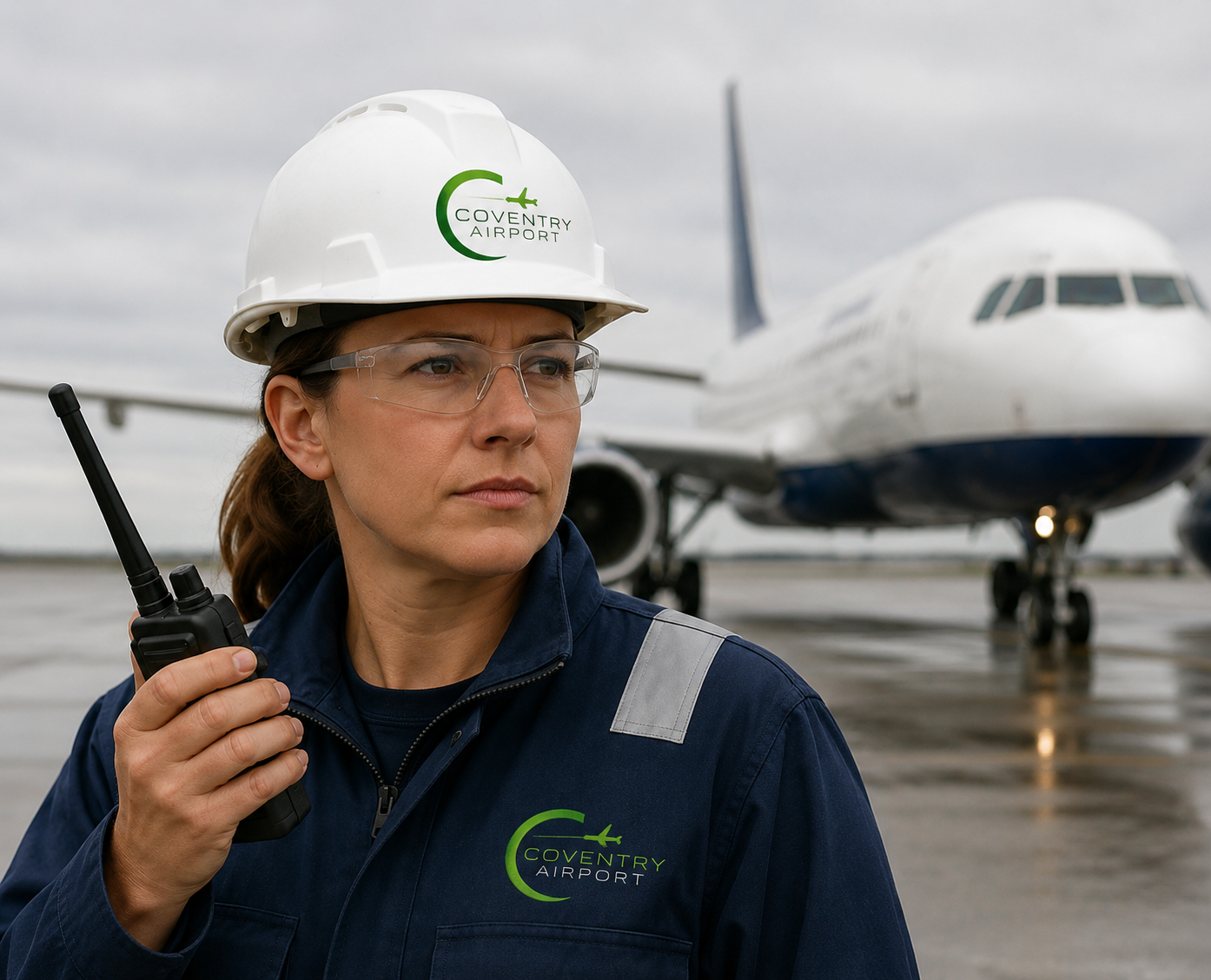
Airport operations involve multiple teams working across a large site, often in challenging conditions and around aircraft, vehicles, ground-support equipment and aviation fuel infrastructureRadio infrastructure is the equipment and supporting systems behind a professional two-way radio network, including repeaters, antennas, base stations, network connections, power systems and dispatch equipment..
For ground crew and security personnel in particular, reliable two-way radio communication is an essential part of day-to-day operations.
With aviation fuel present on site, communication equipment also needs to be suitable for environments where there may be a risk associated with flammable substances. This made the selection of appropriate ATEX-rated radio equipment an important part of the communications solution.
The Challenge
The Requirement
Coventry Airport Limited required a reliable two-way radio communication system that could provide clear and dependable communication for personnel working across the airport.
The system needed to support ground crew and security teams, allowing personnel to communicate quickly with colleagues while carrying out their respective duties.
A key consideration was the airport's aviation fuel environment.
Where flammable gases or vapours may be present, conventional electronic equipment may not be suitable for use in designated hazardous areas. Coventry Airport therefore required ATEX two-way radios designed for use in potentially explosive atmospheres.
The requirement was for a substantial fleet of radios capable of supporting airport operations, while also providing reliable radio coverageRadio Coverage is the geographical area in which a two-way radio system can provide reliable communication. Coverage depends on the radios, antennas, frequency, terrain, buildings and system infrastructure. across the site.
The key requirements were:
- Supply 90 ATEX two-way radios
- Provide suitable communications for ground crew and security personnel
- Ensure radios were appropriate for the airport's aviation fuel environment
- Provide reliable two-way radio coverage across the entire airport site
- Deploy multiple two-way radio repeaters to extend coverage across the large airport environment
- Ensure the repeaterA Repeater receives a two-way radio transmission and retransmits it, usually from an elevated location, to extend the coverage and reliability of a radio communication system. networkA Network is a connected system of radios, equipment and infrastructure that allows users to communicate across a defined area. Radio networks can range from simple radio-to-radio systems to large multi-site networks. provided reliable communication between users working in different areas of the airport
- Support fast, instant push-to-talk communication between operational teams
- Overcome potential coverage challenges caused by buildingsAn antenna transmits and receives radio-frequency signals, allowing a two-way radio to communicate. Antenna type, frequency, height and location can all affect radio performance and coverage., warehouses, hangars, vehicles, structures and the physical layout of the airfield
- Deliver a dependable communications system suitable for a safety-critical working environment
For an airport environment, radio coverage cannot simply be considered in terms of the distance between users. The size and layout of the site, together with buildings, warehouses, hangars, vehicles and other structures, can all affect radio signals.
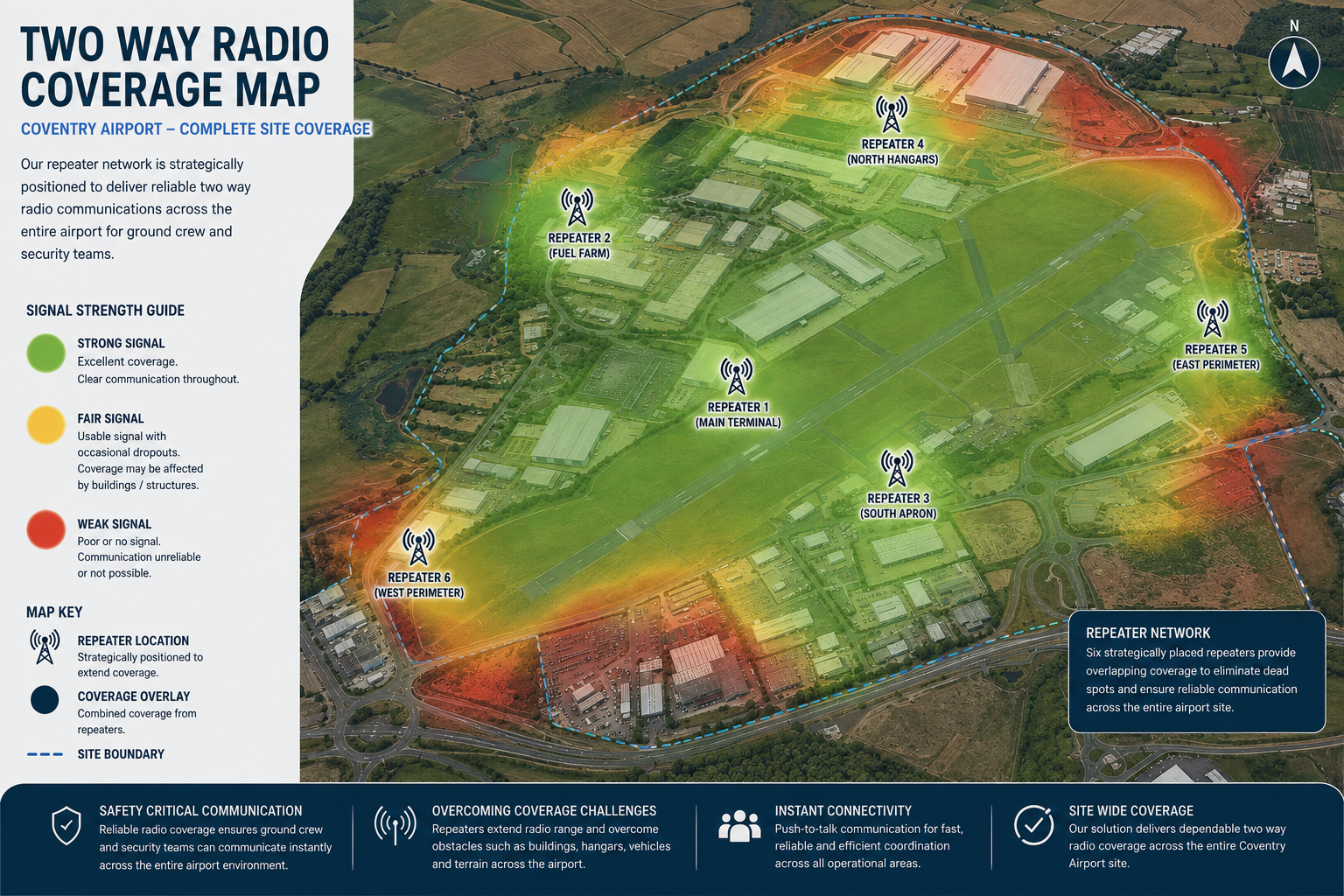
To provide the required coverage, two-way radio repeaters formed an important part of the communications infrastructure. Multiple repeaters were deployed across the airport to extend the effective range of the radio systemA Radio System is a complete communication solution comprising two-way radios and, where required, equipment such as repeaters, antennas, base stations, mobile radios and network infrastructure. and help provide reliable communications throughout the operational area.
The solution therefore needed to combine 90 ATEX handheld two-way radios with a repeater-based radio network, providing ground crew and security personnel with reliable communications across the airport while working in a safety-critical aviation environment.
The Solution
Our Recommendation
DCS 2 Way Radio supplied 90 ATEX two-way radios to Coventry Airport Limited, providing ground crew and security personnel with dedicated professional communication equipment.
ATEX-certified radios are specifically designed for use in environments where potentially explosive atmospheres may be present. This makes them particularly suited to applications involving aviation fuel, fuel storage and aircraft refuelling operations.
The radios provided personnel with instant push-to-talk communication, allowing teams to communicate directly without relying on mobile phone networks or other forms of communication.
For airport operations, this provides a significant operational advantage. A member of the ground crew can communicate with colleagues immediately, while security personnel can remain in contact with their own team and other relevant airport personnel.
Communications Across the Entire Airport
Supplying the handheld radios was only one part of the project.
Coventry Airport required communications across a sizeable operational environment, making radio coverage a critical consideration.
To achieve this, DCS 2 Way Radio deployed a number of radio repeaters as part of the communications infrastructure.
The repeaters extended and strengthened the radio system, helping provide coverage across the entire airport rather than relying solely on the direct range of individual handheld radios.
This created a more comprehensive communications network capable of supporting users working in different areas of the airport.
A Scalable Radio Infrastructure
The combination of 90 ATEX handheld radios and multiple repeaters provided Coventry Airport with a professional radio system designed around the requirements of the site.
Rather than treating the radios as standalone devices, the system was designed as a complete communications solution, with the infrastructure required to provide the necessary site-wide coverage.
This is particularly important in airport environments, where personnel may be spread over large distances and need to remain contactable as they move around the site.
Deployment
The project involved the deployment of 90 ATEX two-way radios, together with the repeater infrastructure required to provide coverage across the airport.
The radios were allocated to personnel including ground crew and security teams, giving operational staff a common communications platform.
The repeater system was incorporated into the wider radio network to extend coverage across the airport.
This meant personnel could communicate while moving between different operational areas without being restricted to the immediate range of another handheld radio.
The resulting system provided a consistent communications platform for teams working across the airport environment.
The Results
The completed radio system gave Coventry Airport Limited a dedicated communications solution built around the requirements of its operational environment.
With 90 ATEX two-way radios deployed across ground crew and security teams, personnel had access to professional radio communications designed for the demands of airport operations and hazardous-area environments.
The addition of multiple repeaters provided the infrastructure necessary to deliver radio coverage across the entire airport, helping ensure that teams remained connected while working in different areas of the site.
The project delivered:
- 90 ATEX two-way radios
- A substantial fleet of ATEX-certified handheld radios supplied for airport personnel.
- Site-wide radio coverage
- Multiple repeaters were deployed to extend communications across the airport.
- Ground crew communications
- Operational personnel could communicate instantly while carrying out their duties across the airfield.
- Security communications
- Security personnel were equipped with reliable professional radio communications to support their operations.
Suitable for aviation fuel environments
ATEX radioAn ATEX radio is a certified two-way radio designed for use in potentially explosive atmospheres, with protection against becoming an ignition source in specified hazardous areas. technology provided equipment appropriate for the safety requirements associated with potentially hazardous environments.
Instant push-to-talk communication
Teams could communicate directly and quickly without relying on mobile telephone networks.
Safety-Critical Airport Communications
In an aviation environment, communication is about more than convenience.
Ground crews, security personnel and other operational teams need to be able to exchange information quickly, particularly when working around aircraft, vehicles and fuel infrastructure.
The presence of aviation fuel also makes the selection of communication equipment particularly important.
ATEX-certified radios are designed specifically for use in hazardous environments where explosive atmospheres may be present, making them an important communications option for applications such as aviation ground operations and aircraft refuelling.
DCS 2 Way Radio's hazardous-area solutions are designed for organisations operating in environments where conventional communication equipment may not be suitable.
For Coventry Airport Limited, the combination of ATEX handheld radios and a repeater-based communications network provided a robust platform for keeping ground crew and security personnel connected across the site.
After Care
For a communications system of this size, ongoing support is an important part of maintaining reliable day-to-day operations.
DCS 2 Way Radio provides ongoing support for professional walkie talkie radio systems, helping customers maintain their equipment and communications infrastructure.
Our support services can include radio maintenance, repairs, programming and technical assistance, helping organisations keep critical communications equipment operational.
For safety-critical environments such as airports, reliable communications are an essential part of the wider operational infrastructure.
Our professional two way radios provide clear and dependable communication for teams across the UK.
Radios
%
Coverage
%