

The Complete Guide to Two-Way Radios & Professional Mobile Radio (PMR)
Part 2 - Chapter 8
Push-to-Talk over Cellular (PoC)
Table of Contents
Push-to-Talk over Cellular (PoC)
Extending Professional Communications Beyond Traditional Radio Networks
For many years, organisations had two primary options for instant communication: professional two-way radios or mobile phones. Each had distinct strengths and weaknesses. Two-way radios offered immediate group communication but were generally limited by the coverage of the radio network. Mobile phones provided nationwide coverage but lacked the speed and simplicity of Push-to-Talk communication.
Push-to-Talk over Cellular (PoC) bridges this gap.
By combining the familiar operation of a traditional two-way radio with the extensive coverage of modern 4G, 5G and Wi-Fi networks, PoC enables organisations to communicate instantly across towns, regions, countries or even internationally. Users simply press the Push-to-Talk button, speak and release just as they would with a conventional radio but the communication is carried over broadband networks rather than dedicated radio frequencies.
For organisations with geographically dispersed workforces, PoC has opened new possibilities. Delivery drivers can communicate with warehouse staff, regional managers can coordinate multiple sites and field engineers can remain connected throughout the country, all using a single communication platform.
This chapter explores how Push-to-Talk over Cellular works, where it excels, its limitations and how it complements rather than replaces traditional Professional Mobile Radio (PMR).
What Is Push-to-Talk over Cellular?
Push-to-Talk over Cellular is a communication technology that delivers instant voice communication using existing mobile data networks instead of traditional radio frequencies.
Rather than transmitting directly between radios or through repeaters, PoC devices communicate via:
- 4G mobile networks
- 5G mobile networks
- Wi-Fi networks
- Cloud-based communication servers
To the user, the experience is almost identical to using a conventional two-way radio.
They:
- Press the Push-to-Talk button.
- Speak.
- Release the button.
Within moments, their message is heard by the intended individual or group.
Did You Know?
DCS 2 Way Radio operates its own Connect Plus LTE/PoC communications platform, providing secure, nationwide Push-to-Talk services with professional-grade features including group calling, GPS location, emergency alerts and real-time dispatch.
How PoC Works
Unlike PMR systems, which use radio frequencies allocated to an organisation, PoC relies on broadband connectivity.
A typical communication follows this sequence:
- The user's voice is captured by the microphone.
- The device converts the speech into digital data.
- The data is transmitted via the available mobile or Wi-Fi network.
- Secure cloud servers route the message to the correct recipients.
- Receiving devices reproduce the audio almost instantly.
Although the communication path differs from traditional radio, the operational experience remains familiar for users.
The Infrastructure Behind PoC
One of the biggest differences between PoC and traditional radio systems is the infrastructure required.
Traditional PMR
A PMR system may include:
- Licensed frequencies
- Repeaters
- Base stations
- Antennas
- Radio masts
- Site surveys
These components provide dedicated communication coverage.
PoC
A PoC system generally relies upon:
- Mobile network coverage
- Wi-Fi (where available)
- SIM-enabled devices
- Cloud-based servers
- Device management software
This significantly reduces the need for on-site radio infrastructure.
Coverage
Coverage is one of PoC's greatest strengths.
Wherever a suitable mobile data connection exists, users can typically communicate.
This allows organisations to maintain communication across:
- Multiple depots
- Distribution centres
- Regional offices
- Nationwide delivery networks
- International operations (where supported)
For businesses operating beyond a single site, this can be a major operational advantage.
Communication Flow Between Multiple Sites and National Delivery Networks
Modern organisations often operate across multiple locations, regional depots and nationwide delivery networks. Maintaining clear, reliable communication between office staff, warehouse teams, drivers and remote workers is essential for efficient operations. By combining Digital Mobile Radio (DMR), Push-to-Talk over Cellular (PoC), smartphones and a central dispatch platform, organisations can create a unified communications network that keeps every team connected, regardless of their location.
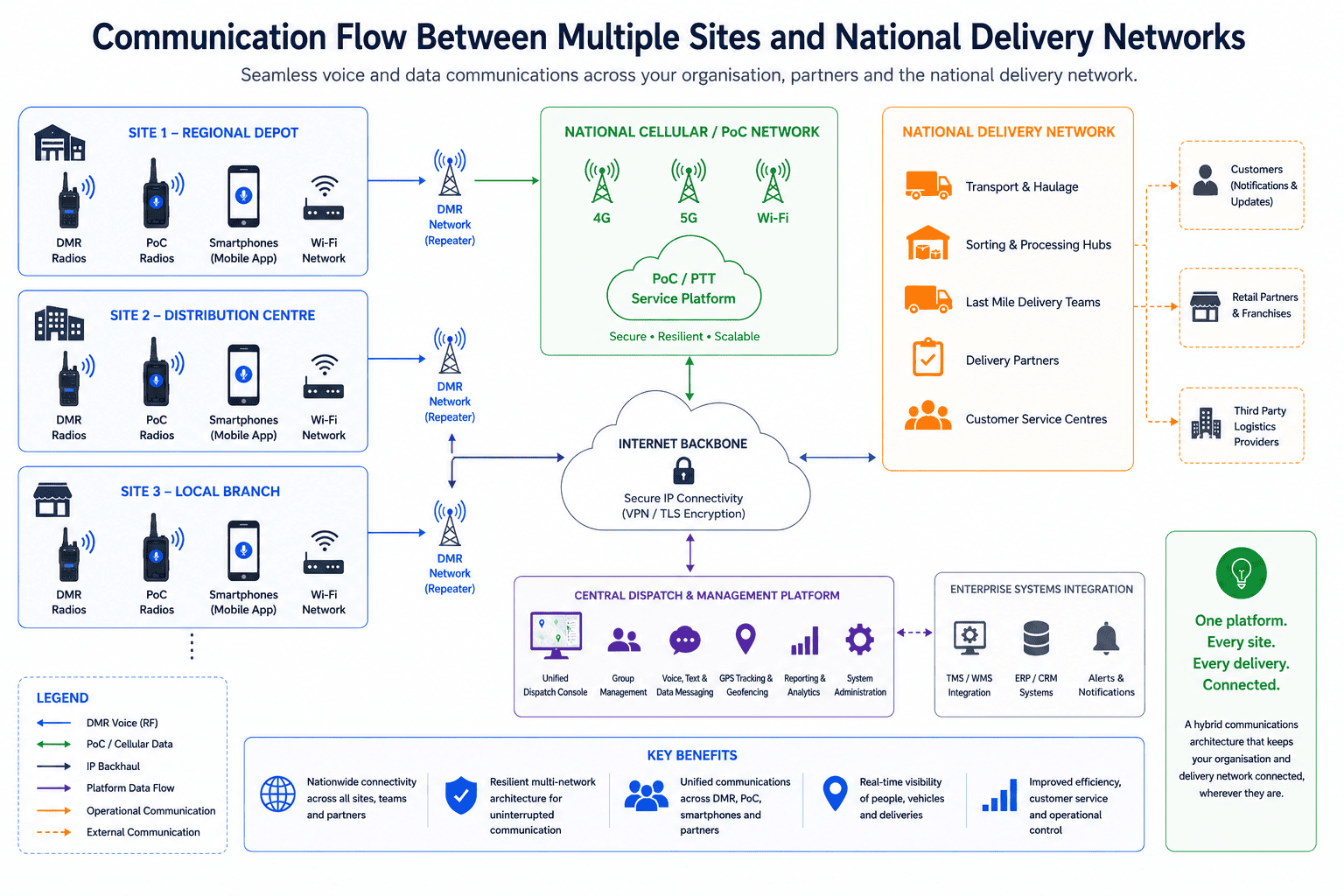
A hybrid communications network enables information to flow seamlessly between sites, vehicles, delivery teams and control centres in real time. Whether coordinating warehouse operations, tracking deliveries or responding to incidents, users can communicate instantly using the most appropriate device or network. This integrated approach improves operational efficiency, enhances situational awareness and ensures every part of the organisation remains connected through a single, scalable communications platform.
Audio Quality
Modern PoC systems provide excellent voice quality.
Because communication is digital from end to end, users benefit from:
- Clear speech
- Noise reduction
- Consistent audio
- Minimal background interference
However, overall quality remains dependent on the underlying mobile or Wi-Fi connection.
Group Communication
Like traditional PMR, PoC excels at group communication.
Users can communicate with:
- Individual colleagues
- Departmental teams
- Entire organisations
- Temporary workgroups
Group structures can often be created and modified through cloud management platforms without needing to reprogramme individual devices.
Nationwide Operations
One of the biggest advantages of PoC is the removal of geographical boundaries.
Consider a logistics company with:
- A warehouse in Birmingham
- Drivers operating across England
- Regional managers in Scotland
- Customer service teams in London
With traditional radio, connecting these locations would require significant infrastructure.
With PoC, they can all communicate using the same platform, regardless of their physical location.
Device Options
PoC is available on a wide range of professional devices.
These include:
Dedicated PoC Radios
Purpose-built handheld devices designed to resemble traditional two-way radios.
They offer:
- Physical Push-to-Talk buttons
- Rugged construction
- Long battery life
- Loud audio
- Professional accessories
Vehicle Devices
Many organisations install PoC units within vehicles.
These provide:
- Larger displays
- Vehicle power
- External antennas
- Hands-free operation
Ideal for fleet operators and transport organisations.
Smartphone Applications
Many PoC platforms also provide mobile applications.
These enable authorised users to participate using compatible smartphones or tablets.
This can be useful for:
- Supervisors
- Managers
- Temporary staff
- Remote workers
Cloud Management
Unlike traditional radio systems, many PoC platforms provide centralised cloud management.
Administrators can often:
- Create users
- Manage talk groups
- Monitor devices
- Update configurations
- View locations
- Generate reports
without physically accessing each radio.
This simplifies administration for larger organisations.
GPS Tracking
Most professional PoC devices incorporate GPS functionality.
This enables organisations to:
- Locate drivers
- Monitor field engineers
- Improve dispatch decisions
- Support lone worker safety
- Review historical movement data
Combined with mapping software, GPS becomes a valuable operational management tool.
Did You Know?
Did you know? Unlike traditional licensed radio systems, Push-to-Talk over Cellular (PoC) operates over 4G, 5G and Wi-Fi networks, so there is no Ofcom radio licence required.
Safety Features
Modern PoC systems often include advanced safety capabilities.
These may include:
Emergency Calls
Dedicated emergency buttons allow users to raise an alert instantly.
Lone Worker Monitoring
Automatic welfare checks can generate alerts if users fail to respond.
Man Down Detection
Some devices monitor orientation and movement.
If a user falls or becomes incapacitated, an emergency alert can be transmitted automatically.
Location Sharing
Supervisors can quickly identify the location of personnel requiring assistance.
Integration with Business Systems
One of PoC's greatest strengths is its ability to integrate with other technologies.
Examples include:
- Fleet management platforms
- Computer-aided dispatch (CAD)
- CCTV systems
- Workforce management software
- Customer relationship management (CRM)
- Incident management systems
- Business intelligence platforms
These integrations help organisations streamline operations and improve decision-making.
Advantages of PoC
Push-to-Talk over Cellular offers numerous operational benefits.
Virtually Unlimited Coverage
Communication is available wherever suitable network coverage exists.
Minimal Infrastructure
No repeaters or radio masts are generally required.
Easy Scalability
Adding new users is often straightforward.
Rich Features
Cloud management, GPS, messaging and reporting are commonly included.
Flexible Devices
Dedicated radios, vehicle units and smartphone apps can all participate within the same system.
Rapid Deployment
Systems can often be deployed more quickly than large PMR installations.
Limitations of PoC
While PoC is highly capable, organisations should understand its limitations.
Network Dependency
PoC requires:
- Mobile data
- Wi-Fi
- Broadband connectivity
Poor network coverage may affect communication.
Subscription Costs
Most PoC services involve ongoing subscription or airtime charges.
Latency
Although generally minimal, communication may experience slightly longer delays than traditional PMR systems.
Public Network Reliance
Unlike dedicated PMR systems, PoC relies on public mobile network infrastructure.
Organisations should consider this when planning communication for critical operations.
PMR vs Push-to-Talk over Cellular (PoC)
Professional Mobile Radio (PMR) and Push-to-Talk over Cellular (PoC) are both designed to provide instant voice communications, but they use fundamentally different technologies. PMR operates over dedicated radio frequencies, while PoC uses 4G, 5G and Wi-Fi networks to deliver communications over virtually unlimited distances. The comparison below highlights the key differences between the two systems.
| Feature | Professional Mobile Radio (PMR) | Push-to-Talk over Cellular (PoC) |
|---|---|---|
| Coverage | Local to regional | Nationwide or international |
| Infrastructure | Repeaters and dedicated radio network | Mobile network (4G/5G/Wi-Fi) |
| Internet Required | No | Yes |
| Typical Running Costs | Lower ongoing costs after installation | Subscription-based service |
| Deployment Speed | Moderate | Fast |
| Rural Performance | Excellent with suitable infrastructure | Dependent on mobile network coverage |
| Indoor Coverage | Site dependent | Often strong where mobile coverage exists |
Neither technology is inherently superior. The most appropriate solution depends on your organisation's operational requirements, coverage needs, infrastructure and the way your teams communicate. Many organisations now combine PMR and PoC to achieve reliable on-site communications alongside nationwide connectivity.
Hybrid Communication
Increasingly, organisations combine PMR and PoC.
For example:
- Warehouse staff use DMR radios.
- Delivery drivers use PoC devices.
- Regional managers use smartphone applications.
- Control rooms communicate with all users through integrated dispatch software.
This hybrid approach provides local resilience alongside nationwide communication.
We'll explore hybrid systems in the next chapter. (Chapter 9).
Is PoC Right for Every Organisation?
Not necessarily.
PoC is particularly well suited to organisations with:
- Multiple locations
- Mobile workforces
- Nationwide operations
- Frequent organisational growth
- Limited desire to install radio infrastructure
However, businesses operating within a single large industrial site may find traditional PMR offers greater resilience and predictable performance.
The most suitable solution always depends on operational requirements rather than technology alone.
Hybrid Communication Architecture
As communication requirements become more complex, many organisations are combining Digital Mobile Radio (DMR) and Push-to-Talk over Cellular (PoC) into a single communications ecosystem. Rather than replacing one technology with another, a hybrid architecture allows different devices and networks to work together through a central dispatch platform.
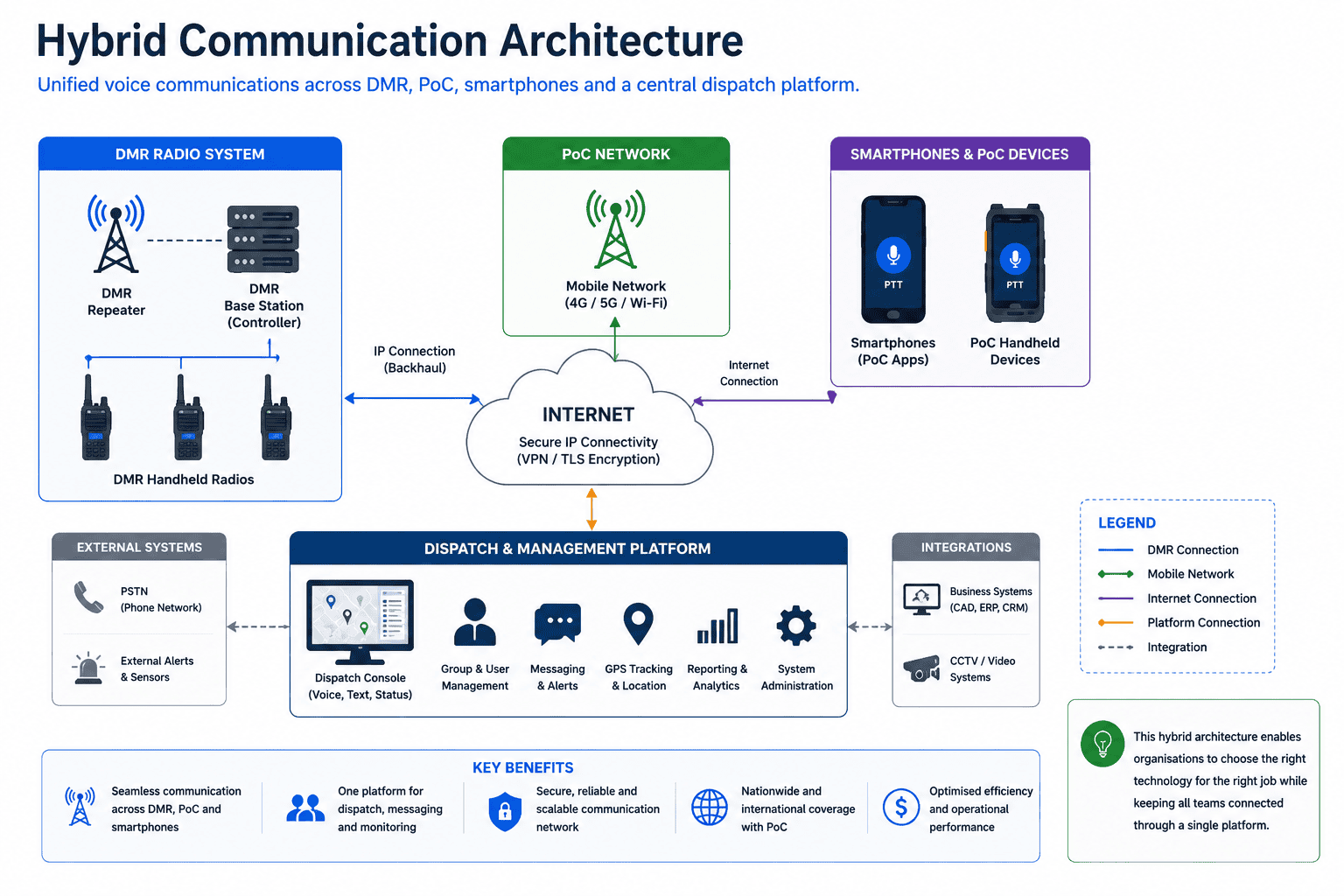
This approach enables office staff, control rooms, field engineers and remote workers to communicate seamlessly whether they are using DMR radios, PoC devices or smartphones. A central dispatch platform provides a single point for voice communications, messaging, GPS tracking and user management, helping organisations improve collaboration across multiple sites and geographic locations.
How a Message Travels Through a Hybrid System
Once devices are connected through a hybrid communications platform, voice calls, text messages and emergency alerts can be routed automatically between users, regardless of the network or device they are using. The diagram below illustrates the typical journey of a message through a hybrid communications system.
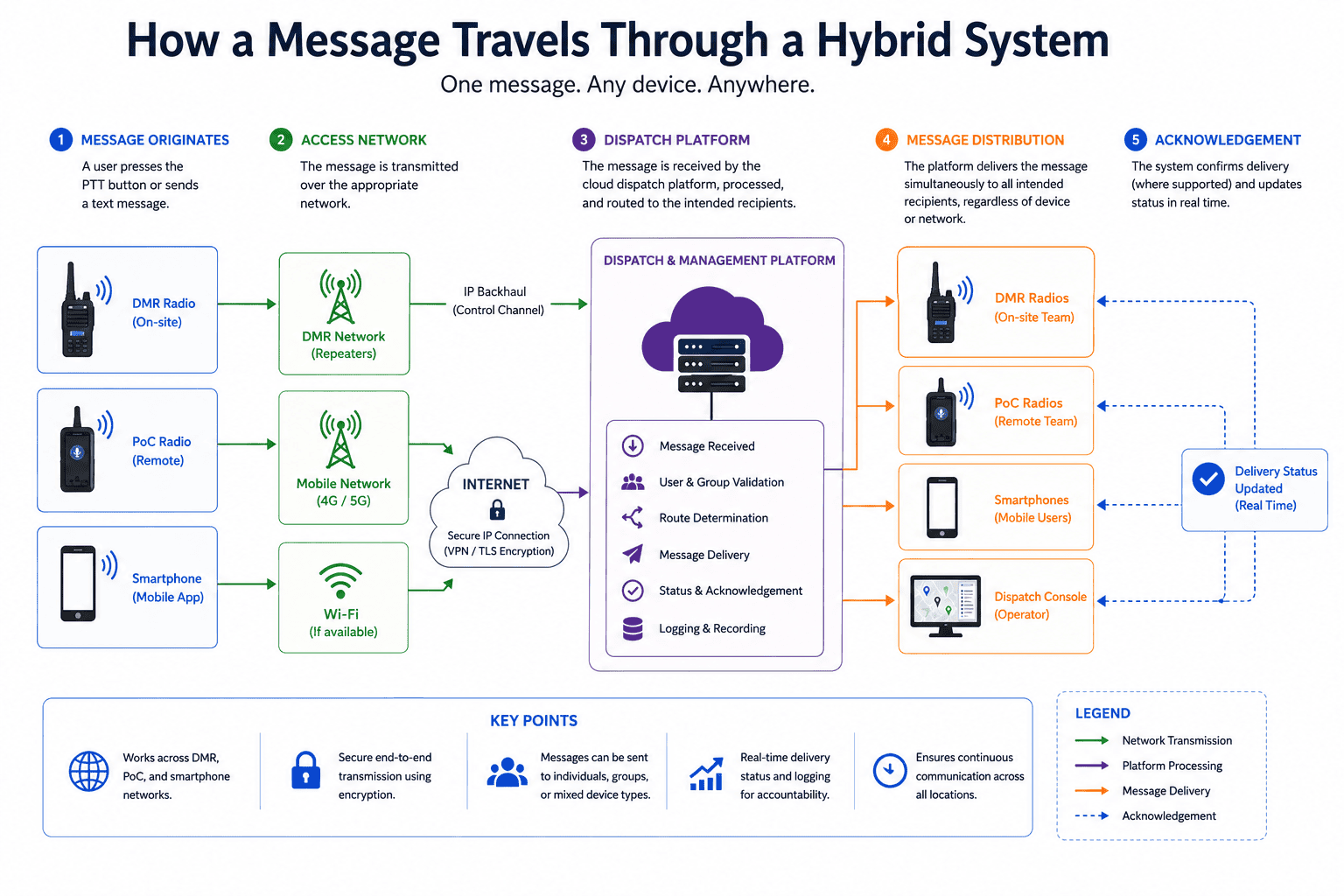
Whether a transmission originates from a DMR handheld, a PoC radio or a smartphone application, the communication is securely routed through the appropriate network to the dispatch platform. From there, it is delivered to the intended users, providing seamless interoperability between different communication technologies. This unified approach enables organisations to keep office staff, field engineers and remote workers connected through a single communications ecosystem.
Key Takeaways
- Push-to-Talk over Cellular combines traditional Push-to-Talk operation with modern mobile broadband networks.
- Communication takes place over 4G, 5G or Wi-Fi rather than dedicated radio frequencies.
- PoC provides extensive geographic coverage with minimal infrastructure.
- Cloud management simplifies administration and scalability.
- GPS tracking, emergency features and integrations enhance operational efficiency.
- PoC relies on mobile network availability and usually involves ongoing subscription costs.
- Many organisations combine PoC and PMR to create flexible hybrid communication systems.
Expert Insight
- PoC is not a replacement for Professional Mobile Radio it is another communication tool.
- The most successful organisations evaluate how their teams work before selecting technology. Businesses operating from a single industrial site may benefit from the resilience of PMR, while organisations with geographically dispersed staff often gain significant advantages from PoC. Increasingly, hybrid solutions provide the best of both worlds.
Business Perspective
Push-to-Talk over Cellular has expanded the possibilities of professional communication by removing many of the geographical limitations associated with traditional radio systems.
For organisations with mobile teams, multiple sites or nationwide operations, PoC can improve coordination, streamline management and reduce infrastructure requirements.
When integrated thoughtfully with existing communication systems, it becomes a powerful component of a modern business communication strategy rather than a direct replacement for conventional radio.
Frequently Asked Questions
What is a hybrid communication system?
A hybrid communication system combines multiple communication technologies—such as DMR, PMR, PoC and smartphone applications—into a single integrated platform.
Do hybrid systems replace existing radio networks?
Not necessarily. Many organisations retain their existing PMR infrastructure while adding PoC and cloud-based services to extend communication capabilities.
Can DMR and PoC users communicate with each other?
Yes. Many hybrid platforms allow users on different technologies to communicate seamlessly through integrated communication gateways.
Are hybrid systems suitable for small businesses?
They can be. Businesses with multiple sites, mobile teams or future expansion plans may benefit from a hybrid approach, even if they have relatively few users.
What are the biggest advantages of hybrid communication?
Greater flexibility, wider geographic coverage, protection of existing investments, improved scalability and the ability to connect different types of users through one communication platform.
Contact The UK's Premier Two Way Radio Experts Today