

The Complete Guide to Two-Way Radios & Professional Mobile Radio (PMR)
Part 4 - Chapter 14
Buying vs Hiring Two-Way Radios
Table of Contents
Buying vs Hiring Two-Way Radios
Choosing the Most Cost-Effective Communication Strategy
When organisations decide they need a professional two-way radio system, one of the first questions they face is whether to buy the equipment outright or hire it.
There is no universal answer.
The right decision depends on several factors, including how frequently the radios will be used, the size of the workforce, the duration of the project, available budgets and the level of ongoing support required.
For some organisations, purchasing a radio fleet is a sensible long-term investment that provides years of dependable service. For others, hiring offers greater flexibility, lower upfront costs and access to the latest equipment without the responsibilities of ownership.
Importantly, the decision is not simply financial. It also affects maintenance, equipment availability, scalability, compliance and operational resilience.
This chapter explores the advantages and considerations of both approaches, helping organisations make an informed decision based on their operational needs.
Understanding Radio Ownership
Buying a radio system means the organisation owns the equipment.
Typical purchases may include:
- Handheld radios
- Vehicle-mounted radios
- Repeaters
- Base stations
- Batteries
- Chargers
- Headsets
- Carrying accessories
- Programming software (where applicable)
The equipment becomes part of the organisation's operational assets.
Advantages of Buying
Lower Long-Term Cost
For organisations using radios every day over many years, purchasing is often more economical than continuous hiring.
Although the initial investment is higher, ongoing costs may be relatively modest when equipment is properly maintained.
Full Control
Ownership gives businesses complete control over:
- Equipment configuration
- Programming
- Accessory selection
- Deployment schedules
- Maintenance planning
There is no dependency on equipment availability from a hire provider.
Permanent Availability
Owned equipment is always available.
There is no need to reserve radios in advance or arrange deliveries before planned work begins.
This can be particularly valuable for organisations with continuous communication requirements.
Customisation
Purchased systems can be tailored to the organisation's specific requirements.
Examples include:
- Bespoke talk groups
- Custom channel plans
- Company branding
- Specialist accessories
- Integration with existing infrastructure
Asset Value
Professional radios often have long service lives.
Well-maintained equipment may continue operating reliably for many years and may retain some residual value.
Considerations When Buying
Ownership also brings responsibilities.
These include:
- Maintenance
- Battery replacement
- Software updates
- Repairs
- Equipment storage
- Fleet management
- Eventual replacement
Businesses should consider these ongoing costs when evaluating ownership.
Understanding Radio Hire
Hiring provides access to professional communication equipment without purchasing it outright.
Hire periods may range from:
- One day
- One weekend
- One week
- Several months
- Long-term rental agreements
Many providers offer complete communication packages, including accessories, programming, technical support and delivery.
Did You Know?
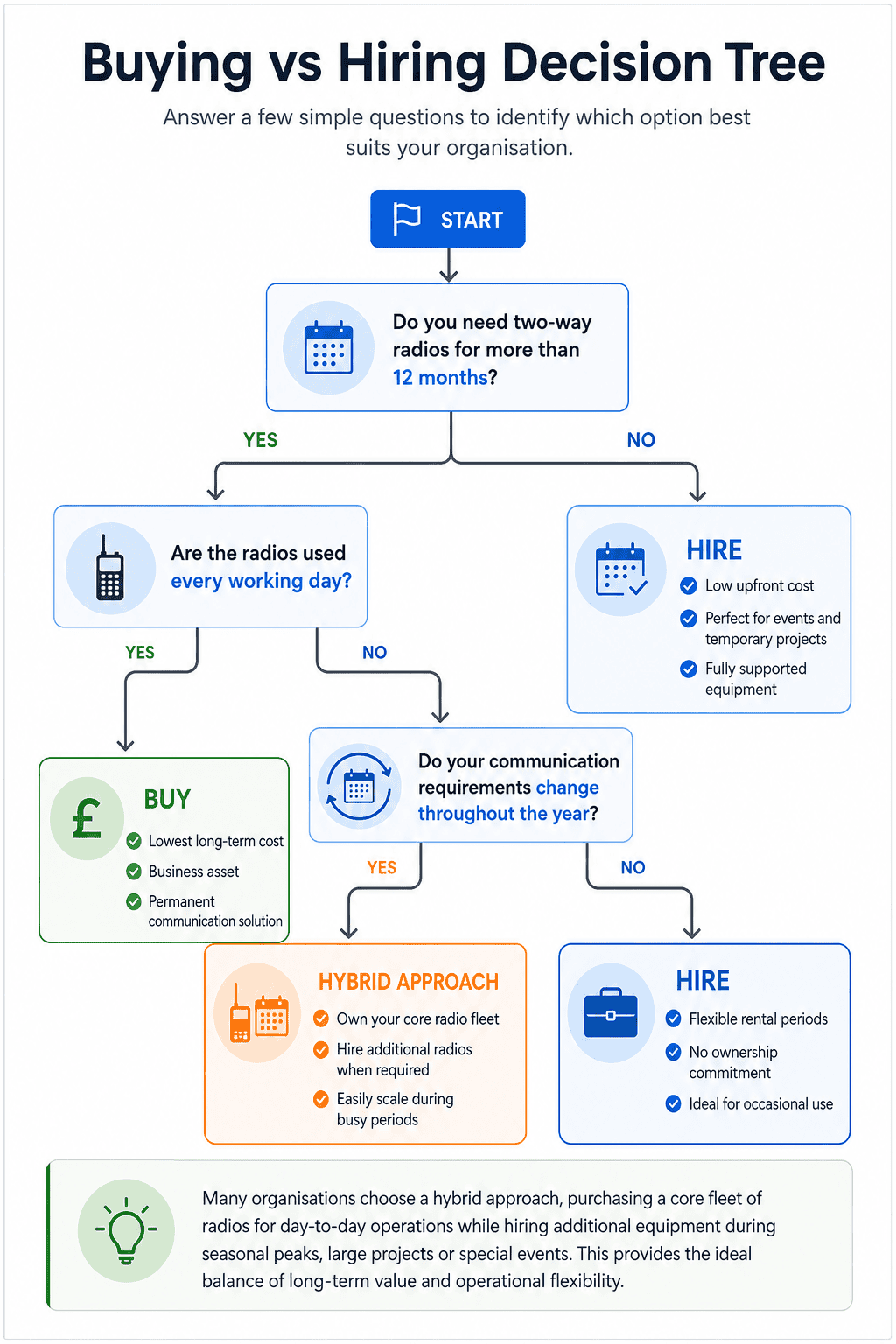
Did you know? Many organisations use a hybrid approach, owning their core fleet of two-way radios while hiring additional equipment during busy periods, seasonal peaks or special events. This provides long-term value while maintaining the flexibility to scale communications when demand increases.
Advantages of Hiring
Lower Upfront Costs
Hiring removes the need for significant capital expenditure.
Instead of purchasing equipment outright, organisations pay only for the period during which it is required.
This can improve cash flow and budgeting flexibility.
Flexibility
Many organisations experience fluctuating communication requirements.
Examples include:
- Seasonal demand
- Temporary projects
- Construction phases
- Major events
- Business expansion
- Emergency response
Hiring allows equipment numbers to increase or decrease as requirements change.
Access to Modern Equipment
Hire fleets are often refreshed regularly.
This allows organisations to benefit from modern technology without replacing owned equipment.
Maintenance Included
In many hire arrangements, maintenance and servicing remain the responsibility of the hire provider.
This reduces the administrative burden on the customer.
Rapid Deployment
Professional hire providers can often prepare and deliver programmed equipment quickly.
This is particularly valuable for organisations responding to:
- Planned events
- Unexpected projects
- Equipment failures
- Emergency situations
Considerations When Hiring
Although hiring offers flexibility, organisations should also consider:
- Ongoing rental costs.
- Equipment availability during busy periods.
- Long-term costs for permanent users.
- Contract terms.
- Responsibility for loss or damage.
For businesses requiring radios every day over many years, ownership may ultimately prove more cost-effective.
Buying vs Hiring Two-Way Radios
Choosing whether to buy or hire two-way radios depends on how your organisation operates, your budget and how long you expect to use the equipment.
Purchasing is often the most cost-effective solution for businesses with a permanent communication requirement, while hiring offers flexibility for short-term projects, seasonal demand and one-off events.
The comparison below highlights the key differences to help you determine which option best suits your operational needs.
| Comparison | Buying Two-Way Radios | Hiring Two-Way Radios |
|---|---|---|
| Upfront Cost | Higher initial investment, but lower long-term ownership costs. | Low upfront cost with predictable rental payments. |
| Long-Term Cost | Typically more economical for businesses using radios every day over several years. | Ideal for short-term use, although ongoing hire costs may exceed ownership over time. |
| Flexibility | Fixed fleet size unless additional equipment is purchased. | Easily increase or reduce the number of radios as operational requirements change. |
| Maintenance & Repairs | Usually managed by the owner or through a maintenance agreement. | Typically included within the hire package, reducing maintenance responsibilities. |
| Technology Upgrades | Equipment remains in service until upgraded or replaced. | Provides access to the latest technology without purchasing new equipment. |
| Scalability | Suitable for organisations with stable, long-term communication requirements. | Perfect for seasonal demand, temporary projects and expanding workforces. |
| Configuration | Fully customised to your organisation, including talk groups, GPS, emergency features and integrations. | Pre-programmed and ready to use, with configuration tailored to the hire period. |
| Support | Support is available through warranty and optional service agreements. | Technical support, programming and replacement equipment are commonly included. |
| Ideal Use Cases | Warehouses, manufacturing, healthcare, education, security, transport and businesses with permanent communication requirements. | Events, festivals, exhibitions, construction projects, seasonal operations, equipment trials and temporary deployments. |
| Best Choice If... | You need reliable communications every day and want the lowest cost of ownership over time. | You need maximum flexibility with minimal capital investment and no long-term commitment. |
There is no one-size-fits-all answer. If your organisation relies on two-way radios as part of its day-to-day operations, purchasing equipment is usually the most economical option over the long term. However, if your requirements are temporary, seasonal or project-based, hiring provides a flexible, fully supported solution without the commitment of ownership.
DCS 2 Way Radio offers both purchase and hire options and can help you choose the solution that best matches your operational and financial requirements.
Buying vs Hiring: Cost Considerations
The decision should consider the total cost of ownership, not simply the purchase price.
Potential costs include:
Buying
- Equipment purchase
- Batteries
- Chargers
- Programming
- Maintenance
- Repairs
- Software updates
- Equipment replacement
- Spare units
Hiring
- Rental charges
- Delivery
- Collection
- Optional accessories
- Insurance (where applicable)
Comparing the complete lifecycle costs provides a more accurate basis for decision-making.
When Buying Is Often the Better Choice
Purchasing is commonly appropriate when:
- Radios are used every day.
- Operations are permanent.
- Infrastructure already exists.
- Equipment is highly customised.
- Long-term budgeting is available.
- Staff require continual communication.
Examples include:
- Warehouses
- Manufacturing facilities
- Hotels
- Hospitals
- Distribution centres
- Security control rooms
When Hiring Is Often the Better Choice
Hiring is frequently suitable when:
- Communication needs are temporary.
- User numbers vary significantly.
- Specialist equipment is occasionally required.
- Capital expenditure is limited.
- Technical support is needed.
- Equipment requirements change regularly.
Examples include:
- Festivals
- Sporting events
- Construction projects
- Film production
- Emergency response
- Temporary logistics operations
Did You Know?
DCS 2 Way Radio offers both purchase and hire solutions, helping organisations choose the option that best matches their operational requirements, budget and long-term communication needs.
Seasonal Demand
Many businesses experience predictable peaks in activity.
Examples include:
- Christmas retail operations
- Summer festivals
- Agricultural harvests
- University open days
- Large exhibitions
Hiring allows organisations to increase communication capacity only when required.
Project-Based Work
Construction, engineering and infrastructure projects often have defined timescales.
As projects begin and end, communication requirements change.
Hiring enables equipment numbers to reflect project size without leaving unused radios in storage once work is complete.
Long-Term Rental
Some organisations choose long-term hire rather than purchasing.
Benefits may include:
- Predictable monthly costs
- Equipment refresh programmes
- Maintenance included
- Reduced capital investment
- Flexible fleet sizes
Long-term rental combines aspects of both ownership and short-term hire.
Maintenance Considerations
Whether buying or hiring, equipment reliability remains essential.
Owned fleets require:
- Preventative maintenance
- Battery management
- Firmware updates
- Cleaning
- Periodic inspection
Hire providers typically undertake these responsibilities before equipment is issued.
Accessories
Communication requirements often extend beyond the radios themselves.
Accessories may include:
- Remote speaker microphones
- Surveillance earpieces
- Heavy-duty headsets
- Vehicle chargers
- Spare batteries
- Multi-unit chargers
- Carry cases
Both purchased and hired systems should include appropriate accessories for the intended application.
Questions to Ask Before Deciding
Before choosing between buying and hiring, organisations should consider:
- How often will the radios be used?
- How many users require communication?
- Is communication business-critical?
- Will requirements change seasonally?
- Is existing infrastructure available?
- What level of technical support is required?
- Are future expansion plans likely?
- What is the available budget?
Answering these questions often clarifies the most suitable approach.
Common Misconceptions
"Hiring is always more expensive."
Not necessarily.
For occasional use, hiring is often significantly more economical than ownership.
"Buying eliminates ongoing costs."
Ownership still involves maintenance, batteries, repairs and eventual replacement.
"Only large organisations should buy."
Many smaller businesses benefit from ownership where communication is required every day.
"Hiring means older equipment."
Professional hire providers often maintain modern fleets featuring current-generation equipment.
Key Takeaways
- Buying and hiring each offer distinct advantages depending on operational requirements.
- Ownership generally provides better value for permanent daily use.
- Hiring offers flexibility, lower upfront costs and simplified maintenance.
- Long-term rental provides an alternative for organisations seeking predictable monthly costs.
- Total lifecycle cost should be considered rather than purchase price alone.
- The best solution depends on usage patterns, operational priorities and future growth.
Expert Insight
- The right decision is rarely determined by price alone.
- Organisations should evaluate how communication supports their operations over time. Businesses with permanent communication needs often benefit from ownership, while those with changing or project-based requirements frequently gain greater value from flexible hire arrangements. The objective should be to choose the model that delivers the greatest operational benefit not simply the lowest initial cost.
Business Example
A regional construction company owns a fleet of 40 digital handheld radios used on its permanent contracts throughout the year. During the summer, the business secures a major infrastructure project requiring an additional 60 workers for six months.
Rather than purchasing another 60 radios that may remain unused once the project finishes, the company hires the extra equipment for the duration of the contract. The hired radios are programmed to operate alongside the existing fleet, allowing all staff to communicate seamlessly.
This blended approach provides operational flexibility while avoiding unnecessary capital expenditure and long-term storage costs.
Business Perspective
Choosing between buying and hiring is ultimately a strategic business decision rather than simply a procurement exercise. Organisations should evaluate how frequently communication equipment is required, how operational demands fluctuate and what level of support they expect throughout the equipment lifecycle. By aligning communication strategy with business objectives, organisations can maximise value while ensuring reliable, effective communication for their teams.
Frequently Asked Questions
Is it cheaper to buy or hire two-way radios?
It depends on usage. Organisations using radios every day for many years often find ownership more economical, while businesses requiring equipment only occasionally usually benefit from hiring.
Can hired radios be programmed for our organisation?
Yes. Professional hire providers typically programme radios with the required channels, talk groups and operational settings before delivery.
What happens if a hired radio develops a fault?
This depends on the hire agreement, but reputable providers generally replace faulty equipment promptly to minimise operational disruption.
Is long-term hire a good alternative to buying?
For some organisations, yes. Long-term rental can provide predictable monthly costs, maintenance support and access to newer equipment without significant upfront investment.
Can owned and hired radios work together?
Yes. Provided they are compatible and programmed correctly, hired radios can often integrate with an organisation's existing communication system.
Contact The UK's Premier Two Way Radio Experts Today