

The Complete Guide to Two-Way Radios & Professional Mobile Radio (PMR)
Part 2 - Chapter 7
Digital Mobile Radio (DMR)
Table of Contents
Digital Mobile Radio (DMR)
The Global Standard for Modern Professional Radio Communications
Digital Mobile Radio (DMR) has transformed the way organisations communicate. Since its introduction, it has become one of the most widely adopted professional radio standards in the world, enabling businesses, public sector organisations and critical infrastructure providers to benefit from clearer audio, greater efficiency and a host of advanced features that were simply not possible with traditional analogue systems.
Across the UK, DMR is used in industries ranging from construction and logistics to healthcare, manufacturing, security, hospitality and utilities. It provides organisations with a modern communication platform that combines the simplicity of Push-to-Talk operation with the capabilities expected of today's connected workplaces.
For many businesses, DMR represents the ideal balance between performance, reliability, scalability and cost. It offers all the immediacy of conventional two-way radio while introducing digital technologies that improve voice quality, enhance user safety and support operational efficiency.
This chapter explores how DMR works, its key features, its advantages and why it has become the preferred choice for so many professional organisations.
What Is Digital Mobile Radio?
Digital Mobile Radio (DMR) is an internationally recognised digital radio standard developed by the European Telecommunications Standards Institute (ETSI) to provide an open, interoperable platform for professional radio communications.
Unlike proprietary technologies that are tied to a single manufacturer, the DMR standard allows equipment from multiple manufacturers to work together, provided they comply with the relevant ETSI specifications.
This interoperability has encouraged widespread adoption and provides organisations with greater flexibility when selecting equipment.
DMR is now supported by many leading manufacturers, including Motorola Solutions, Hytera, Kenwood, Icom and Tait.
Why Digital Replaced Analogue
Analogue radio served businesses well for many decades.
However, organisations increasingly required:
- Better audio quality
- Improved privacy
- More efficient use of radio spectrum
- Data capabilities
- Enhanced safety features
- Greater network capacity
Digital technology addressed these requirements while maintaining the simplicity that made two-way radios so successful.
Rather than replacing the familiar Push-to-Talk experience, DMR enhanced it.
Expert Insight
Although Digital Mobile Radio is widely recognised for its crystal-clear audio, its greatest strengths are improved spectrum efficiency, enhanced safety features, increased capacity and the ability to support modern business applications beyond voice communications.
How DMR Works
At a basic level, DMR follows the same communication process as analogue radio:
1. A user presses the Push-to-Talk button.
2. They speak into the microphone.
3. The radio transmits the message.
4. Another radio receives it.
The difference lies in how the voice is transmitted.
Instead of sending a continuously varying analogue signal, DMR converts speech into digital data.
This digital information is:
- Compressed
- Encoded
- Protected with error correction
- Transmitted efficiently
- Decoded by the receiving radio
The result is clearer, more consistent audio and the ability to support additional features alongside voice communication.
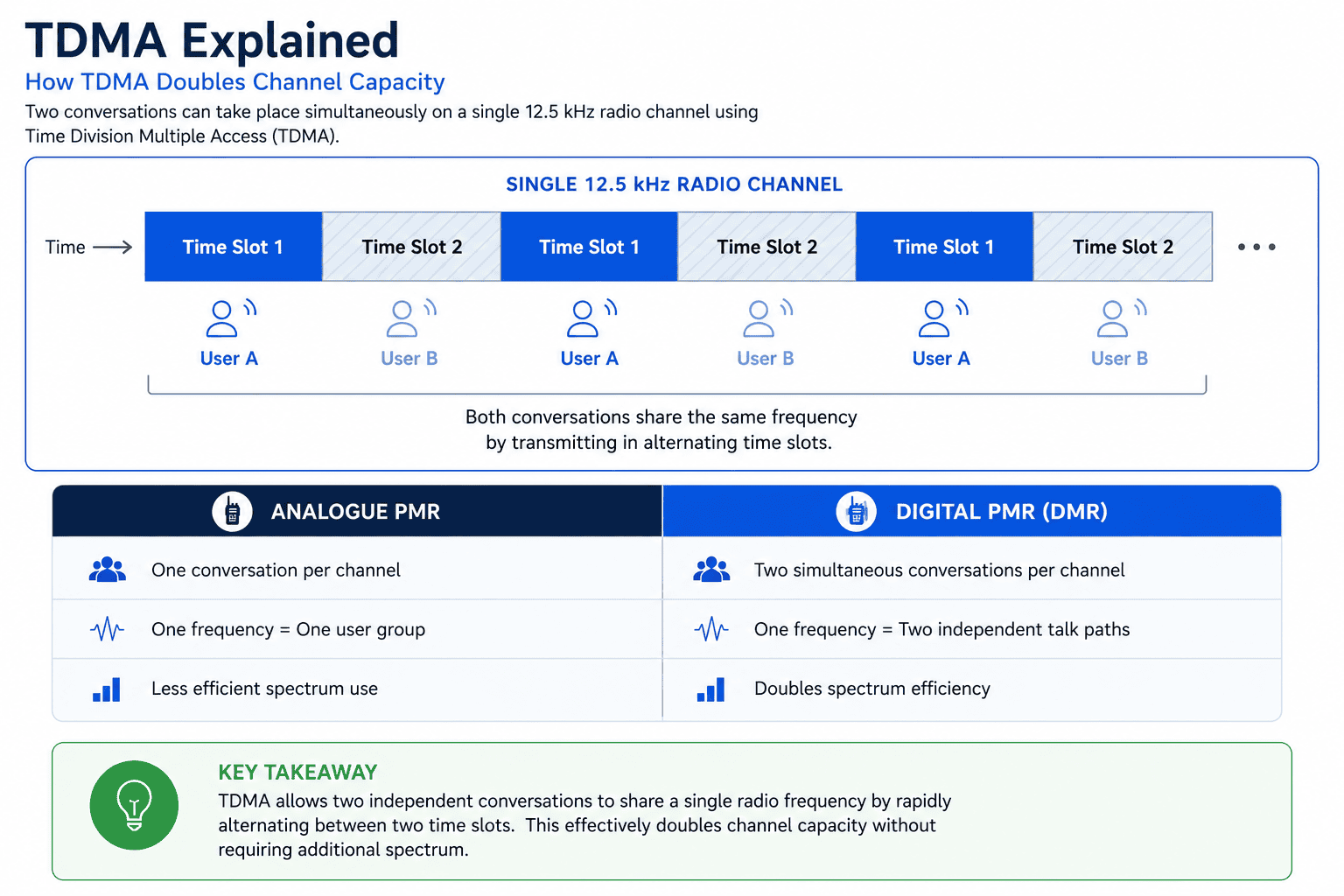
Time Division Multiple Access (TDMA)
One of DMR's greatest strengths is its use of Time Division Multiple Access (TDMA).
Rather than assigning an entire radio frequency to a single conversation, TDMA divides one frequency into two separate time slots.
This means:
- Two independent conversations can take place simultaneously on a single frequency.
- Organisations make more efficient use of licensed spectrum.
- Infrastructure costs can often be reduced.
For businesses, this effectively doubles channel capacity without requiring additional frequencies.
Clearer Audio Quality
One of the first improvements users notice when moving from analogue to DMR is audio clarity.
Digital processing helps eliminate many of the issues associated with analogue systems, including:
- Background hiss
- Static
- Crackling
- Progressive signal degradation
As long as signal strength remains adequate, speech remains consistently clear.
Instead of gradually becoming noisier with distance, digital audio typically maintains its quality until it reaches the edge of coverage.
This is often described as the digital cliff effect audio remains clear before dropping away more abruptly once the signal is no longer usable.
Improved Spectrum Efficiency
Radio spectrum is a limited resource.
DMR's efficient use of available frequencies benefits organisations by allowing:
- More users
- More talk groups
- Greater network capacity
- Better long-term scalability
This is particularly valuable for larger businesses operating across busy communication environments.
Longer Battery Life
Because DMR radios transmit only during their allocated time slot, they typically consume less power than comparable analogue radios.
For many organisations, this results in:
- Longer operating times
- Fewer battery changes
- Reduced downtime
- Improved productivity
For staff working extended shifts, battery performance can be a significant operational advantage.
Enhanced Privacy and Security
Although no communication system should be considered completely immune from interception, DMR introduces several features that significantly improve communication privacy.
These may include:
- Digital encryption
- User authentication
- Individual radio identification
- Controlled access to talk groups
These capabilities help organisations protect operational information and reduce the risk of unauthorised monitoring.
GPS Location Services
Many modern DMR radios incorporate integrated GPS receivers.
This allows organisations to:
- Monitor vehicle locations
- Track field engineers
- Locate security personnel
- Improve dispatch efficiency
- Support lone worker safety
GPS information can often be viewed through dispatch software, providing supervisors with greater situational awareness.
Text Messaging
Voice communication remains the primary function of DMR, but many systems also support text messaging.
Text messages can be useful when:
- Quiet communication is required.
- Information must be recorded.
- Short instructions need to be sent.
- Addresses or reference numbers are shared.
Although not intended to replace email or instant messaging platforms, this capability can improve operational flexibility.
Emergency Features
Safety is one of the most important reasons organisations invest in professional radio systems.
Many DMR radios support dedicated emergency functions, including:
Emergency Button
A programmable emergency button allows users to raise an alert instantly.
Depending on system configuration, this may:
- Notify supervisors.
- Open an emergency voice channel.
- Transmit the user's identity.
- Share location information.
Lone Worker
Lone Worker functionality monitors user activity.
If a user fails to respond within a defined period, the radio can automatically generate an alert.
This is particularly valuable for:
- Security patrols
- Utilities engineers
- Maintenance personnel
- Remote workers
Man Down
Some radios include sensors that detect unusual movement or prolonged inactivity.
If a user falls or becomes incapacitated, the system can automatically initiate an emergency call.
Individual and Group Calling
DMR provides much greater flexibility than traditional analogue communication.
Users can make:
- Group calls
- Individual private calls
- All-call broadcasts
- Emergency calls
This enables organisations to manage communications more effectively while reducing unnecessary radio traffic.
Did You Know?
Before any radio leaves our workshop, it is programmed, configured and tested by our engineers. This ensures every device is ready to use straight out of the box and performs exactly as required.
Talk Groups
Instead of assigning different frequencies to every department, Digital Mobile Radio (DMR) uses talk groups to organise communications more efficiently. A talk group is a virtual communication channel that allows specific teams or departments to communicate independently while sharing the same radio network.
This approach reduces the number of frequencies required, simplifies radio programming and enables multiple departments to operate simultaneously without unnecessary interference.
| Department | Talk Group |
|---|---|
| Security | Security Operations |
| Warehouse | Goods In |
| Warehouse | Goods Out |
| Facilities | Maintenance |
| Management | Supervisors |
| Health & Safety | Incident Response |
By separating communications into dedicated talk groups, organisations can improve coordination, reduce unnecessary radio traffic and ensure that employees hear only the conversations relevant to their role.
Capacity Plus and Large Networks
Many manufacturers have developed scalable DMR networking solutions capable of supporting:
- Hundreds of users
- Multiple sites
- Regional coverage
- Wide-area communication
- Automatic roaming
These systems allow organisations to expand their communication network as operational requirements evolve.
Applications Across Industry
DMR is used extensively throughout the UK.
Construction
Coordinating contractors, deliveries, plant operators and site management.
Warehousing and Logistics
Managing stock movement, loading bays, vehicle dispatch and operational supervisors.
Manufacturing
Supporting production teams, maintenance engineers and quality assurance personnel.
Healthcare
Connecting estates teams, facilities management, security and support services.
Hospitality
Coordinating housekeeping, maintenance, front-of-house staff and event operations.
Security
Maintaining instant communication between patrol officers and control rooms.
Utilities
Supporting engineers working across geographically dispersed service areas.
Events
Coordinating organisers, security, medical services, catering and logistics.
Advantages of DMR
DMR offers numerous operational benefits.
Better Audio
Clear digital speech improves understanding in noisy environments.
Efficient Spectrum Use
Two communication paths on one frequency increase capacity.
Enhanced Safety
Emergency features support employee welfare.
Improved Privacy
Digital technologies help protect communications.
Better Battery Performance
Extended operating times improve productivity.
Flexible Network Design
Systems can be expanded as organisations grow.
Did You Know?
DCS 2 Way Radio can carry out comprehensive on-site radio surveys to assess coverage, identify dead spots and recommend the most suitable communication solution for your environment.
DMR and the Future
DMR continues to evolve alongside other communication technologies.
Increasingly, organisations integrate DMR with:
- Push-to-Talk over Cellular
- Cloud dispatch platforms
- GPS fleet management
- Video systems
- Workforce management software
- Business applications
Rather than being replaced, DMR is becoming part of broader hybrid communication ecosystems that combine local resilience with nationwide connectivity.
Key Takeaways
- DMR is an internationally recognised digital standard for professional radio communications.
- Digital voice provides clearer audio and improved reliability compared with analogue systems.
- TDMA technology allows two simultaneous communication paths on a single frequency.
- DMR supports advanced features including GPS, text messaging, encryption and emergency alerts.
- Organisations benefit from improved battery life, greater spectrum efficiency and enhanced scalability.
- DMR is widely used across industries where dependable communication is essential.
Hybrid communication systems increasingly combine DMR with broadband technologies.
Expert Insight
- Digital Mobile Radio is about much more than audio quality.
- While clearer speech is often the most noticeable improvement, the real value of DMR lies in its ability to support modern operational workflows. Features such as GPS, emergency alerts, talk groups and digital networking allow organisations to improve coordination, strengthen safety procedures and make more effective use of their communication infrastructure.
Business Perspective
For many organisations, DMR has become the benchmark for professional radio communications. It combines the reliability and simplicity of traditional two-way radio with the capabilities required by today's businesses.
Whether supporting a busy warehouse, a large construction project or a nationwide utility provider, DMR provides a flexible platform that can evolve alongside changing operational needs, making it a sound long-term investment for organisations seeking dependable communication.
Frequently Asked Questions
What does DMR stand for?
DMR stands for Digital Mobile Radio, an open international standard developed by ETSI for professional digital radio communications.
Is DMR better than analogue radio?
For many organisations, yes. DMR generally provides clearer audio, better spectrum efficiency, enhanced privacy, longer battery life and a wider range of operational features.
Can DMR radios communicate with analogue radios?
Many professional radios support both analogue and digital operation, allowing organisations to migrate gradually. However, an analogue transmission cannot be understood by a radio operating solely in digital mode on the same channel.
Does DMR require an internet connection?
No. Traditional DMR systems communicate using licensed or licence-free radio frequencies and do not require internet connectivity, although some hybrid systems integrate with cloud-based services.
Is DMR suitable for small businesses?
Yes. DMR systems are highly scalable and can be deployed for anything from a small warehouse to a nationwide multi-site organisation.
Contact The UK's Premier Two Way Radio Experts Today